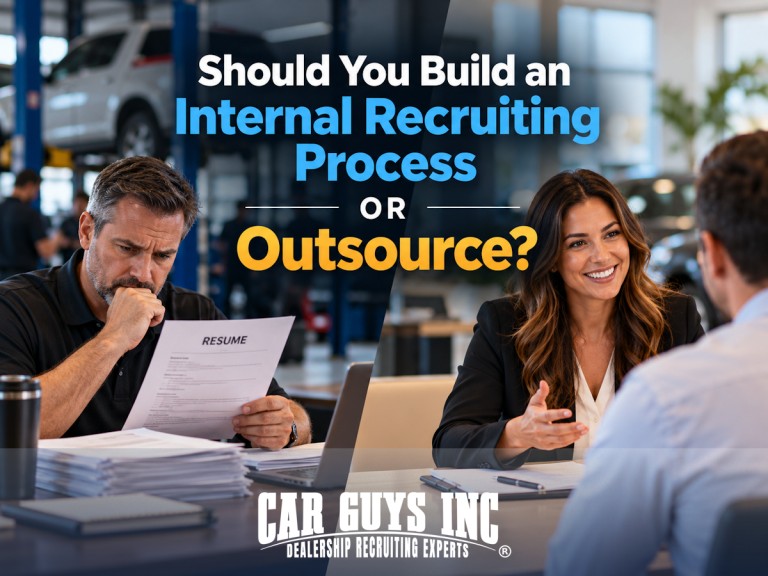
Every dealer principal eventually hits the same wall. The service manager is spending Tuesday afternoon reading resumes instead of watching the drive, a sales manager seat has been open for seven weeks, and someone in the Monday meeting asks whether it’s time to hire a recruiter. The real question underneath is bigger: should you build an internal recruiting process that lives inside your store, or outsource the work to a partner who does it every day?
At CarGuys Inc., we work with dealerships and independent shops on both sides of that decision, and the answer is rarely all or nothing. The right internal recruiting process for a single-point store with 40 employees looks nothing like what a 12-rooftop group needs. This post breaks down what each path actually costs, where each one wins, and how to decide which pieces of hiring to own and which to hand off.
What an Internal Recruiting Process Actually Requires
Most stores say they recruit in-house when they really mean they post a job when someone quits. That isn’t a process; it’s a reaction. A true internal recruiting process has five working parts, and each one needs an owner:
- Sourcing: job board postings, your careers page, employee referrals, trade school relationships, and outreach to people who aren’t actively looking
- Screening: resume review, phone screens, and verifying certifications, pay history, and driving records
- Interviewing: structured interviews with consistent questions and scoring across every manager
- Closing: offers, pay plan walkthroughs, background checks, and counteroffer management
- Systems: an ATS, reporting on time to fill and source quality, and a candidate pipeline that stays warm between openings
If you’ve never mapped your hiring stages end to end, understanding the automotive hiring funnel is a useful place to start. Most dealerships find they handle interviewing reasonably well and neglect sourcing and pipeline maintenance almost entirely. That gap is where good candidates disappear before you ever see them.
The Hidden Cost of Keeping Recruiting In-House
The appeal of internal recruiting is that it feels free; no invoice, no subscription, no placement fee. But the cost is real; it just lands on payroll and production instead of accounts payable.
Consider a service manager who spends six hours a week on recruiting during an active search: reviewing applications, returning calls, scheduling and conducting interviews. Over a ten-week search for an A-tech, that’s 60 hours pulled away from dispatching, warranty oversight, and coaching advisors. The best managers recruit every week by design, but there’s a big difference between steady relationship building and a manager buried in resume review because nobody else owns it.
Then add the direct spend: job board postings, an ATS subscription, background checks, and any recruiting staff salary. A full-time internal recruiter is a sound investment for a large group. For a single store making a dozen hires a year, that same salary works out to a steep cost per hire.
The highest cost, though, is time to fill. Every week a technician bay sits empty, you lose flagged hours, parts gross, and customer-paid work already on the schedule. If your internal process adds three or four weeks to every search, the real cost of an empty bay can easily exceed whatever recruiting fee you were trying to avoid. And if competitors are filling the same roles in half the time, it’s worth understanding why some dealerships hire faster than you do before deciding the answer is to try harder.
When an Internal Recruiting Process Makes Sense
Building recruiting in-house is the right call when you have the volume and the discipline to support it. It tends to work best when:
- You hire consistently. Multi-rooftop groups making 50 or more hires a year can keep a dedicated recruiter fully productive.
- Someone can truly own it. Recruiting fails when it’s everyone’s side job. An internal process needs a named owner, time on the calendar, and accountability for time-to-fill.
- Your reputation already pulls applicants. Stores with strong word of mouth, active referral programs, and visible culture generate inbound candidates without much outbound effort.
- You have the systems. A modern applicant tracking system and a defined interview process keep candidates from slipping through the cracks.
Even in these stores, the internal team has to operate like a marketing function, not an administrative one. Automotive recruiting is becoming more like marketing because the best candidates are already employed and need a reason to look at you. An internal recruiter who posts and waits will lose to competitors who actively court talent.
When It Makes Sense to Outsource Automotive Recruiting
Outsourcing makes the most sense when the cost of being slow or wrong outweighs the cost of help. Common triggers include:
- Hard-to-fill roles. Diagnostic techs, EV-certified technicians, service managers, and F&I managers rarely come from a job posting. You need to find and approach them directly.
- Low or irregular hiring volume. If you make a handful of hires a year, a full internal function means paying for capacity you won’t use.
- Speed matters more than control. When a vacancy is costing production every day, a partner with an existing candidate network can compress the search dramatically.
- Your managers are already at capacity. If recruiting is pulling your service manager or GM away from running the store, outsourcing returns that time to revenue-producing work.
Not all outsourcing is the same. Traditional headhunters charge a percentage of first-year pay per placement, job boards push the screening burden back onto your managers, and subscription-based recruiting platforms sit in between. Our automotive recruiting guide comparing job boards, headhunters, and recruiting platforms breaks down how each model works and what it costs, so you can match the option to the roles you actually need to fill.
The Hybrid Model Most High-Performing Dealerships Use
In practice, the strongest dealerships don’t pick a side. They own the parts of recruiting that depend on knowing the store and outsource the parts that depend on reach and speed.
What usually stays internal: final interviews and hiring decisions, because no outside partner knows your culture, pay plans, and managers better than you do; onboarding and the first 90 days; employee referrals; and a consistent evaluation process, ideally built around an interview scorecard that actually predicts job performance.
What usually gets outsourced: sourcing and initial screening for technical and management roles, outreach to candidates who aren’t reading job boards, and surge hiring for a new rooftop, an expansion, or a busy season.
The handoff point is where hybrid models succeed or fail. If an outside partner delivers qualified candidates but your store takes five days to return a call, you lose them anyway. Dealerships lose great candidates in under 72 hours when internal follow-up lags, so the hybrid model only works if the internal half moves as fast as the external half. Set a same-day response standard and make one manager accountable for it.
Key Takeaways: Choosing the Right Recruiting Model
The decision isn’t really internal versus outsourced. It’s about which parts of hiring your store does well and which parts are quietly costing you time and production. Before you commit to building an internal recruiting process or signing with a partner, answer four questions honestly:
- How many hires do we make per year, and in which roles?
- Who owns recruiting today, and how many hours does it actually take from them?
- What’s our average time to fill for technicians and managers, and what does each week of vacancy cost?
- Where do we lose candidates: sourcing, screening, or follow-up?
Whichever model you choose, treat it as a business decision with a measurable return. Hiring is a revenue strategy, not an HR task, and the stores that win the talent market measure recruiting with the same discipline they apply to fixed ops gross and front-end gross.
CarGuys Inc. is an automotive recruiting company built exclusively for the car business. From technicians and service advisors to salespeople and managers, we connect dealerships and repair shops with qualified talent faster, using nationwide reach and years of hands-on experience.


With over 700 clients and thousands of hires, we don’t just fill positions; we help build stronger teams that foster long-term success.