Two managers interview the same candidate for an open service advisor position, on the same day, using the same job description. One walks away impressed. The other walks away unsure. Neither one wrote down a single note, and by the time the store debriefs at the end of the week, both rely on memory and gut feeling to decide whether to extend an offer. That is not a hiring process; it is a coin flip with extra steps.
CarGuys Inc. works with dealerships and repair shops across the country, and one pattern separates stores that build strong teams from those that keep refilling the same seats: the strongest stores score candidates rather than just interviewing them. A well-built interview scorecard is a fast, cheap upgrade because it replaces impressions with evidence and helps predict job performance.
Why “Feel” Isn’t a Hiring Strategy
Unstructured interviews feel efficient. A manager sits down, asks whatever comes to mind, and forms an opinion by the end of the conversation. But this approach produces wildly inconsistent results, both across interviewers and across candidates.
Interviewers rarely ask the same questions, so they are not actually comparing candidates against the same standard. First impressions form early and color everything that follows, a well-documented pattern known as the halo effect. Without a structured decision-making process, hiring managers tend to default to candidates who remind them of themselves rather than those who are the strongest fit for the role.
The cost shows up later, in turnover, in mismatched pay plan expectations, and in service advisors who cannot handle a heated CSI conversation or technicians who fall apart under real diagnostic pressure. Top 5 HR Mistakes Dealerships Make When Hiring identified unstructured interviewing as one of the most common, and most fixable, hiring mistakes dealerships make. The interview itself is usually where a hiring decision goes wrong, long before the candidate ever sits in the seat.
What a Real Interview Scorecard Includes
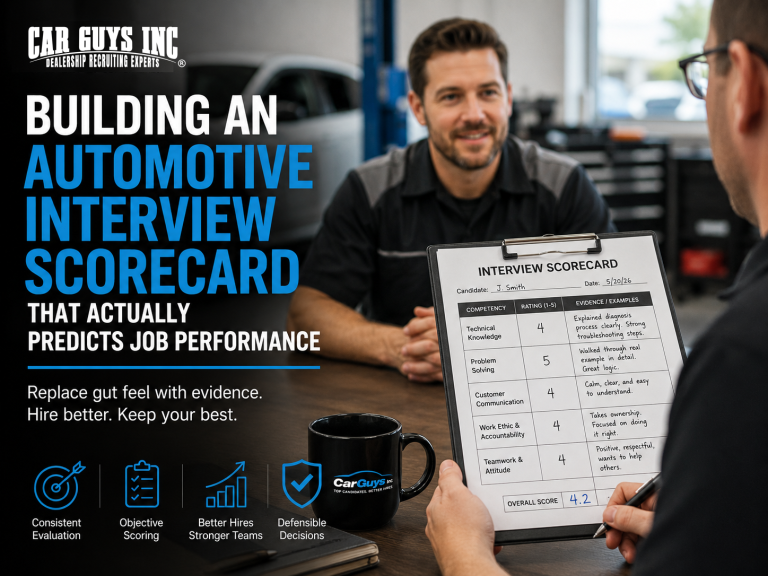
A scorecard is not a checklist of yes-or-no questions. It is a structured rating tool built around the specific competencies that predict success in a role, scored on a consistent scale, and completed independently by every interviewer before anyone compares notes so the process measures what matters.
A solid scorecard includes four elements. First, a short list of core competencies for the role, typically four to six, covering both technical skill and behavioral fit. Second, a defined rating scale, usually 1 to 5, with a brief description of what a 1 and a 5 actually look like for each competency, so a “3” means the same thing across interviewers. Third, a set of structured behavioral questions tied directly to those competencies, asked the same way of every candidate for the role. Fourth, a space for specific evidence: not “great attitude,” but the actual answer or example that earned the score.
This structure is not just about better hires; it is also about defensibility. What EEOC Compliance Really Means for Dealership Hiring covers how consistent, documented interview criteria protect dealerships from discrimination claims, because a scorecard applied evenly across every candidate for a role is one of the clearest ways to demonstrate that a hiring decision was based on job-related criteria, not bias. Stores that already use structured interviews as part of their EEOC compliance strategy usually find that the scorecard improves both hire quality and their legal footing in a single move.
Building Scorecards by Role: Technicians, Advisors, and Salespeople
A single generic scorecard for every open position misses the point. The competencies that predict a strong technician look nothing like the competencies that predict a strong salesperson, and treating every interview the same way produces the same weak signal you get from no structure at all.
For technicians, the scorecard should place heavy weight on diagnostic reasoning, not just on certifications and years of experience. A candidate who can walk through how they diagnosed a specific comeback or an intermittent electrical fault reveals far more than a resume line. 14 Must Ask Automotive Technician Job Interview Questions is a useful source for the specific prompts to build into the technical portion of a technician scorecard, covering everything from flat-rate efficiency history to how a candidate handles a job that is taking longer than the book time allows.
For service advisors, the scorecard needs to weight customer communication and composure under pressure alongside product knowledge. Hiring the Right Service Advisors for Your Shop outlines the specific traits that separate advisors who protect CSI scores from advisors who quietly erode them, and those traits translate directly into scorecard competencies: how a candidate explains a repair to someone with no automotive background, how they respond to a customer who feels overcharged, and how they think about upsell without becoming pushy.
For salespeople, the scorecard should focus on process and resilience over charisma. Charisma is easy to fake for forty-five minutes; a defined sales process and the ability to own a lost deal are not. Hiring a Salesperson: Traits to Look For in Today’s Market breaks down the specific traits worth scoring, including how a candidate talks about their personal closing ratio and how they respond when asked about a deal that fell apart.
Keeping Every Interviewer Rowing in the Same Direction
A scorecard only works if every interviewer uses it consistently, which requires a brief calibration step that most dealerships skip. Before a round of interviews for an open role, the hiring team should agree on the specific competencies to be scored, what a strong versus weak answer looks like for each, and who is asking which questions. That way, candidates are not asked the same three things by every interviewer.
Just as important: every interviewer should score independently before the group compares notes. The moment one manager says “I really liked her” before scores are shared, every other opinion in the room starts to drift toward agreement, and the entire point of the scorecard, an independent, evidence-based view from each interviewer, is lost. Collect scores first. Discuss second.
For panel interviews involving a general manager, a department head, and an HR representative, this discipline matters even more, because the risk of groupthink rises with every additional person in the room.
From Scorecard to Offer: Deciding Faster Without Deciding Carelessly
One objection to scorecards is that they slow the process down. In practice, the opposite is usually true. A structured scorecard gives a hiring team a fast, defensible way to reach consensus, because disagreements become specific (“I scored diagnostic reasoning lower because of how they answered the comeback question”) rather than vague (“something felt off”).
That speed matters more than most stores realize. We’ve found that strong candidates, especially technicians, are often gone within three days if a dealership does not move. A scorecard does not add delay to that window; it removes the indecision that usually causes it, letting a hiring team walk out of back-to-back interviews with real scores in hand and a same-day answer on who gets the offer.
The Bottom Line
An interview scorecard is not a bureaucratic layer on top of the hiring process. It is the difference between a decision your team can defend and explain and one that was really just a feeling. Build one scorecard per role, keep it short enough that interviewers actually fill it out, and use it every time, not just for the roles that feel high stakes. The dealerships winning the talent war right now are not the ones with more applicants; they are the ones who know exactly what a great hire looks like before the interview even starts.
ABOUT CARGUYS INC.
CarGuys Inc. is an dealership recruiting agency built exclusively for the car business. From technicians and service advisors to salespeople and managers, we connect dealerships and repair shops with qualified talent faster, using nationwide reach and years of hands-on experience.


With over 700 clients and thousands of hires, we don’t just fill positions;
we help build stronger teams that foster long-term success.