
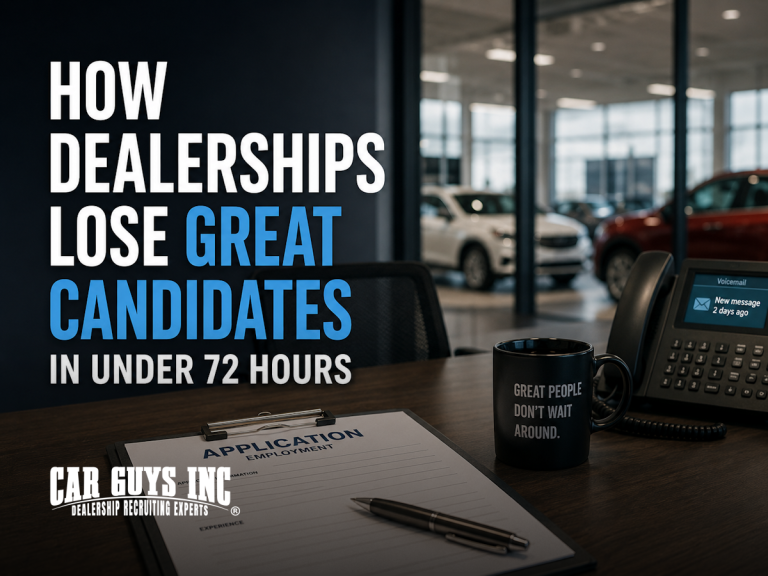
A technician submits an application Monday morning. By Wednesday afternoon, if no one from your dealership has called, texted, or emailed, that technician has probably already interviewed somewhere else. That’s the standard timeline for how strong automotive candidates disappear from active hiring pipelines, and most GMs and service managers never see it happening until a requisition has been open for six weeks and the applicant pool has gone stale.
CarGuys Inc. works with dealerships and repair shops across the country, and the pattern is the same everywhere: dealerships rarely lose good candidates because the job itself is unattractive. They lose them because of what happens, or doesn’t happen, in the first three days after a candidate raises their hand. Pay plans, benefits, and shop culture matter, but none of it gets evaluated if the candidate is already gone before a human being makes contact.
The 72-hour window isn’t an arbitrary number. It reflects how fast serious job seekers move once they’ve decided to make a change, and how little patience they have for a hiring process that feels indifferent to their time.
The Math Behind the 72-Hour Window
A qualified technician, service advisor, or salesperson who is actively looking rarely applies to just one dealership. They’re applying to three, four, or five at a time, and the first one to respond with a real conversation usually wins the candidate before the others get a chance to compete on pay plan or benefits. That’s the uncomfortable truth behind most lost hires: it isn’t a compensation problem, it’s a speed problem.
This dynamic is even more pronounced with passive candidates, who weren’t actively job hunting to begin with. If a passive candidate takes the leap to respond to an outreach message or apply to a posting, that window of motivation is narrow. A slow follow-up doesn’t just delay the process; it can close the window entirely, and the candidate goes back to not looking at all, or worse, starts looking elsewhere on their own terms.
Where the Clock Starts Running Out: The First Contact Delay
The single biggest point of candidate loss happens before an interview is ever scheduled. A candidate applies, and the application sits in an inbox or a stack of resumes for two, three, sometimes five business days before anyone reaches out. By the time your dealership calls, the candidate has either accepted another offer or stopped taking hiring calls altogether because they’ve emotionally moved on.
Dealerships that consistently win top talent treat the first 24 hours after an application is submitted as non-negotiable. That doesn’t mean a full phone screen has to happen the same day; it means the candidate hears from a real person who confirms receipt, sets a time to talk, and gives them a reason to stay engaged. Silence is the most expensive part of the hiring process, and it’s the easiest one to fix.
The Interview-to-Decision Silence
The second major drop-off point comes right after the interview. A candidate walks out of a strong conversation with a service or sales manager feeling good about the opportunity, only to hear nothing for a week while the dealership debates internally, waits for a second interviewer’s schedule to open up, or simply moves on to the next task without closing the loop.
That silence reads as disinterest, even when it isn’t. Strong candidates interpret a slow post-interview process as a signal about how the dealership operates day to day, and they assume, often correctly, that a disorganized hiring process points to a disorganized workplace. Meanwhile, a competing shop that called back within 48 hours with a clear next step is now the frontrunner, regardless of which dealership offered the better package.
This is the same principle behind the hidden cost of waiting to fill key roles: every day a decision gets delayed is a day the best candidate in your pipeline has to decide whether to keep waiting on you or move forward with someone else.
Background Checks and Paperwork That Kill Momentum
Even dealerships that move fast through the interview stage can lose candidates in the final stretch. Background checks, drug screens, and reference verification are necessary parts of a compliant hiring process, but when they’re handled without clear communication, they create a black hole where the candidate has verbally accepted but has no idea what’s actually happening or when they’ll start.
A candidate who doesn’t hear anything for four or five days after clearing a final interview starts fielding calls from other dealerships again, or worse, starts questioning whether the offer is legitimate at all. Fixing this isn’t about rushing compliance steps; it’s about running the screening process without losing the candidate in the first place, which mostly comes down to setting expectations up front and giving the candidate a status update at every stage, even when the update is simply that everything is still in progress.
What Fast-Moving Dealerships Do Differently
Dealerships that consistently close on strong candidates share a few habits that have nothing to do with pay:
- They acknowledge every application within one business day, even with a short text or email confirming the next step.
- They use structured stages, with an owner assigned to each, so no candidate sits in limbo while a decision-maker is busy with something else.
- They run their hiring process through a real applicant-tracking system instead of email threads and sticky notes, so nothing falls through the cracks when multiple people are involved in the decision.
- They treat the entire process, not just the interview, as part of the candidate experience, which means communication is proactive rather than reactive.
- They provide a specific timeline at every stage, so a candidate always knows what happens next and when, rather than having to guess whether they’re still being considered.
None of these habits require a bigger budget or a longer job description. They require treating hiring speed as a competitive advantage, which it is, whether or not it’s being tracked.
The Takeaway: Speed Is a Retention Strategy Before It’s a Hiring One
A dealership that loses candidates in the first 72 hours isn’t just losing that one hire. It’s losing the compounding value of every strong employee that candidate could have become, and it’s likely losing the same type of candidate over and over without realizing the pattern is structural rather than random.
Tightening response times, assigning clear ownership at each stage, and communicating proactively through screening and paperwork closes the gaps where good people are quietly slipping away. These improvements are just one part of building a modern recruiting process. Dealerships looking to improve technician recruiting and overall hiring performance should also evaluate where they source candidates, how they manage applicants, and how quickly they move prospects from first contact to offer.
The fix isn’t complicated. Treat every hour of silence as a cost, because to the candidate on the other end, it already is.
Move Faster Without Cutting Corners
CarGuys Inc. is an automotive recruiting company built exclusively for the car business. From technicians and service advisors to salespeople and managers, we connect dealerships and repair shops with qualified talent faster, using nationwide reach and years of hands-on experience.


With over 700 clients and thousands of hires, we don’t just fill positions; we help build stronger teams that support long-term success.