At CarGuys Inc., we place technicians, service advisors, and sales professionals with more than 800 dealerships and repair shops nationwide, and the pattern we see most often is this: the strongest candidate in any given market is rarely the one who applied. They’re already working, already producing, and not looking at job boards at all.
Most dealership hiring processes are built entirely around active applicants; the people who saw a posting, clicked apply, and are waiting for a callback. That’s a narrow slice of the available talent. The technician running 130 percent efficiency at the shop down the street, the service advisor with a book of loyal repeat customers, the salesperson quietly outperforming their pay plan; none of them are checking Indeed. They’re passive candidates, and they’re consistently the strongest hires available in any market, if you know how to reach them.
The Talent You’re Missing by Only Recruiting Active Job Seekers
Industry estimates put the share of the workforce actively job hunting at any given time somewhere around 10 to 15 percent. The remaining 85 to 90 percent are employed, reasonably satisfied, and not submitting applications, but a meaningful share of them are open to the right opportunity if it’s presented well. That’s not a hypothetical group; it’s the majority of the market, and it’s a majority most dealerships never reach because their recruiting process only fires when someone applies.
This gap matters more in fixed ops than in almost any other area of the dealership. The aging technician workforce means the supply of experienced A-techs entering the active job market keeps shrinking every year. If your sourcing strategy only pulls from that shrinking pool of applicants, you’re competing for a smaller slice of talent every hiring cycle, not a larger one.
Why Job Boards Only Reach a Fraction of the Market
Job boards are built for active job seekers, which is exactly why they underperform for dealerships trying to fill technician and service advisor roles. A posting on a generic board reaches people who are already looking, applying to a dozen jobs at once, and often available precisely because something in their current situation went wrong. We’ve written extensively about how modern automotive recruiting has evolved beyond traditional job boards and headhunters. Our complete guide to automotive recruiting explains the strategies dealerships and repair shops are using to consistently reach passive candidates and build stronger hiring pipelines.
Response speed matters once a passive candidate does engage. Someone who wasn’t looking and is now considering a move will lose interest quickly if the process drags on. A posting that sits open for two weeks before anyone follows up isn’t just slow; it’s actively working against the type of candidate you most want to reach.
What Makes Passive Candidates a Better Long-Term Hire
Passive candidates aren’t just harder to find; they tend to be better hires once you find them. They’re currently employed, which means they’re being evaluated in real conditions rather than through a resume and an interview. You can see their actual production, tenure, and market reputation before you ever make an offer.
They also tend to stay longer. A technician or advisor who moves because they were recruited into a genuinely better opportunity, rather than because they were desperate to leave a bad situation, is making a considered decision. That distinction shows up directly in retention numbers; dealers who build sourcing strategies around passive talent consistently see stronger outcomes than those relying only on reducing turnover after a bad hire is already in the building.
How to Reach People Who Aren’t Looking
Reaching passive candidates requires a different approach than posting and waiting. It starts with knowing who’s out there before you have an open req, not after. That means continuously tracking talent in your market: technicians at competing stores, advisors with strong CSI scores, and salespeople consistently hitting front-end gross targets.
- Direct outreach based on known production or reputation, not job postings
- Employee referrals from your current team, who already know who’s good in the market
- Ongoing relationships with trade schools and technical programs, so you’re building awareness before candidates are even active
- A recruiting partner with existing relationships across your market who already knows who the strong performers are
None of this works as a one-time push. It has to run continuously, in the background, so that when you do have an opening, you’re not starting from zero.
Turning a Passive Conversation Into an Application
The moment a passive candidate agrees to a conversation, the clock starts. They didn’t wake up needing a job; they’re weighing a change against the comfort of staying put, and a slow or clunky process will lose them back to the status quo every time.
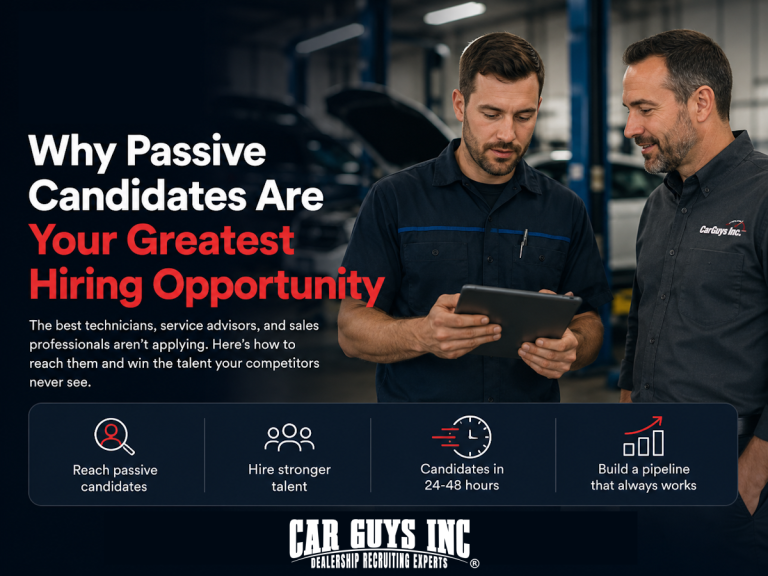
This is where most in-house processes break down. A candidate who’s engaged and interested gets stuck waiting on a callback, a scheduling delay, or a hiring manager who’s buried in other priorities. CarGuys Inc. built Dealer Dash, our proprietary ATS designed specifically for automotive retail, to close that gap. Candidates move from first conversation to delivery in 24 to 48 hours, with no headhunter fees, because a passive candidate’s interest has a short shelf life and the dealerships that move fastest are the ones that land the hire.
Building a Pipeline That’s Always Working
The dealerships that consistently win the best talent in their market aren’t the ones with the cleverest job postings. They’re the ones who treat sourcing as an always-on function rather than a reaction to an opening. That’s the same principle behind building a technician talent pipeline: the pipeline exists before the vacancy does, so you’re never starting a search from a cold list.
And the cost of not doing this is real and measurable. Every week a bay sits empty or a service advisor role goes unfilled is a week of lost revenue; we’ve broken down exactly what an empty bay costs a dealership every month. A passive candidate strategy is what keeps that bay from sitting empty in the first place.
The Bottom Line
Your next great hire is probably not applying to jobs right now. They’re working and producing, not thinking about a move until the right opportunity comes along. The key takeaway is simple: dealerships that build their hiring strategy around reaching that person, rather than waiting for applicants, consistently land stronger talent and keep it longer.
CarGuys Inc. is an automotive recruiting company built exclusively for the car business. From technicians and service advisors to salespeople and managers, we connect dealerships and repair shops with qualified talent faster, using nationwide reach and years of hands-on experience.


With over 800 clients and thousands of hires, we help build stronger teams that foster long-term success.
If you want to quantify technician turnover, staffing shortages, empty bay loss, labor rate strategy, and service department profitability, visit our Service Department Calculators Hub.