
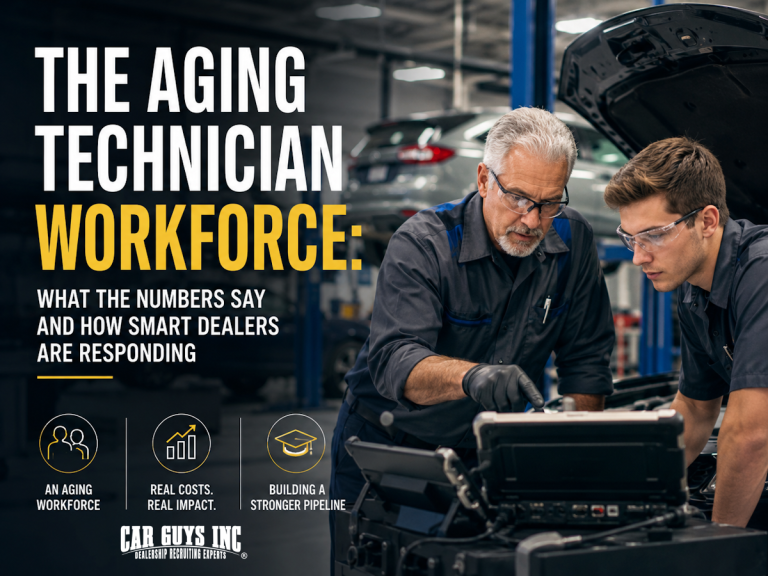
Half of the automotive technicians working in dealership service departments today are over 44 years old. That figure is not a projection from a labor study. It describes the current composition of the workforce, and if you are a dealer principal or general manager who has not seriously considered what your service team will look like in five years, the data makes a compelling case for doing so now.
At CarGuys Inc., we work with hundreds of dealerships on staffing challenges, and workforce aging comes up more consistently than almost any other issue. The stores managing it well share one trait: they treat their technician pipeline as a strategic asset rather than an HR function they address only when a position opens.
The Workforce Data Every Service Director Should Understand
The Bureau of Labor Statistics has tracked the age and composition of automotive service technicians for years, and the trend has moved in one direction for over a decade. The industry requires approximately 76,000 new technicians annually just to replace retiring workers and absorb demand from a growing, increasingly complex vehicle population. Enrollment in automotive technology programs at community colleges and vocational schools has not come close to matching that figure.
The skills dimension compounds the problem of numbers. A technician retiring this year may have spent their career predominantly on internal combustion vehicles. The replacement you need today must be capable of working on connected cars with advanced driver assistance systems, hybrid powertrains, high-voltage battery packs, and software-driven diagnostics that did not exist fifteen years ago. The technical bar has risen sharply while the candidate pool has narrowed, and both trends are affecting the same job posting simultaneously.
The demographic concentration at the top of the skill pyramid is what makes this especially consequential for service departments. Your A-level technicians, the people carrying your most complex warranty work and highest-value diagnostics, are disproportionately in the age cohort closest to retirement. The junior technicians available to hire today are not yet capable of replacing that output. The gap between what is aging out and what is available in the market is real and widening.
What It Actually Costs When a Senior Tech Leaves
The instinct is to think of a technician vacancy in terms of the open posting to be filled. The true cost is much broader. A productive A-level technician at a high-volume dealership generates between $200,000 and $400,000 in annual labor sales, depending on their efficiency rate and local market. Finding a replacement at equivalent skill typically takes months. Developing a junior technician to approach that production level takes years.
Beyond labor sales, there is the institutional knowledge problem. Your most experienced technicians know things that are not in any OEM service manual. They know the repeat ROs that require checking one specific component first. They can diagnose a noise that has stumped two other technicians. They are frequently the informal training anchor for your developing staff. When they leave, that knowledge goes with them unless your store has deliberately built a structure to capture and pass it on. For a direct look at what a vacant bay costs on a daily and monthly basis, see The Real Cost of an Empty Bay Calculator.
The direct replacement cost adds a hard number to the problem. Industry data puts the all-in cost of replacing a skilled technician, accounting for lost productivity, recruiting investment, and reduced output during the ramp period, somewhere between $15,000 and $25,000 per position. A store that loses two or three senior technicians within a 12-month window is absorbing a material financial hit that rarely appears clearly on a single line in the P&L.
Why the Pipeline Is Not Self-Correcting
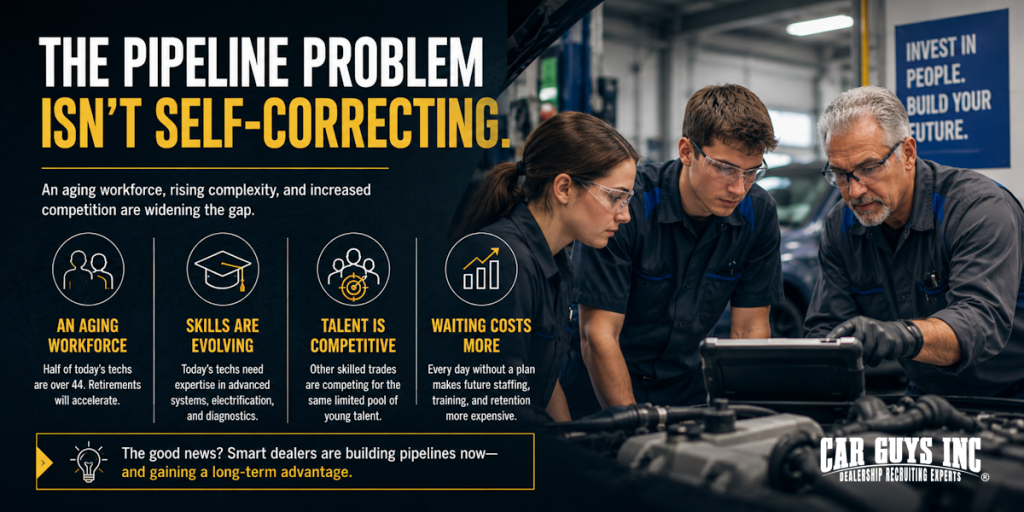
Every industry that depends on skilled trade workers is competing for the same narrowing pool of young people interested in technical careers. Electricians, HVAC technicians, and automotive technicians all draw from the same demographic bucket, and the perception problem in automotive retail is persistent. The trade is still widely seen as physically demanding, poorly compensated, and lacking a meaningful path for advancement. The reality at well-run dealerships is different. A certified A-level technician in a competitive market can earn $80,000 to $120,000 or more. High school guidance counselors and parents who formed their assumptions twenty years ago are not transmitting that message.
The recruiting materials most dealerships use do nothing to close that perception gap. A job board posting that says “automotive technician, competitive pay” reaches people who have already committed to the trade and are actively searching for roles. It does not build the pipeline at the point where it matters, which is before a candidate has decided what to do with their career. The stores actually solving this problem have recognized that reaching future technicians requires showing up earlier than any job board can.
OEM certification programs and manufacturer training pathways are part of the solution, but only when dealerships engage with them actively rather than waiting for credentialed candidates to arrive on their own. Most stores participate passively, waiting for graduates to apply rather than building school relationships that produce a consistent flow of candidates who have chosen the trade partly because of what they saw at that dealership. For context on how broader market conditions are reshaping hiring priorities across all dealership departments, see What the 2026 Auto Finance Market Tells You About Your Next Hire.
What Forward-Looking Dealerships Are Actually Doing
The dealerships that have gotten ahead of the aging workforce challenge share a few consistent practices. None require significant capital expenditure. They require earlier decisions and more deliberate relationship management than most stores currently apply.
Formal school partnerships are the most consistently cited lever. Stores with working relationships with local vo-tech programs and community college automotive departments are generating candidates who arrive with baseline skills, are familiar with the dealership environment before their first day, and chose the trade in part because of what they saw at that specific store. Some dealers offer paid co-op positions during a student’s final semester. Others sponsor a starter tool set for graduating students who commit to an interview. The cost is modest relative to the cost of carrying a long-term vacancy.
Career ladder clarity has a measurable impact on retention of junior technicians, which compounds into a stronger mid-level workforce over time. When a C-tech cannot see a defined pathway to B-tech and A-tech, with specific skills, assessments, and pay milestones attached to each step, the motivation to develop at that store declines quickly. Dealerships that publish their own advancement criteria and compensation steps retain developing technicians at substantially higher rates than stores that describe advancement as performance-based without defining what that means.
Shop environment has become a genuine recruiting differentiator. Candidates for technician positions, particularly younger entrants to the trade, actively assess the shop’s condition when evaluating an offer. Climate-controlled bays, current equipment, functional lifts, and organized parts storage factor into their decision. The dealerships capturing the best junior technicians are not always the ones posting the highest base wages.
Retention Is Your First Line of Defense
No recruiting strategy compensates for a retention problem. If your mid-career technicians are leaving for competitors and you are replacing them with entry-level candidates, you are running a very expensive version of standing still. Average tenure at dealerships that actively manage compensation, culture, and career development is substantially higher than at stores that treat staffing as a transactional function, addressed only when a seat opens up.
Stay interviews are one of the most underused tools available to service managers and GMs. The standard practice is to conduct an exit interview after someone has already accepted another offer, at which point the information is useful only for the next replacement search. A stay interview, conducted annually with your most productive technicians, surfaces compensation gaps, scheduling friction, and environment concerns before they become resignation decisions. The issues that come up are almost always fixable. The technician, who is quietly considering leaving because the scheduling structure conflicts with a recurring personal commitment, will not raise it at a staff meeting. A structured one-on-one with a clear agenda will surface it.
Compensation benchmarking deserves equal attention and receives less than it should. Technician wages in competitive markets have shifted significantly in recent years, and a pay scale that was current three years ago may be meaningfully behind the market today without anyone at the store knowing it. The technician who has been with you for eight years and receives a standard annual increase, while the broader market has moved 12 to 15 percent, has the math working against their loyalty even before they start actively looking. Proactive benchmarking against regional market data, followed by adjustments made before someone brings a competing offer to your desk, is a retention investment that consistently costs less than the turnover it prevents.
CarGuys Inc. is an automotive recruiting company built exclusively for the car business. From technicians and service advisors to salespeople and managers, we connect dealerships and repair shops with qualified talent faster by leveraging nationwide reach and years of hands-on experience.


If you want to quantify technician turnover, staffing shortages, empty bay loss, labor rate strategy, and service department profitability, visit our Service Department Calculators Hub.
With over 700 clients and thousands of hires, we don’t just fill positions; we help build stronger teams that foster long-term success.