At CarGuys Inc., we work with service departments across the country, and the conversation we have most often with fixed ops leaders isn’t about pay plans or scheduling – it’s about timing. Specifically, how long they’ve been operating with an open bay and how much ground they’ve quietly lost while waiting for the right hire to materialize.
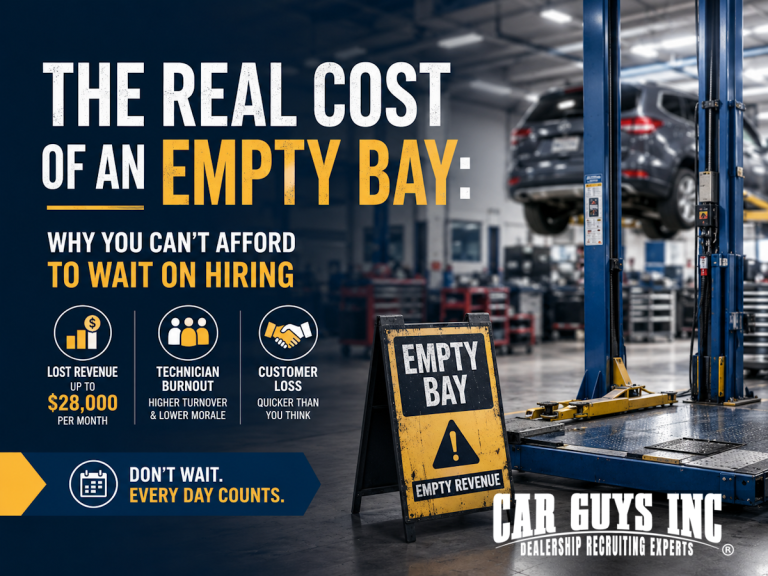
An empty bay is one of the most expensive line items in your service department, and it rarely appears on any P&L. That’s the problem. Because it doesn’t show up as a debit, it’s easy to treat it as a temporary condition rather than an active drain. But the math tells a different story.
What a Single Vacant Bay Actually Costs Per Month
Start with a basic calculation. A flat-rate technician at an average dealer produces between 100 and 140 billable hours per month, depending on the market and the shop’s efficiency. At an effective labor rate of $160 to $200 per hour – a reasonable range for a mid-volume franchise dealer – that single bay generates $16,000 to $28,000 in labor revenue per month when staffed.
When it’s not, that revenue doesn’t go elsewhere inside your department. It walks out the door. Customers who can’t get an appointment within a reasonable window – or who experience delays because your remaining technicians are overloaded – reschedule at the competitor down the street or, worse, don’t come back at all.
Service Department Capacity Planning can help you model the exact impact for your shop based on your labor rate, technician count, and hours per month. The number you’ll land on is almost always higher than what leadership expects.
The Downstream Effects You’re Not Counting
Lost labor revenue is only the most visible cost. What compounds the damage are the second- and third-order effects that don’t get tracked on a spreadsheet.
Technician burnout and turnover. When you’re short-staffed, the technicians you do have absorb the overflow. That means longer days, more pressure to push ROs through, and less time on the quality checks that protect your CSI scores. Over time, your top performers – the ones who could work anywhere – start looking. Losing a productive A-tech to burnout is far more expensive than the open bay that triggered the problem.
Customer retention erosion. A service customer who gets turned away twice doesn’t become loyal. According to industry benchmarks, a returning service customer is worth $500 to $1,200 annually in labor and parts revenue over their ownership cycle. Losing three or four of those relationships per week while you’re understaffed adds up fast.
Parts and sublet revenue loss. Technician hours don’t just drive labor – they pull parts revenue with them. If your parts-to-labor ratio runs at 0.8 or higher, as it should in a well-run shop, every $1 of lost labor also means $0.80 or more in lost parts gross. A vacant bay isn’t just a service problem; it’s a parts department problem too.
Why Dealers Wait – and Why That Logic Doesn’t Hold
Most service managers don’t let a bay sit empty because they want to. They wait because the alternatives feel risky. Hiring the wrong technician, onboarding someone who doesn’t fit, or overpaying in a competitive market are legitimate concerns.
But the math doesn’t support caution as a default position. At $20,000 in lost monthly revenue per open bay, a two-month delay costs $40,000 in forgone gross. Even a mediocre hire who produces at 70 percent efficiency while you continue recruiting would generate $14,000 of that back. The risk of waiting almost always exceeds the risk of moving.
There’s also the staffing market to consider. An aging technician workforce means fewer qualified candidates enter the pipeline than exit it. Holding out for the perfect resume in a market where demand consistently outpaces supply isn’t a strategy – it’s hoping. And dealers who build a technician talent pipeline proactively are consistently ahead of those who post a job and wait.
The Compounding Effect on Service Absorption
Fixed operations leaders think about service absorption – the percentage of your dealership’s total overhead covered by fixed ops gross profit – as a measure of departmental health. A well-run service department targets 70 percent absorption or higher. When you’re operating a bay short, you’re not just missing revenue; you’re making it harder to hit that target every single month.
For a dealership running a tight margin overall, that shortfall in service revenue can be the difference between a profitable month and a loss. Variable ops can swing significantly based on market conditions. Fixed ops is supposed to be the floor. An empty bay chips away at that floor.
The technicians who remain also feel the pressure. When service managers are watching absorption numbers slide and applying pressure to increase productivity, it doesn’t land the same way with an understaffed team. It signals that the problem is being managed at the wrong level.
What Fast-Moving Dealers Do Differently
Dealers who consistently maintain full bays don’t get lucky by improving technician recruiting – they structure their process differently. A few patterns show up repeatedly:
- They treat technician recruitment as an ongoing function, not a reactive one. The pipeline is never completely cold because they’re always in some stage of engagement with candidates.
- They reduce friction in the hiring process. A slow offer process – where a candidate submits an application and waits a week for a callback – is causing a dealership to lose candidates to the shop down the street. The hidden cost of waiting to fill key roles applies at the technician level just as much as it does at the management level.
- They evaluate candidates on production potential, not just credentials. An experienced tech who’s been in the wrong environment will often outperform a perfectly credentialed hire from a more comfortable situation.
- They think of pay plans as much a retention tool as a recruiting tool. A well-structured flat-rate plan with performance incentives keeps your best technicians from looking.
None of these strategies are complicated. What separates fast-moving dealers from slow ones is that they make staffing decisions with the same urgency they’d apply to any other revenue-critical problem.
Quantify It, Then Act
If you haven’t run the numbers on your open bay, start there. The Empty Bay Calculator at CarGuys Inc. walks you through a straightforward calculation based on your shop’s actual labor rate and average technician production. Most managers who run it find the monthly figure is significantly higher than their going-in estimate.
Once the number is real, the conversation about hiring urgency changes. It shifts from ‘we’re being careful’ to ‘we’re losing $X per month and need to move.’ That’s a more accurate framing – and a more useful one for getting everyone aligned on action.
CarGuys Inc. is an automotive recruiting company built exclusively for the car business. From technicians and service advisors to salespeople and managers, we connect dealerships and repair shops with qualified talent faster, using nationwide reach and years of hands-on experience.


With over 800 clients and thousands of hires, we don’t just fill positions; we help build stronger teams that foster long-term success.
If you want to quantify technician turnover, staffing shortages, empty bay loss, labor rate strategy, and service department profitability, visit our Service Department Calculators Hub.