
Most people in the car business wait for a raise to happen to them. They put in another year, hope someone upstairs notices, and get quietly frustrated when the number on their check does not move. If you want to ask for a raise at a dealership and actually walk away with more money, waiting is the wrong strategy. The people who get raises are the ones who build a case, pick their moment, and ask as they mean it.
Whether you are a technician on flat rate, a service advisor chasing CSI scores, or a salesperson living off your pay plan, the same rules apply. Pay conversations in this business are not personal; they are business. Come in with proof of your value and a clear number, and the conversation changes completely.
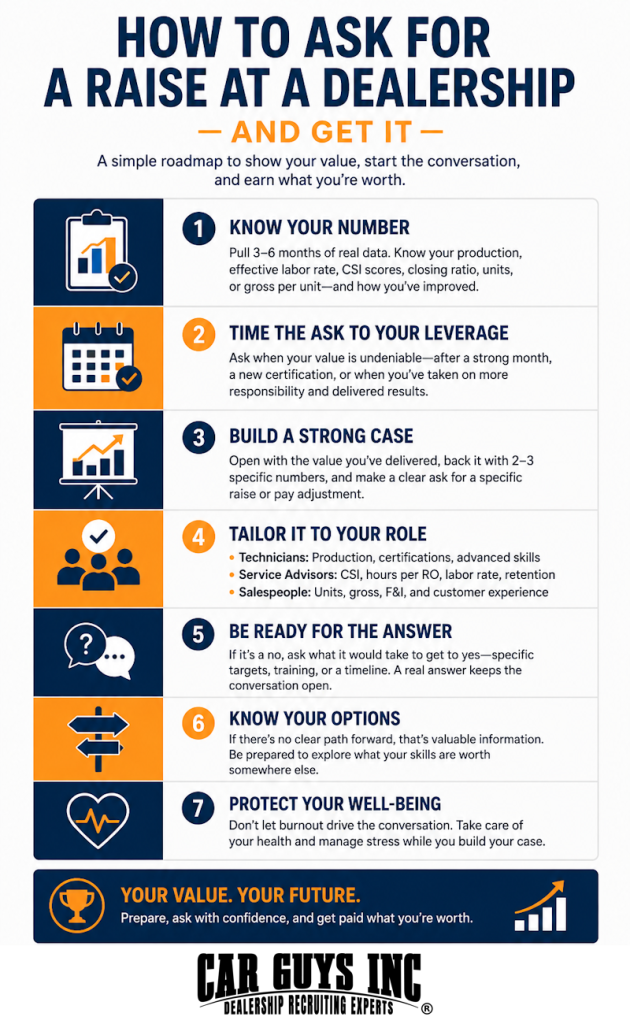
Know Your Number Before You Walk In
You cannot negotiate a dealership pay raise off a feeling. You need a number, and that number needs to come from something real: your flat-rate hours produced, your effective labor rate, your closing ratio, your CSI scores, or your gross per unit. Pull your last three to six months of numbers and know exactly where you stand compared to when you started, and compared to what the role typically pays in your market.
If you are a technician, this means knowing the difference between billed and clocked hours and how that has trended. If you are a service advisor, it means knowing your CSI scores, your hours per RO, and how much you are contributing to service absorption. If you are in sales, it is your units, your F&I penetration, and your customer satisfaction scores. Managers respond to numbers, not to “I feel like I deserve more.”
Time the Ask to Your Leverage, Not the Calendar
The best time to ask for a raise is not your work anniversary. It is the moment your value is undeniable: right after you finish a certification that increases your flat rate, right after a month where your CSI scores or closing ratio hit a new high, or right after you have taken on responsibility nobody asked you to take, like training a new hire or covering a vacant shift without complaint.
Dealerships run on momentum. If you ask when your numbers are strong, the manager has an easy “yes” sitting in front of them. If you ask during a slow month, you are fighting the calendar as much as the budget.
Build the Case Like You Are Pitching a Customer
You already know how to make a case for something people did not know they needed; that is the job. Use the same skill on yourself. Open with the value you have delivered, back it with two or three specific numbers, and close with a clear ask: a specific flat-rate bump, a specific pay plan adjustment, or a specific hourly increase. Vague requests get vague answers. A specific number gets a specific yes-or-no.
Avoid comparing yourself to a coworker by name. Compare yourself to the market and to your own trajectory instead. “Techs at my certification level in this market are running $2 to $4 more per flat-rate hour” lands very differently than “Dave makes more than me.”
Adjust Your Approach by Role
A technician’s case is built on production and certification. If you have added ASE certifications, OEM-specific training, or picked up EV and ADAS diagnostic skills, that is leverage; the industry is short on technicians who can service that work, and every service manager knows it.
A service advisor’s case is built on CSI scores, hours per RO, and how well you are protecting the effective labor rate. If you have improved retention on maintenance work or reduced comebacks, put a number on it.
A salesperson’s case is built on units, gross, and F&I performance, as well as customer experience scores, since those increasingly affect the OEM incentive money the dealership receives. If your reviews and referrals are strong, that is worth mentioning; it is revenue the store would not have without you.
Know What to Do If the Answer Is No
A “no” is not the end of the conversation; it is information. Ask specifically what it would take to get to yes: a production target, a certification, a CSI threshold, a timeline. A manager who gives you a real answer is negotiating in good faith. A manager who gives you a vague brush-off month after month is telling you something, too.
If you have made your case with real numbers and the answer is consistently no with no path forward, that is useful information about how this particular store values its people. It may be time to find out what your skills are worth somewhere else.
Before you have that conversation, it helps to know what a fair offer actually looks like for your role. If you are evaluating your current pay against the market, our guides on evaluating a service advisor job offer, a flat-rate technician job offer, and an automotive sales consultant offer break down what competitive pay structures actually look like across the industry.
Protect Yourself From Burnout While You Build Your Case
Pay conversations often surface after months of feeling overworked and underpaid, and that combination can cloud your judgment. Make sure you are asking for a raise because your value has grown, not just because you are exhausted. If burnout is part of what is driving this, it is worth addressing separately.
Our post on how salespeople can avoid burnout is a good next read if long hours and pay frustration are showing up at the same time; the two problems need different solutions.
Your Next Move
Asking for a raise at a dealership is not about being pushy or ungrateful; it is about ensuring your pay reflects the value you actually deliver. Pull your numbers, pick your moment, make your case like you would to a customer, and ask for a specific figure. Do that consistently, and you put yourself in a much stronger position than the person who waits quietly and hopes.
If your case is strong and the answer still is not there, it is worth finding out what your role is worth elsewhere. Our guide, The Job Search Advice No One Gives You Until It’s Too Late, covers how to start that search the right way, without burning bridges at your current store.
CarGuys Inc. connects skilled automotive professionals with dealerships and repair shops nationwide through intelligent matching technology. Instead of flooding candidates with irrelevant openings, we focus on fit, timing, and transparency. Upload your resume once, and when a matching opportunity arises, you will be notified. No noise. No pressure. Just the right opportunity at the right time.