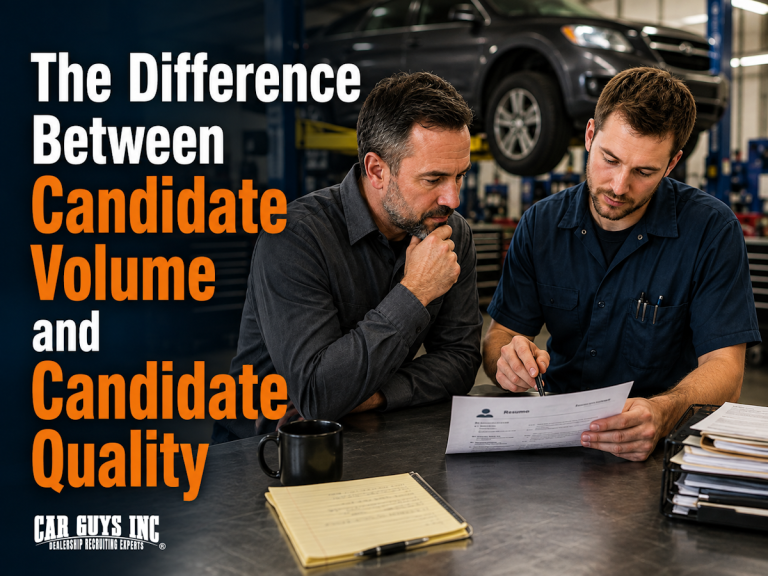
Post a technician opening on a major job board this morning, and by Friday you will have forty resumes in the inbox. Maybe fifty. A hiring manager scrolling through that list might feel like the position is basically filled already; there is no shortage of applicants, only a shortage of time to review them all.
That feeling is the trap. Of those forty resumes, three or four will be worth a phone call. The other thirty-six are noise: candidates who applied to a dozen openings in one sitting, people whose experience does not match the role, or applicants who never intended to show up for the interview at all. Volume creates the illusion of a healthy pipeline while quietly burning the hours your team should be spending on the handful of candidates who could actually do the job well.
At CarGuys Inc., we work inside dealership and repair shop hiring processes across the country, and this pattern repeats everywhere: the dealerships stuck in a hiring rut are rarely short on applicants. They are short on qualified ones. Understanding the difference between candidate volume and candidate quality, and building a process that optimizes for the right one, is one of the highest-leverage changes a service department or sales floor can make.
More Resumes Isn’t the Same as More Options
It is easy to equate a full inbox with a strong hiring position, but the two are not the same thing. Candidate volume measures how many people applied. Candidate quality measures how many of them could succeed in the role, work well with your existing team, and stay long enough to justify the cost of hiring and training them. A dealership can have both, neither, or one without the other, and high volume with low quality is the most common combination on general job boards.
This is largely a function of where the applicants come from. Broad job boards are built to maximize the number of applications, not the fit of any individual one. A candidate can apply to your service advisor opening and 20 others with a single click, which means most people in your funnel were never evaluating whether your dealership was the right fit for them, either. Specialized automotive recruiting works differently, sourcing and pre-screening for the specific skills and experience your role requires before a resume ever reaches your desk. Our Automotive Recruiting Guide: Job Boards vs. Headhunters vs. Recruiting Platforms breaks down exactly how those channels differ and which one fits which hiring situation.
What Chasing Volume Actually Costs Your Dealership
The cost of a volume-first approach rarely appears on the job-posting invoice. It shows up three weeks later, in the hours a service manager spent screening resumes that never should have made the list, and again three months later, when a hire who looked fine on paper does not work out. A bad hire costs far more than the wages paid during their tenure once you factor in training time, lost productivity, comebacks, and the disruption to a team that has to cover the gap.
There is also a speed cost that goes the opposite direction of what most managers expect. A high-volume funnel feels productive, but sorting through it takes real time, and that delay is exactly what causes dealerships to lose the strong candidates buried in the pile. A qualified technician or salesperson with real options will not wait around while your team works through sixty resumes to find them. Ironically, a smaller, better-screened pool of candidates almost always moves faster to an offer than a larger, unscreened one.
What Quality Looks Like Before a Candidate Ever Applies
Quality is not just a resume that lists the right certifications or years of experience, though that matters. It is a combination of verified skill, demonstrated reliability, and fit with how your specific team operates. A technician with strong diagnostic skills but no history of showing up consistently is not a quality hire for a shop that runs tight schedules. A salesperson with charisma but no track record of handling rejection well is a risk on a floor with long sales cycles.
The best quality candidates are frequently not searching job boards at all. They are currently employed, performing well, and not actively applying anywhere, which means a volume-based strategy will never reach them. Reaching this group requires a different approach: direct outreach, referral networks, and relationships built before a position even opens. It also means training your team to recognize quality signals quickly once a strong candidate does surface, rather than defaulting to whoever applied first.
Building a Hiring Process That Filters for Quality, Not Just Fills a Funnel
Shifting from volume to quality does not mean hiring slower or accepting fewer applicants. It means being deliberate about where those applicants come from and how they are evaluated once they arrive. A few changes make the biggest difference:
Source from channels built for fit, not just reach. Specialized automotive recruiting, employee referral programs, and trade school partnerships consistently produce smaller, stronger pools than general job boards. Building that pipeline before you have an urgent opening is what separates dealerships that hire well from ones that hire fast and regret it later.
Use technology to screen for signal, not just to process volume faster. Automated applicant tracking and AI-assisted screening tools are useful, but only when they are configured to surface candidates who match your actual requirements rather than simply moving more resumes through the funnel. The goal is a shorter list of stronger candidates, not a faster pass through a long one.
Score consistently once candidates reach the interview stage. A scorecard applied the same way across every candidate for a role keeps quality assessments objective, rather than reducing the decision to whoever interviewed best on a given day. This is the natural next step once your sourcing is producing a smaller, better pool: you still need a consistent way to tell your strongest candidates apart.
Key Takeaways
A full applicant pipeline is not the same as a strong one, and dealerships that measure hiring success by application count consistently end up with more bad hires, slower offers, and higher turnover than dealerships that measure it by fit. Quality candidates, especially the passive ones already succeeding elsewhere, rarely come from casting the widest possible net. They come from specialized sourcing, real relationships, and a screening process built to filter for fit rather than simply keep pace with volume. The dealerships that make this shift do not just fill roles faster; they build teams that stay.
CarGuys Inc. is an automotive recruiting company built exclusively for the car business. From technicians and service advisors to salespeople and managers, we connect dealerships and repair shops with qualified talent faster, using nationwide reach and years of hands-on experience.


With over 700 clients and thousands of hires, we don’t just fill positions; we help build stronger teams that foster long-term success.