
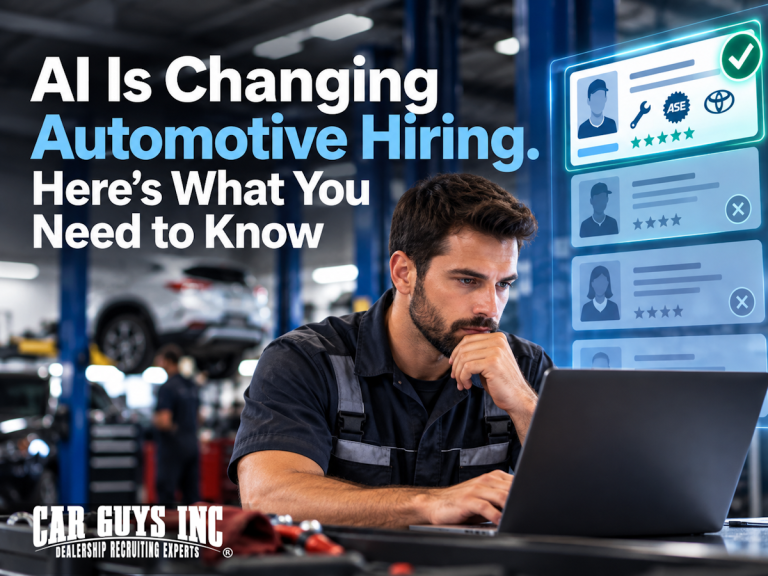
The last technician job you applied for may have been read by software before a service manager ever saw your name. That software pulled your certifications from your resume, compared your work history to the job description, ranked you against every other applicant, and maybe even texted you to ask when you’re free to talk. AI in automotive hiring isn’t coming; it’s already deciding who gets a callback, how fast it happens, and why some strong candidates never hear a word.
At CarGuys Inc., we see both sides every day: dealerships and repair shops adopting new hiring tools, and technicians, advisors, and salespeople trying to figure out what those tools want from them. The good news is that AI doesn’t reward tricks. It rewards clarity, accuracy, and speed, and all three are in your control.
Where AI Shows Up in the Automotive Hiring Process
Most job seekers picture AI as one big system deciding who gets hired. In practice, it’s a handful of smaller tools, each handling one step of the process:
- Resume parsing: An applicant tracking system reads your resume and sorts it into fields like job titles, dates, certifications, and skills. If it can’t read something, that field comes up blank.
- Matching and ranking: The system compares your profile to the job requirements and scores the fit. That score often decides whose resume a busy service manager opens first.
- Candidate search: Recruiters and hiring managers search existing candidate databases before a job is ever posted. Knowing how recruiters search for candidates before posting jobs explains why your profile can get you hired for a job you never applied to.
- Screening and scheduling: Automated texts and chatbots ask the basic questions up front: availability, certifications, pay expectations, whether you can work Saturdays, and when you can come in.
AI usually doesn’t make the final hiring decision at a dealership. A service manager, sales manager, or GM still sits across from you, still talks to your references, and still decides whether you fit the shop. AI decides who gets that conversation. Your job is to make sure you’re on the list.
How AI Resume Screening Reads Your Application
AI resume screening is literal. A service manager who reads “Toyota Master Diagnostic Tech” knows exactly what that means. A screening tool may look for specific terms like “Master Technician,” “diagnostics,” and the brand name, and it can’t credit you for experience you didn’t spell out.
Formatting causes more problems than most candidates realize. Resumes built with tables, text boxes, graphics, multiple columns, or contact information buried in a header can scramble when a system parses them. Your ten years of drivability work might land in the wrong field or disappear entirely. A clean, single-column layout with standard section headings like Experience, Certifications, and Skills reads correctly every time.
A few habits make a real difference:
- Spell out certifications instead of relying only on abbreviations, such as “ASE A6 Electrical/Electronic Systems” rather than just “A6.”
- List OEM training levels by name and brand, since many dealership searches filter on manufacturer experience.
- Use the job titles hiring managers actually search for, even if your shop called the role something unusual.
- Include measurable results where you have them: efficiency percentages, CSI scores, units sold, or hours flagged.
The keyword side of this goes deeper, and it’s covered in detail in What Makes a Resume Searchable to Recruiters. The short version: write for the person, then make sure the software can read what you wrote.
Using AI in Your Job Search Without Sounding Like Everyone Else
Hiring is not the only side using AI. Job seekers are using ChatGPT and similar tools to write resumes, cover letters, and follow-up emails, and hiring managers have noticed. A sales manager who reads ten cover letters that open with “I am excited to leverage my passion for automotive excellence” stops reading by the eleventh.
Used well, AI is a useful assistant. It can help you tailor a resume to a specific posting, tighten a rambling summary, catch grammar mistakes, and generate practice interview questions for the role you’re chasing. Used badly, it produces generic copy that sounds like nobody in particular, or worse, invents details that aren’t true.
That second risk ends careers before they start. If an AI tool adds a certification you don’t hold, inflates your sales numbers, or describes diagnostic experience you don’t have, it will show up in the interview or in the first week on the job. The guide on how to write a cover letter for a dealership role using AI the right way walks you through using these tools as a starting point while keeping the final version accurate and in your own voice.
Remember that everything on your resume is fair game in the interview. A polished document you can’t back up in conversation hurts you more than a plain one you can explain in detail. Hiring managers compare notes on that kind of gap, and what they discuss after your interview often comes down to whether you matched the paper.
Why Speed Matters More With AI in Automotive Hiring
Automation has made the early stages of hiring much faster. A screening text can go out minutes after you apply, and many systems move to the next qualified candidate if you don’t respond. The applicant who answers in an hour often gets the interview slot over the applicant who answers in two days, even if the second one has a better resume.
During an active job search, treat your phone and email like a customer pay RO waiting on approval:
- Answer texts and calls from unknown numbers, or check them quickly.
- Check your spam and promotions folders daily, since automated scheduling emails often land there.
- Keep your voicemail greeting professional and make sure the mailbox isn’t full.
- Confirm scheduled interviews right away, and reply if you need to reschedule.
Silence works in the other direction too. Plenty of candidates assume the system rejected them when the real reason is a missed message, an outdated phone number, or an application that never matched the posting. Why most job seekers never hear back and how to fix it covers the most common causes. And sometimes the job was filled internally or put on hold, which is a reminder that job rejection isn’t always about you.
What AI Still Can’t Judge, and Why That’s Your Advantage
For all the screening and scoring, AI in automotive hiring still can’t measure what makes someone great in a dealership. It can’t tell whether you stay calm with a customer whose warranty claim was denied. It can’t see whether you help the newer tech who’s stuck on a diag or keep the showroom energy up on a slow Tuesday. It can’t judge whether you show up on time, own your mistakes, or fit the culture of a specific shop.
People still evaluate those qualities through interviews, references, working interviews, and reputation. In an industry where service managers know each other and salespeople move between stores in the same market, your reputation travels further than your resume. That’s why networking still matters in the auto industry, even as more of the hiring process goes digital. A strong referral can put your resume on a manager’s desk no matter how the screening tool ranked it.
The candidates who come out ahead aren’t trying to beat the software. They make it easy for the software to find them, then win the human part of the process on skill and character.
Your Next Move in an AI-Driven Job Market
AI in automotive hiring changes how you get noticed, not what makes you worth hiring. Give the tools a clean, accurate, specific resume. Use AI to sharpen your materials without letting it speak for you. Respond fast when an opportunity reaches out. Then let your skills, your work ethic, and your reputation carry the conversation from there.
CarGuys Inc. connects skilled automotive professionals with dealerships and repair shops nationwide through intelligent matching technology. Instead of flooding candidates with irrelevant openings, we focus on fit, timing, and transparency.
Upload your resume once, and we’ll notify you when a matching opportunity arises. No noise. No pressure. Just the right opportunity at the right time.