
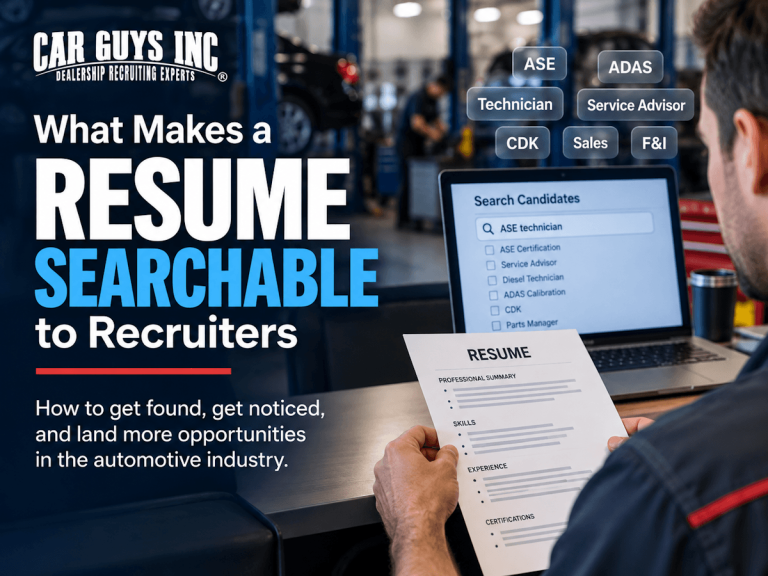
A technician with eleven years of experience and three ASE certifications can lose out to a candidate with half the résumé, not because the newer applicant is more qualified, but because their resume showed up in a search and the veteran’s did not. Most recruiters aren’t reading every resume that comes in; they’re searching a database of thousands for the handful that match specific terms. A resume searchable to recruiters gets pulled into that shortlist. One that isn’t, no matter how strong the candidate behind it, often never gets seen.
That distinction matters more than most job seekers realize. You can have the right experience, the right certifications, and the right attitude, and still lose ground to someone less qualified simply because their resume was built to be found and yours was built to be read. Understanding how recruiters actually search, and what makes a resume surface in those searches, changes how you write every section of it.
Recruiters Search Resumes Before They Read Them
Most hiring at dealerships and repair shops starts with a keyword search, not a stack of applications on a desk. A recruiter working a service advisor opening might type “service advisor,” “CDK,” and “5 years” into a database of resumes on file and pull up whoever matches, long before a job is even posted publicly. Recruiters are often searching for candidates and building shortlists well before a role goes live, which means a resume sitting in that database with the right terms on it has a real shot at surfacing for openings you never applied to.
Once a resume does surface, it doesn’t get read closely at first. Recruiters and the AI tools now supporting them tend to scan a resume for a matter of seconds before deciding whether it’s worth a closer look, which means the terms that matter most need to be visible immediately, not buried in a paragraph three sections down. Searchability gets your resume into the pile. Clarity is what keeps it there once someone opens it.
Use the Exact Job Titles Recruiters Search For
Every dealership has its own internal role names, and that’s exactly the problem. If your title was “Vehicle Reconditioning Specialist” but the job you’re going for is titled “Lot Technician” everywhere else, a recruiter searching that standard term will never find you. The fix isn’t to lie about your title; it’s to include the industry-standard version alongside it so your resume matches the language recruiters and applicant systems actually search for.
This matters most for roles with several common names. A “Business Development Center” role might also be searched as “BDC Representative” or “Internet Sales.” An “F&I Manager” might get searched as “Finance Manager” or “Finance and Insurance Manager.” Knowing the standard titles and expectations across dealership departments helps you pick language that lines up with what a recruiter is actually typing into a search bar, rather than whatever your last employer happened to call the position.
Build Your Skills Section Like a Search Bar, Not a Sentence
Recruiters searching a resume database aren’t looking for well-written prose; they’re looking for exact terms. If you write “I’m comfortable using a variety of diagnostic tools,” that sentence won’t match a search for “Snap-on,” “ADAS calibration,” or “hybrid certified,” even if it’s technically true. A dedicated skills section that lists the specific systems, certifications, and tools you’ve worked with, by name, gives a recruiter’s search something concrete to find.
For technicians, that means naming the diagnostic software, the makes you’re factory-trained on, and any specialized certifications directly. Technicians with ADAS calibration experience should list it explicitly rather than folding it into a general description, since it’s exactly the kind of scarce, high-demand keyword recruiters are actively searching for. For advisors and salespeople, that means naming the CRM and DMS platforms you’ve used, not just “customer service software.” Solid, specific resume language matters across every role in the industry, and the more precisely you name what you actually know, the more searches your resume matches.
Keywords aren’t only technical, either. Soft skills belong on a resume too, and recruiters search for them specifically, especially for advisor and sales roles where terms like “customer retention,” “conflict resolution,” or “team leadership” show up in searches just as often as a certification does. The goal is the same either way: say the specific thing, not the vague version of it.
Formatting Decisions That Help or Hurt Your Searchability
A resume can have all the right keywords and still be invisible if it’s formatted in a way that a search tool can’t read. Tables, text boxes, columns, and graphics that look clean to a human eye often confuse the systems that scan and index resumes, so the keywords inside may never get picked up. A straightforward, single-column layout with standard section headers like “Experience” and “Skills” is far more likely to be read correctly than a visually creative one.
The same goes for where you put your information. Contact details buried in a header or footer sometimes get skipped entirely by parsing software, and an unusual file format can strip out formatting a system depends on to separate one section from another. A handful of small, avoidable mistakes are responsible for a lot of strong candidates never getting found, and formatting choices that block a search from working correctly are near the top of that list. None of this means your resume has to look plain; it means the structure underneath the design needs to stay simple enough for a search to read it correctly.
Keep It Current So You Surface in the Right Searches
A resume that hasn’t been touched in three years doesn’t just look dated; it often ranks lower in a database search than a recently updated one, even when the experience listed is still accurate. Recruiters often filter candidates by “updated in the last six months,” and a stale resume gets filtered out before anyone even considers the qualifications.
This is also why you don’t need to be actively hunting for a new job to keep your resume search-ready; you need it accurate and recent enough to surface when a recruiter runs a search that matches your background. Much of the silence job seekers experience after applying comes down to the same searchability problem: a resume that technically has the right experience but isn’t structured or worded in a way a search actually catches. The same logic extends to your online presence. A well-built, keyword-specific LinkedIn profile gets found in searches the same way a resume does, so treat both as one connected, current picture of who you are and what you’re qualified to do.
Make Every Word Earn Its Place
None of this means gaming a system or stuffing a resume with keywords that don’t reflect your experience; recruiters and AI screening tools both catch that quickly, and it costs you credibility fast. It means being specific instead of vague, using the terms this industry actually searches for instead of the ones your last shop happened to use, and keeping your information current enough to show up when it counts. A resume searchable to recruiters isn’t a trick. It’s simply one written in the language recruiters are already using to find their next hire.
CarGuys Inc. connects skilled automotive professionals with dealerships and repair shops nationwide through intelligent matching technology. Instead of flooding candidates with irrelevant openings, we focus on fit, timing, and transparency. Upload your resume once, and we’ll notify you when a matching opportunity arises. No noise. No pressure. Just the right opportunity at the right time. If you want your resume working for you instead of sitting unseen, our job board is a good place to start.