A dealership that tracks lot traffic, close rate, and gross per unit down to the decimal point usually cannot tell you how many technician applicants it takes to land one good hire.
That is not a data problem. It is a blind spot, because most dealerships never built a hiring funnel to measure in the first place. They built a single event called “post the job and see who applies.”
At CarGuys Inc., we work inside dealership and repair shop hiring processes nationwide, and the automotive hiring funnel behaves a lot like the sales funnel a dealership already manages every day. Candidates enter at the top, most of them drop off along the way, and the dealerships that win are the ones paying attention to where that drop-off happens instead of just counting who’s left at the end.
Understanding the automotive hiring funnel stage by stage is what turns hiring from a guessing game into a process you can actually improve.
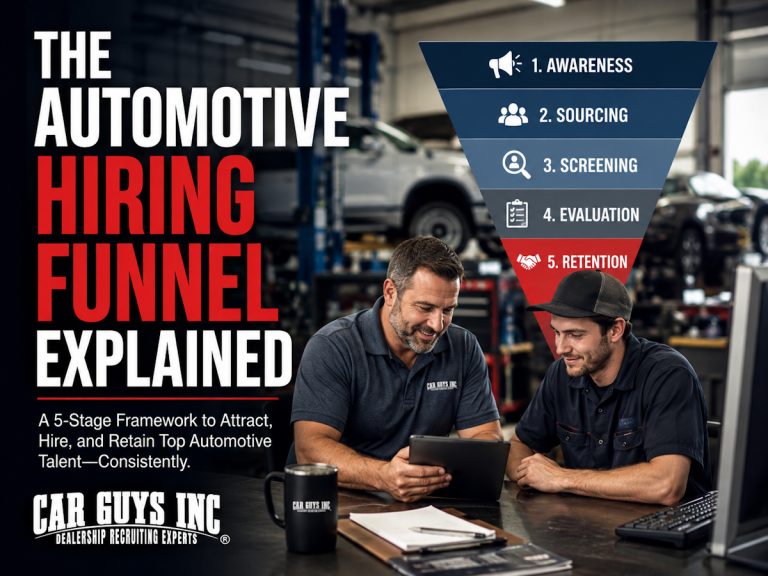
Stage One: Reputation and Awareness Shape the Top of the Funnel
Every hiring funnel starts before a single application arrives.
A technician or salesperson forms an opinion about your dealership from your Google reviews, your reputation among people who already work there, and what they hear at a parts counter or trade school long before they ever see a job listing.
That is the same top-of-funnel logic marketing teams have used for years. Awareness happens whether or not you’re actively trying to shape it, so the dealerships that manage it deliberately start every hiring cycle with an advantage.
In fact, automotive recruiting is becoming more like marketing because candidates increasingly research and evaluate potential employers before deciding whether an opportunity deserves their attention.
Reputation is the clearest lever inside that awareness stage, and it works the same way a dealership’s customer-facing reputation does: it is built slowly, through consistent experience, not through anything you can fix with a better job ad.
A shop known for burning out technicians or churning through service advisors has a narrower funnel before it ever posts an opening, no matter how good the pay plan looks on paper. A shop known for developing people has candidates entering the funnel who already have a reason to trust it.
Stage Two: Sourcing Decides Who Enters the Automotive Hiring Funnel
This is the stage most dealerships treat as the whole hiring process instead of just one part of it.
Where candidates come from determines the quality of everyone you’ll eventually get to choose from.
A general job board can fill the top of the funnel wide and shallow: lots of applicants, many of them a poor fit, because the board is built to maximize applications rather than matches. Specialized automotive recruiting narrows that funnel intentionally, focusing on candidates who fit the actual role rather than simply generating more resumes.
That distinction matters because there is a significant difference between candidate volume and candidate quality. More applications do not automatically create more hiring options if managers have to sort through dozens of unqualified candidates to find the few worth interviewing.
The strongest candidates also may never enter the funnel through a job posting at all. Many are currently employed, performing well, and not actively browsing job boards. A sourcing strategy built entirely around active applicants can therefore miss a large portion of the available talent market.
That is why great hiring starts before you need an employee.
The dealerships that rarely seem completely caught off guard by an opening are often the ones that already have names in mind before the seat becomes vacant. Maintaining relationships with potential candidates during the slow months can turn “we need someone now” into “we already know who to call.”
Sourcing is not something that should begin only when somebody gives notice. It is an ongoing part of keeping the funnel healthy.
Stage Three: Screening Is Where Most of the Funnel Actually Drops Off
Post a technician opening and forty resumes can land in the inbox by Friday, while only three or four may be worth a phone call.
That drop-off is normal. The mistake is not managing it intentionally.
Dealerships that let the funnel collapse under its own volume end up spending hours screening candidates who were never a real fit, while the handful who were worth an interview can move on to a faster-moving competitor.
Speed and signal both matter at this stage.
Knowing what to look for in a resume in the first few minutes is what keeps a qualified candidate from getting buried under the noise of everyone who does not meet the requirements. The goal is not necessarily reading every resume more carefully. It is knowing which ones deserve that attention in the first place.
Technology earns its place at this stage too, not by replacing judgment but by compressing the time it takes to exercise it. AI-assisted screening tools can help surface candidates who actually match your requirements instead of forcing a manager to manually review every applicant in the same way.
The objective is not simply fewer candidates. It is getting the right candidates through the funnel faster.
Stage Four: Evaluation and Decision Speed Determine Who Makes It to an Offer
A candidate who survives screening still has to survive your interview process, and this is where an inconsistent process can quietly leak strong people.
Interviewing every candidate against the same criteria, instead of relying primarily on gut feel from one conversation to the next, makes it easier to compare candidates fairly and identify the person who actually fits the role.
One way to create that consistency is by building an automotive interview scorecard that predicts job performance, giving managers defined criteria to evaluate instead of reconstructing the definition of a “good candidate” after every interview.
Speed matters just as much as structure.
A strong candidate with real options does not necessarily wait around for a slow decision. A dealership that takes two weeks to schedule a second interview can lose someone it had already decided it liked.
In fact, dealerships can lose great candidates in under 72 hours when another employer communicates faster, schedules interviews sooner, or simply makes a decision while everyone else is still discussing the next step.
The funnel does not just narrow here because of your own evaluation. It also narrows because candidates are evaluating you.
Stage Five: The Funnel Doesn’t End at the Offer Letter
Most dealerships stop measuring the funnel the moment someone signs an offer.
But a hire who leaves in four months did not really solve the staffing problem. The dealership simply moved the cost of the vacancy further down the calendar.
Retention is the funnel’s last stage, and it is one of the easiest stages to ignore once the immediate pressure of an open position disappears.
A hire who is quietly burning out is that same funnel leaking again, just later and more expensively than a candidate who never applied in the first place. By the time burnout becomes a resignation, the department may already have paid for it through declining productivity, reduced efficiency, increased workload on other employees, and eventually another recruiting cycle.
That is why understanding the true cost of technician burnout belongs in the hiring conversation just as much as sourcing and interviewing do.
The dealerships that reduce the impact of turnover also tend to be the ones that never allow the top of the funnel to run completely dry. They continue building relationships and watching the candidate market even when every seat is currently filled.
That habit is what makes the hiring funnel a loop instead of a one-time project.
The moment you stop feeding the top of it, the next vacancy forces you to start over from zero.
What Dealerships Should Measure at Each Stage
Building a hiring funnel is only useful if you can see where it is working and where candidates are disappearing.
You do not need a complicated recruiting analytics system to start. A handful of measurements can reveal a lot.
Awareness: Track traffic to your careers and job pages, candidate engagement, employee referrals, and what candidates say about your reputation during interviews.
Sourcing: Track how many candidates each recruiting source produces, but more importantly, how many of those candidates are actually qualified.
Screening: Measure your applicant-to-interview rate. If hundreds of applicants consistently produce only a handful of interviews, the problem may be candidate quality rather than candidate volume.
Evaluation: Track interview-to-offer rate, offer acceptance rate, and the amount of time between application, interview, and decision. Long delays can reveal a process problem even when sourcing is working.
Retention: Track 90-day, six-month, and one-year retention. A recruiting process that consistently produces hires who leave quickly may be filling positions without actually solving the underlying staffing problem.
Eventually, those numbers let you answer the question most dealerships cannot answer today:
How many candidates do we need at the top of the funnel to produce one successful long-term hire at the bottom?
Once you know that number, hiring becomes much easier to forecast.
Key Takeaways
Hiring is not one event. It is a process that moves through five stages: awareness, sourcing, screening, evaluation, and retention.
Most dealerships spend the majority of their attention in the middle of that funnel – reviewing resumes and conducting interviews—while giving much less attention to the awareness and retention stages on either end.
That is exactly where candidates and employees can quietly disappear without anyone tracking why.
Treating recruiting activity like any other dealership metric – measuring performance by stage rather than simply asking whether the position eventually got filled – is what turns a leaky hiring funnel into a more predictable one.
The dealerships that build and measure a real hiring funnel spend less time starting from zero and more time choosing from candidates who were a fit before an opening became an emergency.
CarGuys Inc. is an automotive recruiting company built exclusively for the car business. From technicians and service advisors to salespeople and managers, we connect dealerships and repair shops with qualified automotive talent using nationwide reach and years of hands-on recruiting experience.
If you want to quantify technician turnover, staffing shortages, empty bay loss, labor rate strategy, and service department profitability, visit our Service Department Calculators Hub.
More than 800 dealerships and repair shops have used CarGuys Inc., and we have helped place more than 6,000 automotive professionals. We do not just help dealerships fill open