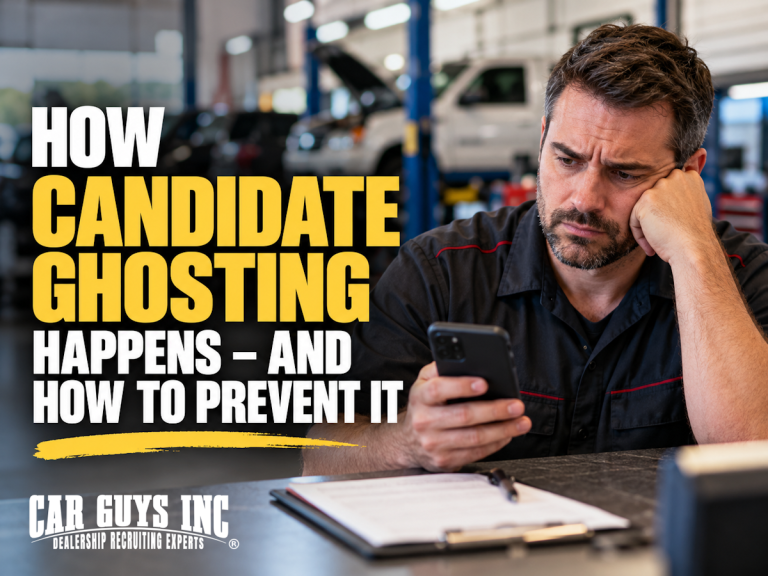
A technician confirms a Tuesday 10 a.m. interview by text on Monday afternoon. At 10:20 on Tuesday, the service manager is still standing at the advisor counter checking his phone. Two follow-up calls go to voicemail. A month later, that same technician is turning wrenches at the store across town. Candidate ghosting has become one of the most common frustrations we hear from dealership managers, and it rarely comes out of nowhere.
At CarGuys Inc., we manage candidate pipelines for dealerships and repair shops nationwide, so we see ghosting from both sides of the desk. The pattern is consistent: candidates disappear at predictable points in the hiring process, for predictable reasons, and most of those reasons trace back to something the dealership did or didn’t do. That’s good news, because it means candidate ghosting is a process problem, and process problems can be fixed.
Why Candidate Ghosting Costs More Than a Wasted Interview Slot
A no-show interview looks like an hour lost. The real cost is bigger. The service manager got pulled off the drive, the shop foreman blocked time for a working interview, and other candidates were delayed or passed over because this one looked like the frontrunner. When ghosting happens after an offer, the damage multiplies: the runner-up has already been told no, the job ad has come down, and the shop schedule has been built around a start date that never arrives. Every one of those days is an open bay, and the real cost of an empty bay adds up faster than most managers estimate. A late-stage ghost can push a seat back to square one weeks after you thought it was filled.
There’s also an uncomfortable truth worth naming. For years, dealerships ghosted candidates far more often than the other way around. Applications went unanswered, and interviewed candidates never heard a final decision. Job seekers learned that silence is an acceptable way to end a hiring conversation. They didn’t invent the behavior; they’re returning it.
The Four Points Where Candidates Ghost Dealerships
Ghosting isn’t one problem. It shows up at four distinct stages, and each stage has its own cause:
- After applying, the candidate never answers your first call or text. Usually, the gap between application and first contact is too long, and the candidate has already gained momentum elsewhere.
- Before the interview, they confirm, then don’t show. The interview felt optional because it was scheduled days out with no personal connection to the person they’d be meeting.
- At the offer stage. They go quiet after receiving an offer. This typically signals a competing offer, a pay plan they don’t understand, or a counteroffer from their current employer.
- Before day one, they accept, then never start. The one to two weeks between acceptance and start date are the most neglected window in dealership hiring.
Mapping these stages against the automotive hiring funnel shows exactly where your store leaks. If most of your ghosts happen before the interview, the problem is response time and engagement. If they happen after the offer, the problem is the offer itself, or the silence that follows it.
What Causes Candidate Ghosting in Dealership Hiring
It comes down to three factors: speed, clarity, and connection.
Speed. Strong technicians and service advisors are rarely talking to just one store. We’ve documented how dealerships lose great candidates in under 72 hours, and ghosting is often the visible end of that slow process. When a competitor calls back the same afternoon, and you call back Thursday, the candidate doesn’t feel obligated to tell you they’ve moved on; they stop answering. Why some dealerships hire faster than you do almost always comes down to process, not pay.
Clarity. Candidates disappear when they can’t figure out what happens next or what the job actually pays. A flat-rate tech who can’t get a straight answer on the hourly rate, the guarantee, or how many hours the shop really flags will assume the worst. Vague pay conversations are one of the HR mistakes dealerships make when hiring, and they show up as silence at the offer stage. Pay plans start reducing turnover in the interview, not after the first paycheck.
Connection. A candidate who has only interacted with an auto-responder and a scheduling link has no relationship to walk away from. Automation keeps a pipeline organized, but the core lesson of how AI should and shouldn’t be used in recruiting applies here: a real person has to enter the process early. Ignoring a scheduling bot costs a candidate nothing. Ignoring a service manager who called personally feels different.
How to Prevent Candidate Ghosting Before the Interview
The first stretch of the hiring process is where commitment gets built. These habits consistently reduce interview no-shows:
- Make first contact the same business day, by phone and text. Technicians and advisors on the shop floor answer texts long before they check email.
- Schedule the interview within 48 hours of first contact. Every extra day gives a competitor another chance to step in.
- Have the hiring manager send the confirmation, not a coordinator. A short text from the service manager, such as “Looking forward to meeting you Thursday at 2. Ask for me at the service drive,” turns an appointment into a personal commitment.
- Tell candidates exactly what to expect: who they’ll meet, how long it takes, whether there’s a shop walk or working interview, and when they’ll hear back.
- Send a reminder the morning of the interview with the address, parking info, and a direct number.
That level of attention is impossible if you’re working through a stack of 80 unscreened applicants. It’s why candidate volume and candidate quality aren’t the same thing; a short list of screened, interested candidates is easier to engage personally, and engaged candidates show up. Using AI to organize applicants can handle the sorting so your managers spend their time on the conversations that keep candidates committed.
How to Prevent Ghosting After the Offer and Before Day One
Late-stage ghosting is the most expensive kind, and also the most preventable.
Deliver the offer verbally first, then in writing within 24 hours. Walk through the pay plan line by line: flat rate, guarantee, effective hourly at expected flagged hours, benefits start date, and any tool allowance. A candidate who fully understands the offer doesn’t need to disappear to think it over. Ask directly about counteroffers, too. “If your current shop offers you more to stay, what will you do?” is a fair question, and the answer tells you what to prepare for.
Then treat the time between acceptance and start date as part of the hire. Background checks, drug screens, and paperwork shouldn’t create a week of silence; background checks that protect your dealership without killing hiring keep the candidate informed at every step. A mid-notice-period call from the service manager, a welcome text from the shop foreman, and a confirmed bay assignment all make the new job feel real. Role-specific onboarding can start before day one, and sending the first-week plan in advance gives a new tech a reason to show up and a reason to say no when the old shop makes a last-minute counteroffer.
Finally, keep your runner-up warm until the new hire actually clocks in. Instead of sending a rejection the day an offer is accepted, have an honest conversation: you’ve extended an offer, and you’d like to stay in touch. It’s a habit of managers who recruit every week instead of starting from zero each time. For hard-to-fill seats, a dedicated technician and mechanic recruiting partner can keep a backup pipeline active, and the Empty Service Bay Revenue Loss Calculator shows what a late-stage ghost actually costs if you don’t have one.
Wrapping It Up
Candidate ghosting isn’t random, and it isn’t just a generational attitude problem. It happens at four predictable stages, driven by slow response, unclear pay, and a process that never connects the candidate to a real person. Respond the same day, put the hiring manager’s name on every step, explain the pay plan before the candidate has to ask, and treat the weeks before day one as part of recruiting. Dealerships that do this don’t just lose fewer candidates; they build a better candidate experience that pays off in referrals and reputation long after the seat is filled.
CarGuys Inc. is an automotive recruiting company built exclusively for the car business. From technicians and service advisors to salespeople and managers, we connect dealerships and repair shops with qualified talent faster, using nationwide reach and years of hands-on experience. To quantify technician turnover, staffing shortages, empty bay loss, labor rate strategy, and service department profitability, visit our Service Department Calculators Hub. With over 700 clients and thousands of hires, we don’t just fill positions; we help build stronger teams that foster long-term success.