Most dealerships start hiring the day a position becomes a problem. A technician gives two weeks’ notice, a service advisor takes a competitor’s offer, or a sales manager finally admits the department has been short-handed for months. Only then does the requisition go out, the job board posting goes live, and the clock starts. By that point, the dealership is no longer hiring. It is scrambling.
CarGuys Inc. works with dealerships and repair shops nationwide, and the pattern is consistent: the shops with the least hiring stress are not the ones with the least turnover. They are the ones who never stopped recruiting in the first place. That is why great hiring does not start when a seat opens. It starts long before, with a pipeline already in motion and a process built to move fast the moment it is needed.
The Reactive Hiring Trap
Reactive hiring occurs when a dealership recruits only in response to a vacancy. It feels efficient because no time is spent sourcing candidates for roles that do not yet exist, but the tradeoff is steep. Every open requisition starts from zero: no warm candidates, no shortlist, no relationships already in progress. The dealership is competing for talent under time pressure, which almost always means settling for whoever is available rather than choosing who is best.
This is the same dynamic covered in The Real Cost of an Empty Bay: Why You Can’t Afford to Wait on Hiring, where every day a technician bay sits empty translates directly into lost billable hours and declining CSI scores. That same cost shows up in reactive hiring: it is not just the eventual hire. It is every week of reduced capacity, missed ROs, and overworked staff that precedes it.
The deeper issue is that reactive hiring treats recruiting as an event instead of a function. That is why a dealership would never run its parts department with zero inventory on hand, ordering only after a customer asks for a part that is out of stock. Yet many run their staffing the exact same way, with zero candidate inventory until a seat is already empty.
What Starting Early Actually Looks Like
Starting early does not mean hiring people before there is work for them. It means maintaining visibility into the talent market on an ongoing basis, so that when a vacancy opens, the dealership can choose from a warm list rather than build one from scratch. This shows up in a few concrete habits: reviewing the applicant flow monthly, even when there is no open role; staying in touch with strong candidates who were not hired the first time; and tracking which positions are most likely to turn over next.
This is where passive candidates matter most. The strongest technicians and advisors are usually already employed and not actively job hunting, as explored in Why Passive Candidates Are Your Greatest Hiring Opportunity. They will not appear on a job board the week a dealership has an opening. Reaching them requires ongoing outreach unrelated to any current vacancy, which is precisely why most dealerships never talk to them until it is too late.
Dealerships that plan ahead treat every strong applicant, hired or not, as part of a longer-term bench. A candidate who was a close second for a sales role six months ago may be exactly who is needed when a different position opens next quarter, but only if someone kept the relationship warm.
Building a Pipeline Before the Vacancy Exists
A hiring pipeline is not a stack of resumes waiting for a job to match them to. It is an active, maintained list of people the dealership would hire again if the right role opened. Building one starts with identifying the roles most prone to turnover, whether that is flat-rate technicians, BDC staff, or service advisors, and sourcing continuously for those roles regardless of current headcount.
The mechanics of this are covered in detail in Building a Technician Talent Pipeline: Where to Start, but the principle applies well beyond the service department. That same discipline benefits sales, parts, and management roles: a running list of qualified people, ranked by fit, updated as new candidates surface and old ones move on.
This is also where a proprietary ATS like Dealer Dash changes the math. Instead of a folder of old applications that nobody revisits, a dealership can flag high-quality candidates the moment they apply, tag them by role and fit, and automatically resurface them when a matching position opens. In this way, the pipeline no longer depends on someone’s memory and runs as a system.
The Real Cost of Waiting Until You Are Short-Staffed
Every week, a key role sits open, carrying a compounding cost that rarely gets tracked as closely as it should. A vacant technician bay means fewer completed ROs and a lower parts-to-labor ratio. A vacant service advisor seat means longer customer wait times and declining CSI scores. A vacant sales position means fewer closed deals and reduced front-end gross, month after month, until the seat is filled.
The pattern is the same one described in The Hidden Cost of Waiting to Fill Key Dealership Management Roles: the longer a leadership vacancy goes unfilled, the more it destabilizes everything underneath it. Decisions stall, teams lose direction, and by the time a replacement starts, the department has often absorbed months of avoidable drag. In that way, what looks like patience while searching for the right fit is frequently just delayed cost.
None of this is visible on a standard P&L line labeled ‘vacancy.’ Instead, it shows up scattered across labor costs, missed revenue, and overtime, which is exactly why it goes unaddressed for so long. As outlined in The Dealership Hiring Iceberg: What You See vs. What You Don’t, the visible cost of an open position is a small fraction of what the vacancy actually costs the dealership underneath the surface.
How Sourcing Changes When You Plan Ahead
Job boards work reasonably well when a dealership needs any qualified candidate quickly. They work poorly when a dealership needs the right candidate for a specialized role, because the best people in fixed ops and automotive sales are rarely the ones actively scrolling listings. This is the core argument in Forget Job Boards: Why Dealerships Need Specialized Recruiting: generic sourcing yields generic results, and dealerships competing on a job board compete on price and speed rather than fit.
Planning ahead flips this. Instead of writing a job description reactively and posting it everywhere at once, a dealership that recruits continuously can be more selective about where and how it sources, because it is not racing a clock. In that setting, specialized automotive recruiting, informed by pay plan benchmarks and real fixed ops experience, consistently surfaces stronger candidates than a generic posting ever will, and it does so without the pressure of an empty bay sitting unfilled while the search drags on.
Turning Hiring Into a Continuous Process
The dealerships that hire best treat staffing the same way they treat service department capacity planning: as an ongoing operational function, not a periodic fire drill. The same forward-looking discipline described in Service Department Capacity Planning for Dealership Managers applies directly to staffing. Just as a manager who forecasts bay utilization three months out should apply the same lens to headcount, anticipating which roles are likely to turn over before they do.
In practice, this means building a simple, repeatable rhythm: review open and at-risk roles monthly, keep a warm list of strong candidates regardless of current openings, and treat every application as a long-term asset rather than a one-time transaction. None of this requires a large HR department. It requires a system, and a partner who can keep that system running without adding to a manager’s workload.
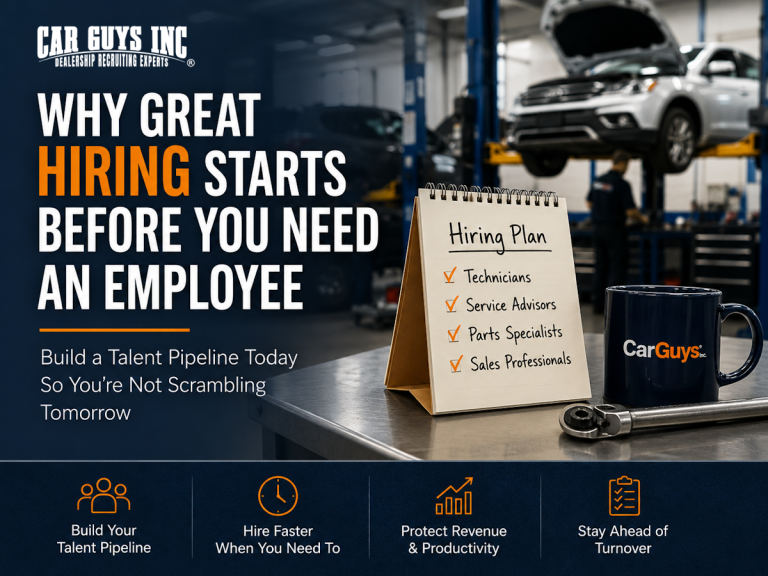
Dealerships that build this habit stop feeling the panic of a sudden vacancy. When a technician resigns, or a sales role opens unexpectedly, a shortlist is already in place, and the search that would have taken weeks takes only days. The next step is to keep that shortlist warm by reviewing at-risk roles monthly and maintaining ongoing relationships with candidates. That is the real difference between reactive and proactive hiring: not fewer vacancies, but far less damage when they happen.
Key Takeaway: Great hiring is not a response to an open position. It is a continuous process that keeps a dealership ready before a vacancy exists, so what used to feel like an emergency becomes routine.
CarGuys Inc. is an automotive recruiting agency built exclusively for the car business. From technicians and service advisors to salespeople and managers, we connect dealerships and repair shops with qualified talent faster, using nationwide reach and years of hands-on experience.


With over 700 clients and thousands of hires, we do more than fill positions; we help build stronger teams for long-term success.