
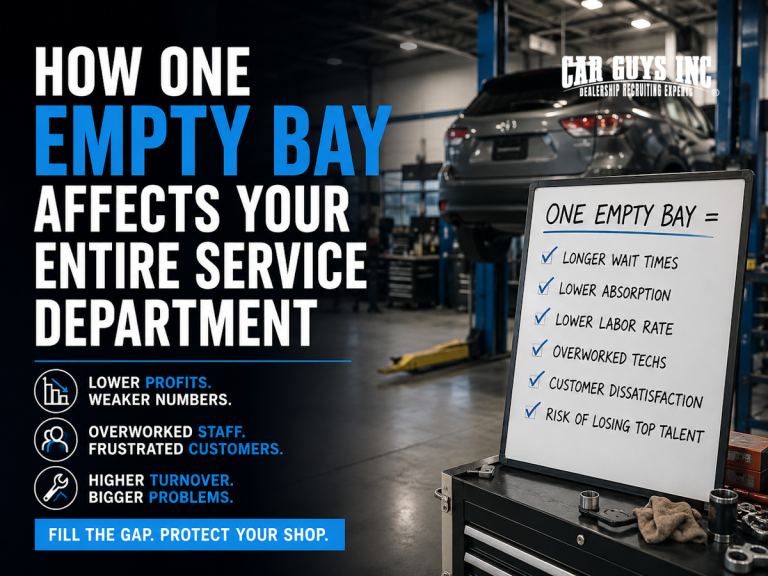
One open technician position doesn’t show up on a P&L as a crisis. It shows up as a staffing gap, easy to defer for another pay period while you wait for the right resume. But a bay isn’t an isolated cost center. It’s one node in a system, and when it goes empty, the system redistributes the load in ways that show up everywhere except the place you’d expect to see them first. At CarGuys Inc., we work with dealerships nationwide to fill technician openings fast, and one empty bay rarely stays contained to just one bay’s worth of damage.
We’ve written before about the cost of waiting to fill that bay. This is the other half of that story: what happens inside your building, department by department, while that bay sits open.
The Workload Doesn’t Disappear, It Redistributes
When a technician leaves and the bay goes unfilled, the ROs that would have gone to that lift don’t stop coming in. They get absorbed by the remaining techs, usually your A-techs, because they’re the ones who can handle the harder or more time-sensitive jobs without a second look. That feels like a short-term fix. It isn’t. Your best people are now working outside their specialty, taking on lower-skill jobs to keep the drive moving, and their own billable hours on higher-value work start slipping in the process.
This is the same dynamic we cover in our breakdown of the aging technician workforce: your most experienced techs are already carrying more weight than they used to. An empty bay just adds another shift’s worth of overflow onto people who were never supposed to be your overflow plan in the first place.
Your Service Advisors Absorb It Next
Fewer techs on the floor means longer promise times, which means your advisors are the ones fielding the frustrated phone calls and managing customer expectations they can’t control. Write-ups slow down because advisors are triaging instead of writing clean estimates. Multi-point inspections get rushed or skipped to keep cars moving, which quietly erodes upsell opportunity and shrinks the very repair orders that were supposed to offset the staffing gap.
CSI scores take the hit shortly after. Customers don’t see a staffing chart; they see a longer wait, a missed callback, or a car that wasn’t ready when promised. If your advisors are already stretched thin turning tickets into revenue, as we outlined in turning service advisors into profit builders instead of order takers, an empty bay undercuts that effort before it has a chance to work.
Absorption Rate and Effective Labor Rate Both Move in the Wrong Direction
Fixed ops profitability runs on two numbers that an empty bay quietly attacks simultaneously. Service absorption drops because you’re generating less gross to cover fixed overhead. Effective labor rate softens because rushed jobs, more comebacks, and lower-skill work billed at a discount all pull the average down. Neither number falls off a cliff in a single month. They erode gradually, which is exactly why the damage from one empty bay is so easy to underestimate until you’re three or four months in and staring at a shop that isn’t hitting the numbers it used to hit with fewer techs on payroll, not more.
- Fewer billable hours produced across the department, not just the vacant seat
- More comebacks and diagnostic time from rushed or reassigned work
- Lower absorption, which pressures every other fixed ops decision you make
- A widening gap between scheduled hours and actual hours delivered to customers
The Empty Bay Revenue Loss Calculator below estimates how much potential service revenue your dealership may be losing when service bays remain unused.

This Technician Shortage Cost Calculator helps dealership managers and shop owners estimate how much revenue is being lost due to unfilled technician positions.

It Puts Your Remaining Technicians at Risk of Leaving Too
The most expensive version of this problem is the one most managers don’t see coming: the empty bay becomes two empty bays. Techs who spend months covering for a position that never gets filled start looking elsewhere, and they don’t have to look far. A flat-rate technician who consistently works outside their pay grade to cover gaps will eventually find a shop that doesn’t ask them to do that. Losing a second technician to burnout compounds every problem above rather than resetting them.
This is why filling the position quickly matters more than filling it perfectly. Great hiring starts before you need the employee, but if you’re already sitting on an open bay, speed to a qualified candidate is what stops the bleeding across every department connected to it.
Key Takeaways for Fixed Ops Leaders
An empty bay is never just an empty bay. Track it as a department-wide risk, not a line-item vacancy:
- Monitor overtime and job mix among your remaining technicians, not just hours produced.
- Watch advisor write times and CSI trends for early signs of strain before customers start complaining.
- Track absorption rate and effective labor rate monthly so drift gets caught early, not discovered at year-end.
- Treat technician turnover on adjacent bays as an early warning sign that the gap has gone on too long.
The math for one open bay doesn’t apply only to that one bay. It moves through your advisors, your absorption rate, and, eventually, your retention numbers for the technicians you were counting on to hold things together. Run the real cost for your own shop before deciding that waiting one more pay period is the safe choice.
CarGuys Inc. is an automotive recruiting company built exclusively for the car business. From technicians and service advisors to salespeople and managers, we connect dealerships and repair shops with qualified talent faster, using nationwide reach and years of hands-on experience.


With over 700 clients and thousands of hires, we don’t just fill positions; we help build stronger teams that foster long-term success.
If you want to quantify technician turnover, staffing shortages, empty bay loss, labor rate strategy, and service department profitability, visit our Service Department Calculators Hub.