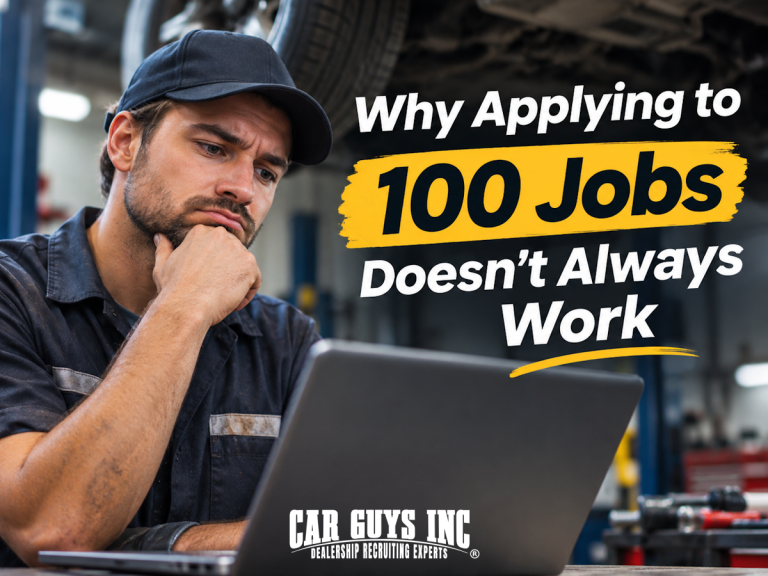
You’ve spent three evenings clicking Easy Apply on every technician, service advisor, and sales opening within 40 miles. The count just passed 100. Your phone has rung twice: once for a lube tech role you don’t remember applying to, and once from a number you missed while you were under a lift. If that sounds familiar, you’ve already found out why applying to 100 jobs doesn’t always work. The effort goes up, but the results don’t follow.
At CarGuys Inc., we work with dealerships and repair shops nationwide on the hiring side, so we see what a 100-application search looks like from the other end of the desk. It rarely looks like a motivated candidate. More often it looks like a resume that doesn’t fit the job, attached to someone hard to reach. The fix isn’t working harder. It’s aiming better.
Why Applying to 100 Jobs Feels Productive but Rarely Pays Off
Volume feels like control. When the job search is stressful, a big number gives you something to point to: you did the work, so the results should come. The logic is borrowed from sales, where more ups are supposed to mean more deals. But even on the showroom floor, the top closers aren’t the ones who talk to the most people. They’re the ones who ask the right questions before they ever show a vehicle, so they spend their time with buyers who are a real fit.
A job search works the same way. When you apply to everything, each application gets a few seconds of your attention, and hiring managers can tell. The same generic resume goes to a diesel tech opening at a truck dealer, an alignment tech role at a tire chain, and a service advisor desk at a luxury store. Plenty of information explains why most job seekers never hear back once their resume enters a screening system. The bigger issue with mass applying is upstream: the strategy itself feeds that system the wrong inputs to begin with.
What Hiring Managers See When You Apply Everywhere
From your side, 100 applications are 100 separate chances. From the hiring side, they often show up as a pattern, and not a flattering one.
Dealer groups share one system. Many dealer groups run every rooftop through a single applicant tracking system. A fixed ops director at a six-store group can see that you applied for master tech at the Ford store, lube tech at the Toyota store, service advisor at the Honda store, and BDC rep at the used car center, all in the same week. That doesn’t read as ambition. It reads as “will take anything,” which is the opposite of what a manager wants when filling a flat rate bay or a seat on the service drive.
Mismatched qualifications stand out fast. Applying to an OEM-certified diploma tech role with no factory training, or a finance manager position with no F&I experience, doesn’t just get you passed over. It trains the recruiter to skim past your name next time. Recruiters notice within seconds whether a resume matches the opening in front of them, and a mass-applied resume usually doesn’t.
Callbacks get fumbled. When you’ve applied to 100 places, you can’t keep them straight. A service manager calls, and you answer with “Sorry, which shop is this?” That one sentence usually ends the conversation. Hired candidates remember the store, the brand, and what they liked about the posting.
The Hidden Math Behind Mass Job Applications
The numbers behind a high-volume automotive job search are worse than they look. A good share of the postings you’re applying to aren’t what they seem:
- Evergreen ads. Plenty of shops keep a technician posting running year-round to collect resumes, whether a bay is open today or not.
- Roles that are already spoken for. Dealerships often hire before a position is ever advertised, with the posting going up as a formality or to satisfy a policy.
- Recycled listings. Job aggregators repost the same opening across multiple sites, sometimes weeks after it closed. Ten of your applications may have gone to one job.
Meanwhile, the best automotive jobs often never make it to Indeed. Recruiters often fill them from a short list, a referral, or a database search. Understanding how recruiters search for candidates before posting jobs explains why being findable can matter more than being prolific.
There’s an emotional cost, too. Send 100 applications, hear back from three, and it’s easy to conclude something is wrong with you. Most of the time, it’s the math. Rejection isn’t always about you, and silence after a mass search usually signals the approach needs adjusting, not your skills.
A Better Job Search Strategy: Fewer Applications, Better Targets
Swapping volume for precision doesn’t mean applying to three jobs and waiting. It means every application has a reason.
Start with what you actually want. Before you apply anywhere, decide what matters: flat rate or hourly, the brands you want to work on, the schedule you can live with, and where you want to be in five years. There’s a real difference between a job that pays the bills and one that builds a career, and knowing which one you’re after narrows the list fast. If you’re leaving because you’ve noticed the signs it’s time to leave your current shop, be clear about what you’re leaving so you don’t apply straight back into the same problem.
Build a short list of 10 to 15 shops. Take the time to research each dealership before you apply. Look at employee reviews, how busy the service drive is on a weekday morning, whether the shop has enough work for techs to flag real hours, and how long their advisors tend to stick around. Constant openings for the same role tell you something.
Tailor every application. Lead with what that specific job needs: your ASE certifications, OEM training, brand experience, CSI scores, or units sold per month. If the posting asks for a cover letter, use AI the right way to tighten your draft, not to generate 50 identical ones. Auto-apply tools that fire off applications in bulk are a growing problem, and as AI changes automotive hiring, screening tools are getting better at spotting them.
Make your resume work while you sleep. A resume built with the right keywords and a clean layout is searchable to recruiters running database searches, which means it can surface for jobs you never applied to.
Follow Up and Network Where Targeted Applications Win
The biggest advantage of a short list is that you can actually follow up. With 100 applications, follow-up is impossible. With 12, it’s a Tuesday afternoon.
Call the store two or three business days after applying and ask for the service manager or sales manager by name. Better yet, stop by the service drive mid-afternoon, after the morning write-up rush has cleared, introduce yourself, and leave a resume. Managers remember the tech who showed up in person. The same principle carries through the rest of the process; following up after a dealership interview keeps you top of mind once you’re in the running.
Then use the people already around you. Parts counter reps, tool truck drivers, warranty administrators, and former coworkers all know which shops are busy, which managers treat people well, and which stores are about to lose a tech. Networking still matters in the auto industry because so many hires happen through a conversation, not a job board. And once you land somewhere, stay visible; you don’t need to be actively job hunting to get hired for your next move.
Make Your Next 10 Applications Count
Applying to 100 jobs isn’t a character flaw. It’s an understandable response to a frustrating search. But if the results aren’t coming, more of the same won’t change that. Pick the shops you’d actually say yes to, tailor what you send, follow up as you mean it, and make sure the right people can find you. Ten focused applications will almost always beat 100 rushed ones.
When you’re ready to start, browse current openings for automotive technician jobs, service advisor jobs, or dealership sales jobs, and apply only to the ones that fit where you want to go.
CarGuys Inc. connects skilled automotive professionals with dealerships and repair shops nationwide through intelligent matching technology. Instead of flooding candidates with irrelevant openings, we focus on fit, timing, and transparency. Upload your resume once, and we’ll notify you when a matching opportunity arises. No noise. No pressure. Just the right opportunity at the right time.