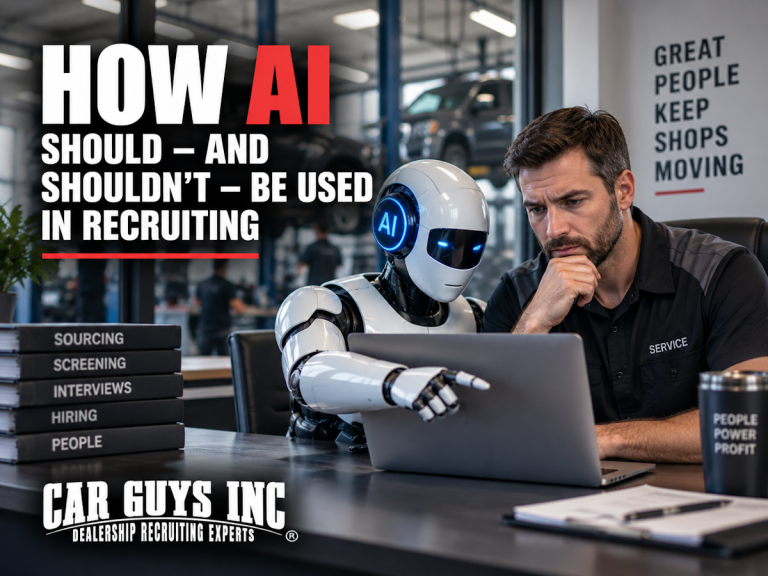
A dealership can screen two hundred technician applications before lunch and still end up with a worse hire than the shop that read fifteen resumes by hand the old-fashioned way. That’s not a knock on artificial intelligence; it’s a warning about how it gets used. AI has moved from a novelty in automotive recruiting to something most service and sales departments touch in some form, whether that’s an applicant tracking system quietly ranking resumes or a chatbot pre-screening candidates before a human ever sees a name.
At CarGuys Inc., we work inside dealership and repair shop hiring processes nationwide. The pattern we see is consistent: the shops getting real value from AI are using it to remove friction from the parts of hiring nobody wants to do by hand, while the shops getting burned by it are the ones that handed the algorithm a decision it was never built to make. The difference between those two outcomes isn’t the technology itself; it’s whether a dealership understood which stage of hiring AI actually belongs in before turning it loose.
Where AI Actually Speeds Up Recruiting
Sourcing is the clearest place AI earns its keep. Instead of a hiring manager scrolling through job boards hoping the right technician happens to be looking that week, AI-driven matching tools can scan far larger pools of candidates and surface people whose experience, certifications, and location fit a specific opening. That’s a volume problem AI is genuinely built to solve; a human cannot read as many profiles as fast, and there’s no judgment call involved in matching a diesel certification to a diesel opening.
Administrative drag is the other place the technology pays for itself immediately. Applicant tracking systems that automatically log, sort, and route resumes save a service manager hours a week that used to disappear into email and spreadsheets. None of that time savings comes at the expense of hiring quality, because nothing about routing a resume to the right inbox requires understanding whether a candidate will actually thrive in your shop.
This is also why the industry’s adoption curve looks the way it does. Dealerships that were early to bring automation into sourcing and administrative work are the ones now setting the pace for everyone else. CarGuys built its own matching technology around this exact distinction, using automation to widen the top of the funnel without ever letting it make the final call.
Deciding how much of that sourcing work to bring in-house versus hand to a specialized recruiting partner is its own decision, and it’s worth making deliberately rather than by default. Our Automotive Recruiting Guide: Job Boards vs. Headhunters vs. Recruiting Platforms breaks down how AI-driven platforms, traditional headhunters, and general job boards actually compare on cost, speed, and candidate quality.
Where AI Quietly Makes Hiring Worse
The trouble starts the moment a dealership lets AI make a decision instead of narrowing a pool. A resume-scoring algorithm can tell you who looks qualified on paper; it cannot tell you who’s going to get along with your service advisor team or handle an angry customer without losing patience. Those are judgment calls that still belong to a person sitting across a table from a candidate, which is exactly what a structured evaluation process is built to capture.
Volume is the second trap, and it’s subtler. AI makes it easy to generate more applicants, but more applicants were never the goal; the goal was always finding the right one. A dealership that lets its screening tool flood the funnel without a real filter on the other end trades one problem, too few resumes, for another, too many mediocre ones to evaluate carefully.
The mistake underneath both of these is the same one dealerships have always made with any new hiring tool: treating it as a replacement for judgment instead of an accelerant for it. An algorithm that’s never corrected by a human who actually knows the shop keeps making the same blind mistakes; it just makes them faster and at a larger scale.
The Compliance Risk Hiding Inside a Convenient Algorithm
Every dealership leader who’s adopted an AI screening tool should be asking a question most never think to ask: what is this tool actually filtering on, and can we explain that filter if someone challenges it? Resume-screening algorithms trained on historical hiring data can unintentionally learn to replicate whatever bias already existed in past hiring decisions, and a dealership using that tool inherits the risk without ever writing a discriminatory word itself.
This isn’t a hypothetical concern reserved for large corporate HR departments. A service department using an unreviewed AI tool to auto-reject candidates below a certain score has no real answer if that scoring pattern turns out to correlate with age, gender, or any other protected characteristic, intentionally or not. The fix isn’t avoiding AI; it’s keeping a human reviewing what the tool actually screens out, not just what it lets through.
The Candidate Experience Cost of Full Automation
Automating every touchpoint in the hiring process solves an internal efficiency problem while quietly creating an external one. A candidate who submits an application, gets an automated acknowledgment, sits through a chatbot screening, and never talks to a real person until an offer or rejection shows up has no reason to feel like this dealership actually wants them specifically. The employees who end up vouching for your shop after they’re hired are still your best recruiting asset, and that’s not something a chatbot can manufacture.
Speed still matters, and this is where the two ideas have to work together rather than against each other. AI can compress the time it takes to identify and initially screen a strong candidate. Still, if the human step that follows is slow, a dealership has just built a faster path to losing that candidate to somebody else instead of a faster path to hiring them.
A Practical Framework: What to Automate and What to Keep Human
The clearest way to think about this is the same way marketing already thinks about automation: use the technology to reach and identify the right people at scale, then hand the relationship off to a person the moment it becomes personal. Recruiting has been moving toward that same logic for years; AI just made the scale part possible.
Visibility into where AI is actually helping matters as much as the tool itself. A dealership that can’t see its own funnel- how many candidates a tool surfaced, how many actually converted to an interview- has no way to know whether the automation is working or just generating noise that looks like activity.
Put simply, the stages that reward scale- sourcing, initial screening, administrative routing- are where AI should be doing the heavy lifting. The stages that reward judgment- evaluating fit, making a final call, building the relationship that gets a candidate to say yes- are where a person needs to stay in the loop. Mapping AI onto your funnel stage by stage, rather than turning it loose across the whole process at once, is what separates the shops getting real value from it from the ones quietly making worse hires faster.
Key Takeaways
AI in automotive recruiting isn’t a yes-or-no decision; it’s a where decision. The technology earns its place at the top of the funnel, sourcing, matching, and administrative work, where scale is the whole point, and no judgment call is being outsourced. It has no place making the actual hiring decision, evaluating cultural fit, or replacing the relationship-building that turns a candidate into a long-term employee. The dealerships getting this right aren’t the ones with the most advanced tools; they’re the ones who know exactly which parts of hiring they were never willing to automate in the first place.
CarGuys Inc. is an automotive recruiting company built exclusively for the car business. From technicians and service advisors to salespeople and managers, we connect dealerships and repair shops with qualified talent faster, using nationwide reach and years of hands-on experience.


With over 700 clients and thousands of hires, we don’t just fill positions;
we help build stronger teams that foster long-term success.