Every trade publication in automotive retail has spent the last three years warning dealers that EVs are coming for their service revenue. The reality is more specific than that, and more useful for planning. Yes, electric vehicles require less routine maintenance than internal combustion vehicles. Yes, EV adoption is trending upward in most markets. What those headlines rarely deliver is a grounded picture of what the revenue mix actually looks like over the next 36 months for a typical dealership, which work types are available, and where the real money is for shops that pay attention now.
At CarGuys Inc., we work with dealerships across the country, and the EV staffing conversation increasingly surfaces a more fundamental question: does my service department have a plan for the next three years? This post attempts to give you the data and framework that should inform that answer.
What EVs Actually Need Serviced (and What They Do Not)
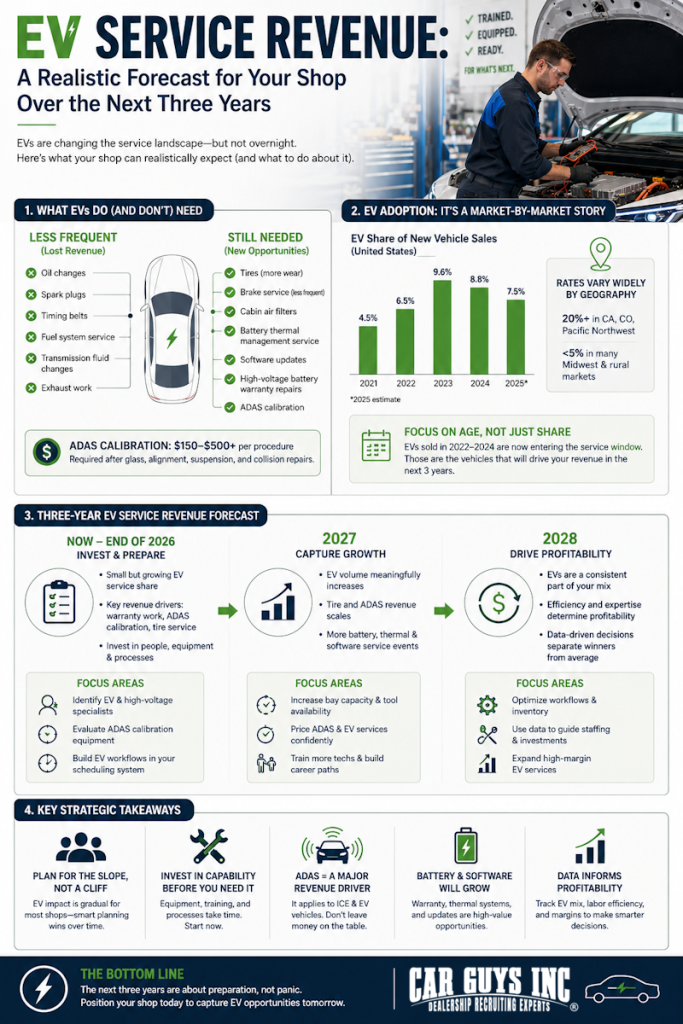
The starting point for any honest forecast is understanding the EV service menu. The loss column gets most of the attention, and it is real. Electric vehicles do not require oil changes, spark plugs, timing belt replacements, fuel system service, transmission fluid changes, or exhaust work. For a high-mileage customer who came in four times a year for maintenance, that is a meaningful reduction in visit frequency and ticket size.
The gain column is less discussed but genuinely significant. EVs still need tires, and they tend to wear them out faster due to vehicle weight and the immediate torque delivery of electric motors. Brake service intervals are longer because regenerative braking reduces rotor and pad wear, but the work still needs to be done. Cabin air filters require regular replacement. Battery thermal management systems use coolant that requires periodic service. Software updates that cannot be completed over the air require a dealer visit. High-voltage battery warranty claims, which typically run 8 years or 100,000 miles on most EVs currently on the market, can generate substantial repair orders.
The category that does not appear on most service menus but should is ADAS calibration. Every windshield replacement, front-end alignment, suspension repair, or collision-related job on a vehicle equipped with advanced driver assistance systems requires recalibration of cameras, radar units, and sensors. This applies to ICE and EV vehicles equally, and the billing rate for calibration work ranges from $150 to $500 or more per procedure, depending on system complexity. For a deeper look at the EV and ADAS skill set from a technician development perspective, see The Future of Automotive Repair: EVs, Hybrids, and ADAS.
A Realistic Picture of EV Volume in Your Market Right Now
EV adoption rates vary more by geography than most national coverage suggests. Markets in California, Colorado, and the Pacific Northwest have seen new EV registrations approach or exceed 20 percent in recent years. Midwestern and rural markets are frequently below five percent. The relevant number for your service department planning is not the national average. It is the EV penetration rate among registered vehicles in your primary service draw area, and specifically among vehicles in the three-to-ten-year age range that represent your core service mix.
As of mid-2026, the aggregate U.S. EV share of new vehicle sales has pulled back from its 2023-2024 peak, reflecting changes to federal tax incentive structures and broader affordability pressures documented in Experian’s most recent auto finance reporting. That moderation does not change the direction of the trend; it changes the timeline. In practice, this means that for most dealerships outside the highest-adoption markets, the pressure on service revenue from EV adoption is gradual rather than abrupt. You are not facing a cliff in 2026. You are managing a slope, and the decisions you make now determine whether you are positioned on the right side of it by 2028. For context on how the broader finance environment is shaping vehicle acquisition and staffing decisions, see What the 2026 Auto Finance Market Tells You About Your Next Hire.
The more important number to track is the age distribution of the EVs already in your market. The vehicles sold during the 2022-2024 adoption surge are now entering the service window where deferred maintenance, warranty claims, and tire cycles become regular revenue events. Your service department will see those vehicles whether or not you have a formal EV strategy. The question is whether you have the equipment, training, and capacity to handle them profitably.
A Three-Year Revenue Forecast, Broken Down by Year
Rather than a single projection, it is more useful to think about EV service revenue in three distinct phases, each with its own primary revenue drivers and infrastructure requirements.
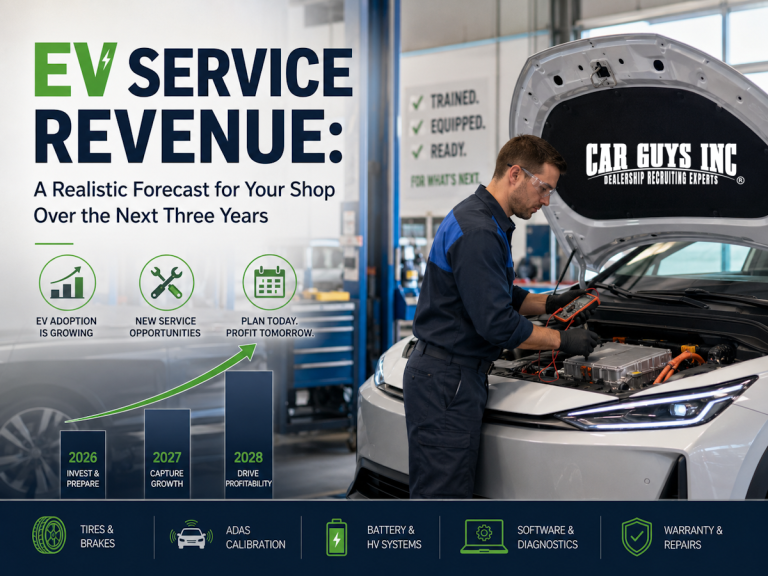
In the near term through the end of 2026, EVs represent a small but growing share of the vehicles you see. The primary revenue events are warranty work on vehicles in their first ownership cycle, ADAS calibration tied to collision and glass repair volume, and tire service. The financial impact of EV substitution on your service gross is real but manageable for most stores. The strategic actions that matter most right now are not revenue-generating yet; they are investment decisions. Identifying which of your technicians will become your high-voltage specialists, evaluating ADAS calibration equipment, and reviewing your service scheduling system for EV-specific workflows are the decisions that determine your position in 2027 and 2028.
Moving into 2027, the picture changes in two meaningful ways. First, the vehicles sold during the peak adoption years of 2022 through 2024 are now four to five years old and entering a service frequency that starts to resemble ICE patterns. Battery thermal management service, high-voltage system inspections, and warranty-period battery performance claims become recurring revenue events rather than occasional ones. Second, the dealerships that invested in ADAS calibration capabilities in 2025 and 2026 are now generating a return on that investment from a growing base of both EV and ICE vehicles requiring post-repair calibration. The stores that waited are subcontracting this work, which means they are paying another shop to do work their own customers brought to them.
By 2028, the differentiation between prepared and unprepared service departments becomes a customer retention issue, not just a revenue mix issue. EV owners who discover that their dealer cannot confidently handle a battery system diagnostic or an ADAS recalibration after a minor collision will find a shop that can. The independent EV specialists that are building capability today will have three years of EV-specific experience by then. Dealerships with OEM tooling, certified technicians, and established EV service workflows will have a meaningful competitive moat. Dealerships without them will be competing on oil changes in a market where a growing share of their service draw does not need one.
The Infrastructure Gap Most GMs Are Not Talking About
The barrier to capturing EV service revenue is not primarily a demand problem. The vehicles are there, and they need service. The barrier is infrastructure, and most of it is more manageable than the capital expense conversation suggests.
High-voltage safety certification is the non-negotiable starting point. Working on or around high-voltage battery systems without certified training creates significant liability exposure and poses a serious risk. The investment in getting one or two technicians through an accredited high-voltage awareness and safety program is modest, typically a few hundred to a few thousand dollars per person depending on the program, and it is the prerequisite for everything else. Without it, your shop cannot legally or safely handle a growing category of the vehicles coming through your lane.
OEM diagnostic tooling matters more for EVs than for ICE vehicles because proprietary software access is frequently required for battery management, charging system diagnostics, and software-related service campaigns. If your technicians are relying on generic scan tools for EV diagnostics, they are missing data the vehicle generates, and the OEM expects to be reviewed during service. This is not a vendor recommendation; it is a workflow reality that affects both diagnostic accuracy and warranty claim outcomes.
ADAS calibration equipment is where the investment case is clearest for most dealerships. The capital cost of a professional calibration target system ranges from roughly $5,000 to $30,000 depending on the platform and capability level. At an average of $200 per calibration procedure and even modest volume tied to your existing collision and alignment work, the payback period is measured in months, not years. The obstacle is not the economics. It is that most service directors have not modeled the opportunity because the revenue is currently leaving the building without appearing on a report. For more on how service department profitability metrics should be read and improved, see 5 KPIs Every Service Manager Should Track.
Where the Real Opportunity Is for Most Dealerships Right Now
For the majority of dealers outside the top EV adoption markets, the three-year revenue story is less about replacing lost oil-change volume and more about capturing work that is already coming in but is being handled poorly or not at all. Two categories stand out.
ADAS calibration is the most immediate opportunity and offers the fastest payback. Every vehicle in your service lane with a camera or radar-based safety system generates a calibration event after certain repairs. Most dealerships are either skipping the calibration step, which creates liability exposure and warranty complications, or subcontracting it to a glass or calibration specialist. Neither outcome is good for your service gross or your customer relationship. Building in-house calibration capability, training your alignment and glass technicians to identify when calibration is required, and adding calibration to your service write-up process are revenue-capture improvements that do not depend on EV volume growth at all.
The second opportunity is EV customer acquisition from owners who bought their vehicle elsewhere. A meaningful percentage of EV owners in most markets did not purchase from a franchised dealer in your brand family. They bought from a competing OEM, a used vehicle marketplace, or a private seller. Many of them are currently underserved by the independent shop network, which has been slow to invest in HV certification and EV tooling. A dealership that clearly communicates it can service any EV, not just the brands it sells, and has the certified technicians and equipment to back that claim, can capture service revenue from a customer base it never sold a vehicle to. That is incremental fixed ops gross with no floorplan cost attached. For context on the staffing side of this opportunity, see The Aging Technician Workforce.
The dealers who will be best positioned in 2028 are the ones making deliberate infrastructure and staffing decisions today, not because the volume demands it yet, but because the lead time on certified technicians, calibration equipment, and OEM tool access is long enough that waiting for the volume to arrive means being 18 months behind when it does.
Staff Your Service Department for the Shop You Are Building
Infrastructure and staffing decisions for EV service are inseparable. High-voltage certification, ADAS calibration workflow, and battery diagnostic capability all require technicians with the right training and mindset to execute them consistently.
CarGuys Inc. works with over 800 dealerships to find the certified, experienced technicians that fixed ops departments need, with no headhunter fees, qualified candidates within 24 to 48 hours of launch, and the Dealer Dash ATS built for the way automotive hiring actually works.
If you are building toward a service department that is ready for 2027 and 2028, see how we can help you find the people to staff it.


If you want to improve technician recruiting, quantify technician turnover, staffing shortages, empty-bay loss, labor-rate strategy, and service department profitability, visit our Service Department Calculators Hub.