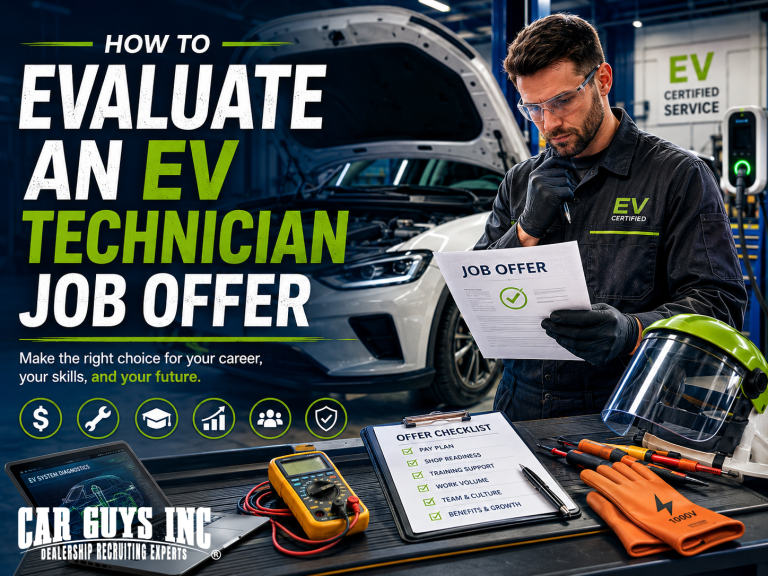
An EV technician job offer now differs significantly from what it was five years ago. EV Technology has advanced, shops vary in EV readiness, and compensation structures are less predictable. Choosing the wrong shop can leave you without proper tools, training, or enough EV work to build skills. Declining the right shop could mean missing a pivotal career opportunity.
At CarGuys Inc., we see automotive technicians make these choices every day. This post explains what to consider, ask, and watch for before you accept any EV technician job offer.
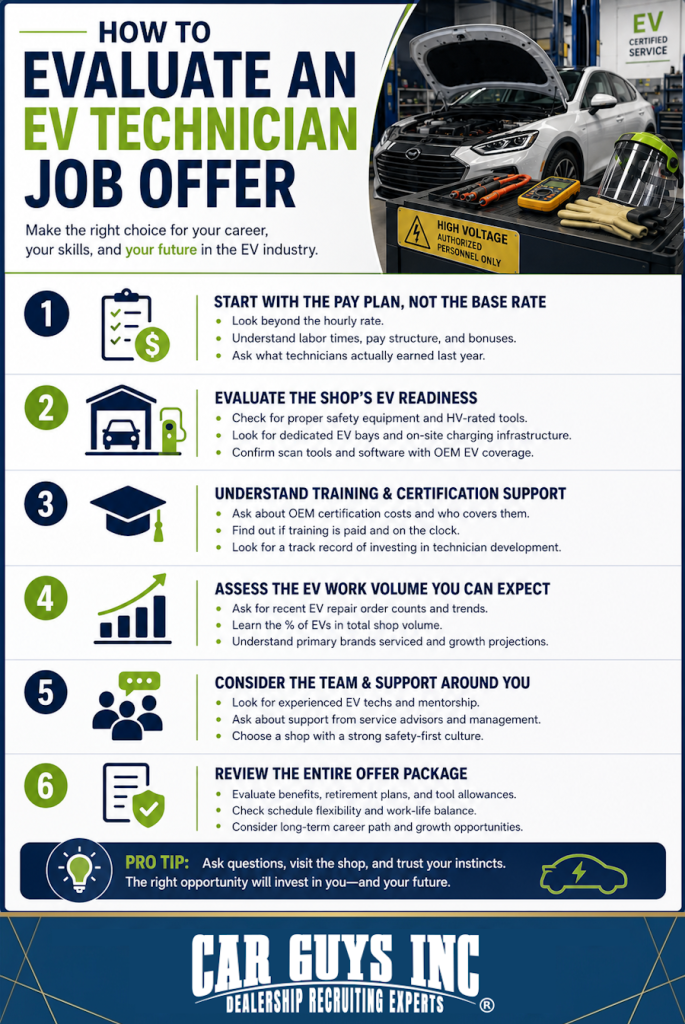
Start With the Pay Plan, Not the Base Rate
The hourly rate or salary in an EV technician offer is just the base. EV work uses different labor time standards than combustion repair, and each shop’s method affects your actual earnings.
Ask these questions before accepting:
- Are EV diagnostic and repair jobs flagged at full book time, or does the shop discount them because they are still figuring out the labor times?
- Is there a flat rate structure, hourly guarantee, or hybrid model? A flat rate at a shop with low EV volume can significantly hurt your weekly hours.
- Does the pay plan include bonuses tied to certifications, customer satisfaction, or productivity? Some shops building out their EV departments use certification bonuses to reward technicians who invest in training.
- What did technicians in this role actually earn last year? Request examples, not projections.
EV work is expanding, but labor time standards are still evolving. Understanding how a shop prices this work reveals its commitment to the EV department.
Evaluate the Shop’s EV Readiness, Not Just the Job Description
A job posting can label a role ‘EV technician’ when the shop has only serviced a few connected cars recently. This differs greatly from a dealership or independent shop that has invested in the right infrastructure, tools, and training for serious EV service.
During the interview or site visit, look for:
- High-voltage safety equipment: proper PPE, insulated gloves rated to 1000V, HV-rated tools, and lockout/tagout procedures that are posted and practiced.
- Dedicated EV bays: shops serious about EV work designate specific bays with appropriate electrical capacity and clearances. Sharing a standard lift with ICE work signals they are not fully committed.
- DC fast chargers or Level 2 charging infrastructure on-site: service bays that cannot charge vehicles they are supposed to service are limited in what they can diagnose and verify.
- Scan tools and software with OEM EV coverage: generic scan tools do not access the full diagnostic capability on most EV platforms. Ask what tools the shop runs and whether software subscriptions are current.
A good job description is meaningless if the shop lacks the physical setup. Touring the service bays often reveals more than extended conversation.
Understand What Training and Certification Support Is on the Table
EV training is crucial in such roles. Technology changes fast, certifications affect both income and safety, and training is expensive. How a shop invests in training shows if they value you as an asset or a mere fill-in.
Ask specifically:
- Does the shop cover the cost of OEM EV certifications? These can run from a few hundred to well over a thousand dollars depending on the brand and level.
- Is training done on the clock or on your own time? Being asked to complete mandatory certification on your days off without compensation is a red flag.
- What is the expected timeline to complete EV certification, and what happens to your pay during the training period if you are not yet certified for certain repair categories?
- Has the shop sent technicians to OEM training programs in the past 12 months? Ask by name if possible. Shops that are genuinely investing in EV capability have a track record of doing so.
Technicians who earn and maintain EV certifications qualify for higher pay and greater job security as the market evolves. A shop that supports this with real training follows a long-term strategy, not just a job title.
How to Get Started as an EV Technician
Assess the EV Work Volume You Can Actually Expect
Many overlook this question. A shop with three weekly EV work orders is very different from one with thirty. Volume matters for your flat-rate income and your skill growth as an EV technician.
To understand real volume:
Ask how many EV-specific repair orders the shop completed last month and the month before. Seasonal variation exists, but the trend line matters more than any single month.
- Find out what percentage of the shop’s overall car count is EV or plug-in hybrid. A shop where EV represents 5% of volume today may be betting on growth or simply overstating its EV presence.
- Ask what brand or brands of EVs the shop primarily services. Technicians specializing in one OEM’s EV platform develop deep expertise faster, but limiting yourself to one make carries risk if that brand’s sales volume shifts.
- Find out whether the shop is an authorized service provider for any EV brands. Authorized service centers tend to see more warranty work, which keeps volume steadier and supports investment in proper tooling.
Low EV volume can be acceptable if the shop is in a high-growth area with solid infrastructure. But you need this information to know what your first 12 to 18 months will involve.
Read the Career Growth Signal Carefully
EV technician roles are changing quickly. The shop you join can either boost or stall your career, based on its real commitment to building EV expertise. Understand where the role leads before accepting.
Ask the service manager or fixed ops director:
- How many EV-certified technicians does the shop plan to have in 12 months? A concrete answer with a plan behind it signals real commitment. A vague answer signals they are reacting, not planning.
- Is there a lead technician or EV specialist role above this position? Understanding the next step on the ladder matters.
- How does the shop handle it when a senior technician transitions a lot of EV diagnostic work to their own ticket? Shops with strong culture encourage mentorship. Shops with weak culture create internal competition that limits your development.
Compare what you learn here against what you already know about compensation. The same framework applies: base rate, benefits, growth path, and culture all factor into whether an offer is actually good, or just looks good on paper. Key takeaway: Weigh growth prospects, benefits, and culture alongside compensation when evaluating offers.
Know What to Negotiate and How to Do It
After your research, negotiate with facts, not guesses. EV technicians with certifications or relevant experience have real leverage in the current job market. Use it wisely.
Reasonable items to negotiate include:
- A sign-on bonus that offsets lost income during training or transition from a previous role.
- An accelerated review timeline tied to certification completion, with a defined pay increase attached.
- A training and tool allowance if the shop is asking you to bring specialty EV tools or expects you to fund your own certifications upfront.
- A guaranteed minimum hours commitment if the role is flat rate and EV volume is lower than you would prefer.
Be specific. Asking to revisit rate after 90 days if you complete Level 2 certification is reasonable. Requesting a signing bonus due to required training is also fair. Avoid vague requests for higher pay without clear reasons.
CarGuys Inc. matches skilled auto professionals with shops nationwide using smart technology. We focus on fit, timing, and transparency. Upload your resume once; we notify you of real opportunities. No noise, no pressure, just the right job at the right time.