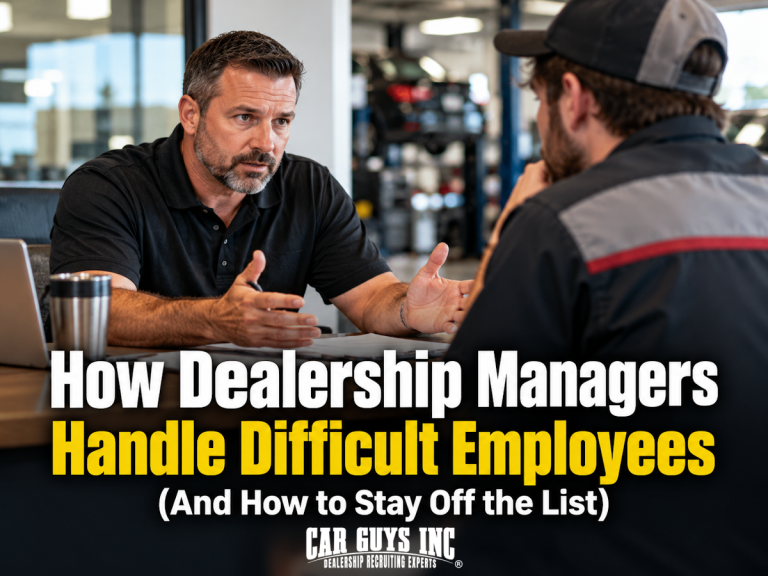
Every dealership has at least one. The tech who argues every warranty job with dispatch. The salesperson who skates past the ups they don’t like. The advisor who is great with customers and impossible with everyone in the shop. If you’ve been in the business long enough, you’ve probably wondered how managers handle difficult employees: who gets coached, who gets tolerated, and who gets walked out on a Tuesday afternoon.
At CarGuys Inc., we talk with service managers, sales managers, and GMs every day about the people on their teams, and the difficult employee conversation comes up constantly. Knowing how that process works from the other side of the desk does two things for your career: it keeps you off that list, and it helps you raise real concerns without getting labeled a problem.
What “Difficult” Actually Means to a Dealership Manager
Most employees assume “difficult” is about personality. It rarely is. A manager can work with someone quiet, blunt, or a little rough around the edges. What gets someone tagged as a difficult employee is behavior that costs the store money, customers, or teamwork.
In the service department, that looks like refusing or slow-walking warranty work, fighting the advisor on every RO, comebacks that never get owned, or a tech who drags the whole shop’s mood down. On the sales floor, it’s cherry-picking ups, ignoring the CRM, arguing with the desk in front of customers, or bad-mouthing the dealership on the lot. In every department, it’s chronic lateness, gossip, and the person who turns every policy change into a group complaint session.
Notice what’s missing from that list: asking questions, disagreeing respectfully, or pushing for better pay. Those are not what make someone difficult. How and where you do them is what makes the difference, and we’ll get to that.
How Managers Handle Difficult Employees, Step by Step
A single-point store won’t have the same HR structure as a 20-rooftop group, but most dealership managers follow a similar progression.
The informal conversation. It usually starts with a pull-aside: “Hey, I need you to stop arguing with the advisors on the drive.” It feels casual. It isn’t. It’s the first step in a process, and your manager is now paying attention.
Documented coaching. If the behavior continues, the next talk happens in the office, and the manager writes it down. Signed or not, it’s in your file.
The written warning. This is the formal version, often with HR or the GM copied. It spells out the behavior, what needs to change, and what happens if it doesn’t.
The performance improvement plan. Larger groups often use a PIP with specific goals and a deadline, like a CSI target, an efficiency number, or attendance requirements. Some managers use a PIP to develop people; others use it to build a paper trail. The amount of support that comes with it tells you which one you’re on.
Separation. If nothing changes, the final step is a termination or a quiet push toward the door through fewer hours, worse dispatch, or a smaller share of the ups.
The key point for you as an employee: by the time you notice a formal step, your manager has usually been frustrated for weeks. The informal conversation is the cheapest place to fix it.
Why Top Producers Get More Rope, and Why It Runs Out
Managers don’t handle every difficult employee the same way. The A-tech flagging 60 hours a week and the salesperson leading the board in front-end gross get more patience than the new hire with the same attitude. That’s not fair, but it’s real, because replacing a top producer is expensive and slow.
That extra rope has a limit, and it’s shorter than most top performers think. Managers eventually do the math on what one person is costing them: advisors who won’t work with that tech, newer salespeople who quit because of the culture, CSI scores that drop every time that name is on the RO. When the cost of keeping someone passes the cost of replacing them, the decision gets made quickly.
And the reputation follows you. The auto industry is smaller than it looks. Service managers know service managers. Sales managers move between stores. When someone calls for a reference, “great numbers, tough to manage” is often enough to cost you the offer. What hiring managers really discuss after your interview is frequently whether you’ll be easy or hard to work with, not just whether you can do the job.
Signs Your Manager Sees You as a Difficult Employee
Most people don’t get told directly. Instead, the signals show up in how work and communication change. Watch for these:
- Your manager’s tone shifts from casual to formal, or conversations suddenly happen behind a closed door.
- Requests and expectations start arriving by email or text instead of in person, which creates a written record.
- On the shop side, your dispatch quietly changes. Fewer customer-pay jobs, more warranty and diag time, and your flagged hours start slipping.
- On the sales floor, you get fewer ups, worse schedules, or are left off training and spiffs.
- You’re asked to “just sign this” acknowledging a conversation you thought was informal.
If you’re seeing more than one of these, don’t wait. Ask for a private conversation and ask the question directly: “Is there something about how I’m working that you want to see change?” Managers respect it, and it often stops the process before it reaches paper.
Then follow through. A reset only works if the behavior actually changes, and the habits in 10 Habits of High-Performing Automotive Employees are a good checklist for what managers want to see.
How to Raise Real Concerns Without Being Labeled Difficult
Dispatch isn’t always fair. Pay plans change. Some managers play favorites. Speaking up about those things is reasonable. How you do it determines whether you’re seen as someone who cares about the store or someone who’s a problem.
Take it private. Complaining on the shop floor or in the sales tower turns a concern into a morale problem. Bring it to your manager one-on-one.
Bring facts, not feelings. “I feel like I’m getting the bad jobs” is easy to dismiss. “Over the last four weeks, 70 percent of my ROs were warranty, and my effective rate dropped by six dollars” is a conversation a manager has to take seriously. If you’re on flat rate, understanding how flat rate pay works helps you make that case with real numbers.
Pick your timing. Don’t ambush a service manager at 7:30 on a Monday with a full drive, or a sales manager on the last day of the month. Ask for a few minutes when things are calm.
Offer a solution. The employee who brings a problem along with a possible fix stands out immediately.
The same approach works for pay. If you think you’re underpaid, there’s a right way to make that case, and our guide on how to ask for a raise at a dealership walks through it step by step.
When the Difficult Employee Is Someone Else
Sometimes you’re not the problem; you’re stuck working next to it. A coworker who steals deals, leaves comebacks on your RO, or makes every shift miserable affects your income and your sanity.
Start by keeping your own conduct clean. Don’t match their behavior or vent about them to the rest of the team; that puts you in the same category. If it’s affecting your work, keep simple notes with dates and specifics, then bring it to your manager framed around the business impact: lost hours, customer complaints, or deals that went sideways. Managers act on problems they can measure.
If management won’t address it, or the difficult person is the manager, that tells you something important about the store. A dealership that tolerates bad behavior long term usually has bigger culture issues, and those are among the clearest signs it’s time to leave your current shop. Before your next move, research the dealership before you apply or interview so you know how they treat their people before you’re one of them.
Protect Your Reputation and Your Career
Understanding how dealership managers handle difficult employees takes the mystery out of a process that catches many good people off guard. Respond to the informal conversation as it matters, because it does. Raise concerns privately and with facts. Don’t count on your production numbers to cover for attitude forever. And if you’re surrounded by a culture that won’t fix its own problems, know that you have options. Your reputation goes with you to every store you work for, so treat it like your best tool.
CarGuys Inc. connects skilled automotive professionals with dealerships and repair shops nationwide through intelligent matching technology. Instead of flooding candidates with irrelevant openings, we focus on fit, timing, and transparency. Upload your resume once, and we’ll notify you when a matching opportunity arises. No noise. No pressure. Just the right opportunity at the right time.