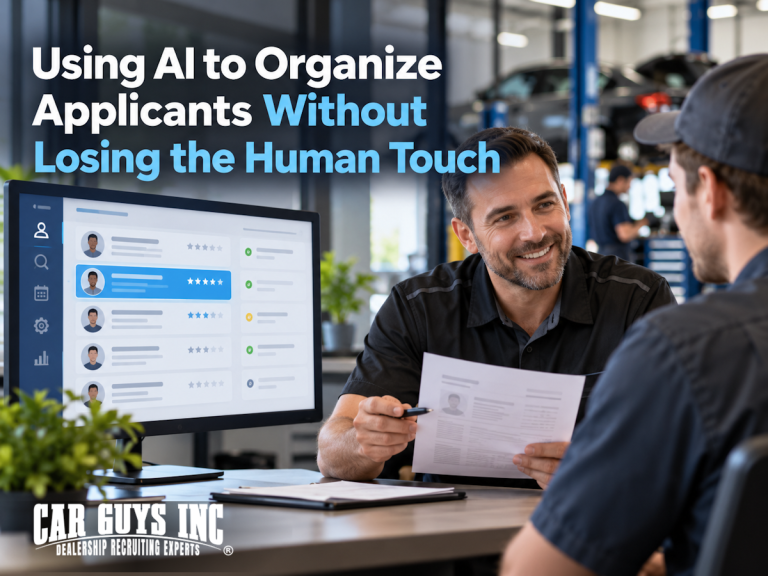
Most dealerships don’t have an applicant shortage as much as an applicant organization problem. Resumes arrive from three job boards, the website, a Facebook ad, two employee referrals, and the tech who walked in the back door on a Saturday. Using AI to organize applicants can bring order to that mess; used carelessly, it also turns your store into one more faceless auto-reply in a candidate’s inbox.
At CarGuys Inc., we work inside the hiring processes of dealerships and repair shops nationwide, and the stores that get this right share one habit: they let AI keep every applicant accounted for, and they make sure their managers keep every applicant feeling noticed. Here’s how to build both into the same process.
Why Applicant Disorganization Costs Dealerships Good Hires
A disorganized applicant flow never shows up as a line item. It shows up as a bay that stays empty six weeks longer than it should, or a service advisor desk covered by a manager who ought to be watching the drive. When nobody owns the applicant list, three things happen predictably.
First, good candidates sit. A qualified technician application that waits four days for a reply is usually a lost candidate, because the strongest people in the market don’t stay on it long. Managers routinely underestimate how often dealerships lose great candidates in under 72 hours.
Second, managers spend time on the wrong resumes. Without consistent sorting, a service manager opens applications in the order they arrived, not the order they matter. That’s why resume filtering costs dealership managers time they don’t have between ROs, warranty claims, and the morning rush.
Third, history disappears. The runner-up from last spring’s shop foreman search, the lube tech who wanted a shot at a B-tech role, the advisor who wasn’t ready then but would be now; if those people live in a deleted email thread, every search starts from zero. If you want to put a number on that delay, the Empty Bay Revenue Loss Calculator shows how quickly lost billable hours add up while a position sits open.
What to Automate When Using AI to Organize Applicants
The best use of AI in applicant management is the work no manager should be doing by hand:
- Consolidating every source into one list. Job board applicants, website submissions, referrals, and walk-ins should land in the same place, tagged by source so you can see which channels actually produce hires.
- Parsing and tagging qualifications. ASE certifications, OEM training levels, diesel or EV experience, years on flat rate, DMS experience for advisors, F&I licensing for finance candidates; AI can pull these off a resume so a manager can sort in seconds.
- Catching duplicates and returning applicants. The same technician applying through two boards shouldn’t show up twice, and someone who applied eight months ago should be flagged, not treated as a stranger.
- Moving candidates through clear stages. New, reviewed, contacted, interviewing, offer, hired, not selected. Every applicant should have a status, and nobody should sit in “new” for more than a day.
- Handling scheduling logistics. Letting a candidate pick an interview slot from the manager’s real calendar removes two days of phone tag.
Set up well, automated applicant tracking saves dealerships time in exactly the places managers resent most. The goal isn’t to have software make hiring decisions; it’s to make sure a decision-maker sees every qualified candidate quickly, with the relevant details already in front of them. For a wider view of which hiring stages AI belongs in, see how AI should and shouldn’t be used in recruiting.
Rank Applicants with AI, but Don’t Let It Quietly Reject Them
The fastest way to lose the human touch is to let organizations slide into elimination. An AI ranking that moves a candidate down the list is useful. A filter that removes them from view entirely is a risk, because resumes are imperfect. The tech who writes “Chevy line tech, 9 years” may never use the exact phrase your criteria look for, and a strong advisor from a high-volume independent shop may not carry the dealership job titles the system was told to prefer.
A few rules keep sorting honest:
- Let managers set the criteria. The service manager knows whether a missing A8 certification matters for this opening; the software doesn’t.
- Rank, don’t auto-reject. Keep low-scoring applicants visible and have someone scan the bottom of the list once a week. It takes ten minutes and regularly turns up a candidate the algorithm misread.
- Separate “not now” from “not ever.” A candidate who wasn’t right for this opening may be perfect for the next one. Tag them for your pipeline instead of closing the file.
That last rule matters more than most stores realize. Managers who recruit every week, instead of only when someone quits, usually draw from a well-organized bench of past applicants. AI makes that bench searchable; someone still has to keep it warm. And when it’s time to choose between finalists, a ranked list is a starting point, not an answer. A structured interview scorecard is still what separates the strongest candidate from the best-written resume.
Where the Human Touch Belongs in the Dealership Hiring Process
Automation is very good at sending messages. It is not good at making someone feel wanted, and in a tight labor market, feeling wanted is often what wins the hire. A technician with three offers compares how each store treated him, not just the flat rate each one pays. Build human contact into specific points:
- A real person within one business day. An automated confirmation is fine the moment someone applies, but a qualified candidate should hear from an actual person, by phone or a personal text, within a day.
- Templates written in a real voice. Write automated messages the way your service manager actually talks, sign them with a real name, and include a direct number. “This is Mike, the service manager” lands differently than “Your application has been received.”
- Hiring managers involved early. For an A-tech or a proven closer, the first call should come from the person they’d work for, not a coordinator reading a script.
- Closing the loop. Every candidate who interviews should hear the decision from a person. The ones told “not this time, but let’s stay in touch” become next year’s pipeline.
These moments are what creating a better candidate experience in dealership hiring looks like on an ordinary Tuesday. AI should give managers the time and the reminders to make these touches; it should never stand in for them.
Assign Ownership So Organized Applicants Get Hired Faster
Even a perfectly organized applicant list fails if nobody owns it. The dealerships that move fastest tend to share a simple rhythm:
- One owner per open role, usually the department manager, with a named backup for days off.
- A ten-minute review of new applicants every morning, before the drive opens or the sales meeting starts.
- Response standards everyone knows: qualified applicants contacted within 24 hours, interview feedback within 48.
- A weekly pipeline check: applicants per role, how many were contacted, and where candidates are stalling.
None of this is complicated, and that’s the point. When you look at why some dealerships hire faster than you do, the answer is usually process discipline, not a bigger budget. AI handles the sorting, reminders, and status tracking that make the rhythm sustainable; the manager handles the conversations that turn applicants into employees.
Key Takeaways
Using AI to organize applicants is one of the most practical upgrades a dealership can make to its hiring process. Let the technology consolidate sources, tag qualifications, track status, and handle scheduling. Keep people in charge of the criteria, reviewing what the system ranks low, the first real conversation, and the final decision. The result is a process that runs faster and more consistently without feeling automated to the technician, advisor, or salesperson on the other end. Organized applicants get contacted sooner, and contacted applicants who feel valued are the ones who say yes.
CarGuys Inc. is an automotive recruiting company built exclusively for the car business. From technicians and service advisors to salespeople and managers, we connect dealerships and repair shops with qualified talent faster, using nationwide reach and years of hands-on experience.
With over 700 clients and thousands of hires, we don’t just fill positions; we help build stronger teams that foster long-term success.