Ten years ago, a windshield replacement was a glass job and nothing else. Today, on most late-model vehicles, that same job isn’t finished until a camera behind the mirror gets recalibrated, and getting that step wrong can mean a lane-keep system that nudges the wheel at the wrong moment. That single change previews where the rest of the industry is headed, and it’s why more technicians are asking whether ADAS calibration is a skill worth learning now instead of waiting to be told it’s required.
The honest answer is yes, and the technicians who move first will be the ones setting the terms, not catching up to them. ADAS calibration technician work didn’t exist at scale a decade ago. It exists now because the vehicles rolling into every dealership and repair shop are loaded with cameras, radar units, and sensors that don’t tolerate being ignored after a repair, and somebody in that shop has to know how to put them back to spec.
What ADAS Calibration Actually Involves
Advanced driver assistance systems, forward collision warning, automatic emergency braking, lane-keep assist, adaptive cruise control, blind-spot monitoring, all rely on cameras and radar sensors that are calibrated to a precise position relative to the vehicle. Anything that shifts that position even slightly (a windshield replacement, a bumper repair, a suspension job, a wheel alignment, a sensor swap) can throw the system out of spec, and most OEMs are explicit that calibration isn’t optional after that kind of work.
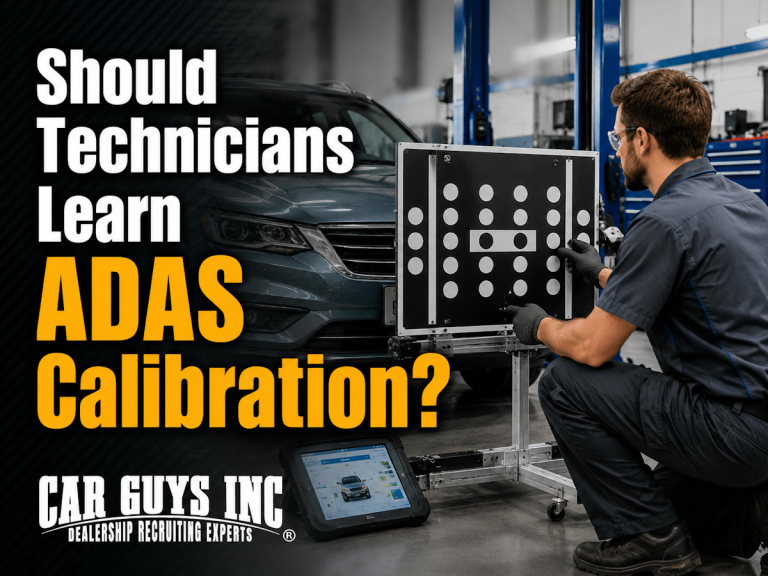
There are two broad approaches to the job. Static calibration happens in a controlled bay, with target boards and measured distances set up around the vehicle while a scan tool walks the system through its calibration sequence. Dynamic calibration happens on the road, with the vehicle driven at a specified speed while the scan tool confirms the system has relearned its surroundings. Plenty of vehicles require both in sequence, and knowing which procedure a given repair calls for, and confirming it actually completed instead of just started, is most of what separates a technician who’s good at this from one who’s just going through the motions.
None of this is exotic knowledge reserved for engineers. It’s procedural, it’s scan-tool-driven, and it rewards the same traits that make someone a strong technician in general: patience, attention to sequence, and a refusal to skip steps because the car “seems fine.” What’s changed is that this procedural work is now a line item on far more repair orders than it used to be, which is exactly why the shift toward EVs, hybrids, and ADAS is reshaping what repair work even looks like across the industry, not just in specialty shops.
Where This Work Is Already Showing Up
Collision repair is where ADAS calibration shows up most often, and it’s no longer a small corner of the business. A bumper repair used to be a body and paint job; now it often comes with a radar sensor that needs to be recalibrated before the car is safe to hand back to the customer. That’s part of why collision repair keeps ranking as one of the more resilient career paths in this industry: the work has gotten more technical, not less relevant.
It’s not limited to collision, either. General repair and maintenance shops run into it constantly, since a routine alignment or suspension job on a newer vehicle can trigger the same calibration requirement as a crash repair. And technicians building toward EV and electronics-focused specialties are finding that ADAS calibration is already listed as a core responsibility in those roles, not an optional add-on. A technician who can calibrate a forward-facing camera and a radar sensor confidently is useful in more bays than one who can’t, regardless of what that shop’s specialty happens to be.
What It Does for Pay and Career Path
Calibration work carries a premium because it requires equipment most shops haven’t fully invested in yet and training most technicians haven’t gone through yet. Shops are already billing $150 to $400 per calibration procedure, and a technician who can perform that work reliably is doing something a shop can’t just assign to whoever’s free that hour. That scarcity is what drives the pay difference, not the difficulty of the individual repair.
For a technician paid on flat rate, that matters directly. Understanding how flat rate pay actually works means understanding that book time on a calibration procedure reflects real, billable labor, not a favor the shop is doing you. A technician who’s the only one in the building who can complete a calibration correctly has more control over his flagged hours than one competing with three other people for the same routine jobs.
It also opens a path upward that has nothing to do with waiting for someone above you to retire. Shops evaluating candidates for shop foreman and lead technician roles are increasingly looking for someone who can own the diagnostic and calibration work the rest of the team can’t, not just someone with the most seniority. The same framework used to evaluate an EV technician job offer, looking past the base rate to ask whether the shop actually has the equipment, the training support, and the work volume to back up the offer, applies just as directly to a calibration-focused role. A shop that talks about ADAS work but doesn’t own a target board or a dedicated calibration bay isn’t offering the opportunity it sounds like it is.
Deciding Where to Learn It
Not every shop is equally positioned to teach this. Calibration equipment, target boards, alignment racks, and OEM-specific scan tools represent a real investment, and dealerships and independent shops tend to make that investment on very different timelines. A franchised dealership often has OEM-backed training and equipment already in place, which can mean a faster, more structured path to learning calibration work. An independent shop that’s serious about staying competitive may be building that capability from scratch, which can mean more hands-on exposure sooner, but only if the shop is actually committing the money and the time to do it right.
Either path can work. What matters is asking direct questions before assuming a shop will teach you this on the job: does the shop own calibration equipment or send that work out, is training covered on company time or expected on your own, and how much of the current calibration workload goes to one or two technicians versus being spread around so more people build the skill. The broader case for choosing a technician career in the first place still holds here: the shops worth working for are the ones investing in what their technicians can do, and calibration capability is one of the clearest signals of that investment right now.
Getting Started Without Waiting to Be Asked
You don’t need your current shop’s permission to start building this skill, and waiting for a formal training program is usually the slower path. OEM-specific certification programs, I-CAR’s ADAS calibration curriculum, and manufacturer training portals are all accessible to working technicians, and shops that see a technician pursuing that training on his own initiative tend to notice. The habits that separate high-performing automotive employees from everyone else usually include exactly this: building a skill before it’s required, not scrambling to learn it after a shop makes it mandatory.
The timing case here is straightforward. This is already one of the better moments in years to build a career as a technician, and calibration is one of the clearest ways to separate yourself in that opportunity instead of blending into it. The window for being an early mover on this skill is still open, but every year more technicians get trained on it, and the premium that comes with being one of the few who can do it competently narrows a little more each year it goes unaddressed.
Where This Leaves You
Learning ADAS calibration isn’t a bet on a niche skill that might not pay off. It’s a bet on where the vehicles already are, since the cameras and radar units driving these systems aren’t going away, and every one of them needs a technician who knows how to keep them working correctly after a repair. The technicians treating this as core knowledge instead of an optional extra are the ones who’ll have the most leverage over their pay and their next role for years to come.
You don’t have to have this all figured out before you start being findable to the recruiters and shops actively looking for technicians with these skills. Building the skill is the part that’s actually in your control; being ready when the right opportunity notices you is what comes next.
CarGuys Inc. connects skilled automotive professionals with dealerships and repair shops nationwide through intelligent matching technology. Instead of flooding candidates with irrelevant openings, we focus on fit, timing, and transparency. Upload your resume once, and when a matching opportunity arises, you will be notified. No noise. No pressure. Just the right opportunity at the right time. If you’re building specialized skills like ADAS calibration, our job board is a good place to make sure the right shops can find you.