

A shop foreman or lead technician role can seem like a sensible next step in an automotive career. It often sounds like a promotion: more respect, influence, and pay. Sometimes it is. Other times, it just means more responsibility for a busy technician, without enough pay, support, or authority to make it worthwhile.
To make the best move, shift your focus from just the title to the full offer. This step lays the groundwork for an in-depth examination of what each shop foreman or lead technician role entails.
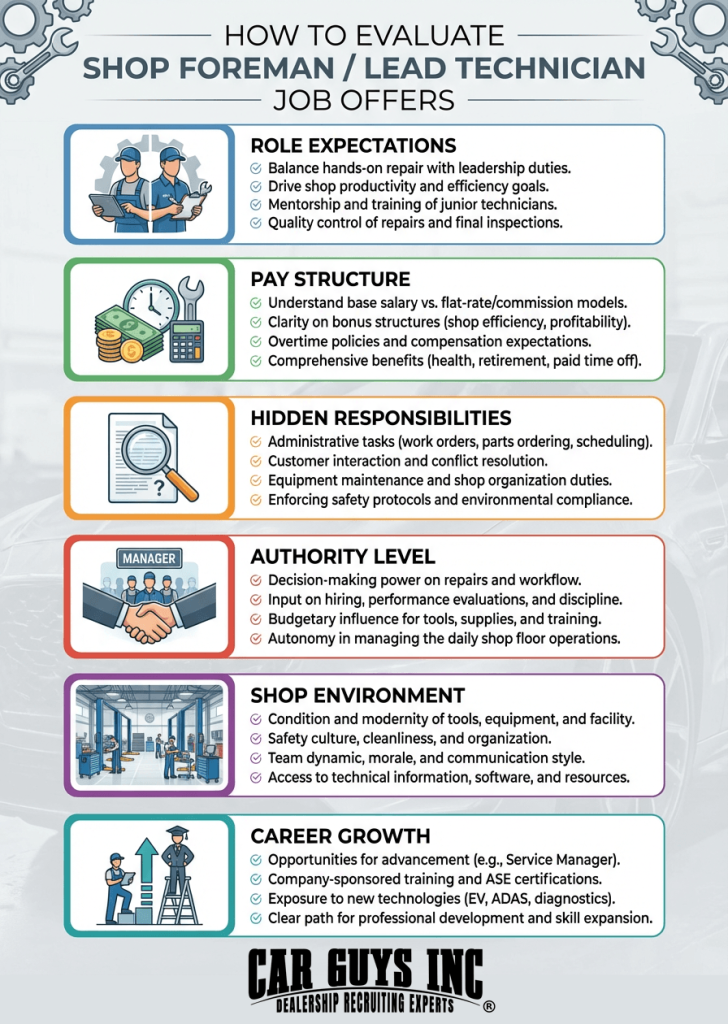
In many shops, a foreman or lead technician does far more than diagnose and repair vehicles. The role may involve helping other technicians solve problems, reducing comebacks, improving workflow, supporting quality control, and acting as a bridge between the shop and management. These duties can add career value, but can also hurt your production, raise stress, and lower earning potential if the pay plan isn’t structured well.
A better title does not automatically mean a better opportunity. Before accepting a shop foreman or lead technician offer, clarify exactly what the role entails and confirm that the full compensation and benefits package align with your needs. The key takeaway: evaluate substance, not just the title or promise.
Understand What the Role Actually Includes
A common mistake is assuming ‘shop foreman’ and ‘lead technician’ mean the same everywhere. They do not.
In one shop, the role may make you the top diagnostic tech and go-to for stuck technicians. In another, you may help with dispatch, mentor junior techs, check repairs, answer advisor questions, and keep work moving. Sometimes the job mixes production and informal management.
That’s a major difference, especially if the pay plan doesn’t account for extra time and pressure.
Before accepting, make sure you understand the employer’s daily expectations. Ask if you must maintain strong personal production while helping others. Determine if your day includes troubleshooting, training less experienced techs, or handling shop slowdowns. Ask whether you will check quality, coordinate workflow, or communicate with advisors and managers.
A clearly defined role helps you decide if the opportunity matches your needs, reduces risk, and sets you up for success.
Evaluate the Pay Structure, Not Just the Pay Rate
Compensation is one of the most important parts of any job offer, but it matters even more in a foreman or lead technician role because the job often includes duties that reduce your personal billable time.
A pay increase may look good at first glance, but the real question is whether it reflects the full value of what you are being asked to do.
Some lead technician and foreman offers are built around a higher flat rate. Others may include hourly pay, salary, performance bonuses, or a foreman premium layered onto production. The exact structure matters because a technician who spends a large part of the day helping others may not be able to flag hours at the same pace as one focused solely on their own work.
If you are expected to solve advanced diagnostics, answer questions, support shop workflow, prevent comebacks, and mentor junior techs, your pay plan should reflect more than just the number of hours you personally turn in. Otherwise, you may end up carrying more liability while earning less than you expected.
A strong offer should recognize both your production value and your leadership value. If the employer wants both, the compensation plan must support them.
Watch for Hidden Responsibilities That Cut Into Your Income
This is where many foreman and lead technician jobs lose their appeal.
On paper, the job may look like a clear step up. In reality, it can mean a day full of interruptions while you are judged by production standards as if you work only on your tickets.
That is a problem.
A lead technician may be asked to assist with difficult drivability issues, verify diagnoses, help newer technicians avoid mistakes, answer service advisors’ questions, prevent comebacks, and step in whenever workflow breaks down. All of those tasks bring value to the shop. However, they also consume time that could otherwise be devoted to billable repair work.
If responsibilities cut into your billable hours and the pay plan does not offset lost productivity, reconsider accepting the offer.
This is a key point before accepting. Ask if added responsibility is truly recognized, or if management expects you to absorb extra pressure just for the title.
Make Sure Responsibility Comes With Real Authority
A foreman or lead technician role can become frustrating very quickly when it involves responsibility but not authority.
Many employers want lead techs to raise standards, guide the team, improve repair quality, and solve recurring problems. That sounds reasonable until you realize you may not have the power to influence the underlying problems.
For example, are you expected to boost shop productivity without input on workflow? Are you responsible for quality but unable to address repeated mistakes or training gaps? Are you to mentor techs while management ignores your feedback on skill gaps, bad habits, or process failures?
If you lack authority alongside responsibility, stress may outweigh rewards. Ensure your input will change outcomes.
A better opportunity matches responsibility with real trust. This doesn’t mean full management authority, but your judgment should matter. If you are to help lead and improve the shop, your input should count.
Evaluate the Shop Environment Before You Accept
A skilled technician can still struggle in a bad environment. That is especially true in a lead role.
Even a good paycheck may not be worth it if the shop is disorganized, turnover is high, parts support is weak, advisors communicate poorly, or management lacks consistency. In such cases, the lead technician often has to hold everything together.
That may sound flattering at first, but it can become exhausting over time.
Pay attention to the overall operation. Look at team skill, dispatch consistency, parts support, and advisor communication. Check if the shop has the needed tools, equipment, and information. Notice if management is stable and whether problems are addressed or simply passed off to the most capable person.
A lead role in a well-run shop is a great move. In a disorderly one, it feels like endless cleanup.
Ask How Success Will Be Measured
A strong employer should be able to explain what success in the role looks like.
That sounds simple, but many foreman and lead technician positions are surprisingly vague. Management may say they want someone who can lead the team, improve the shop, solve problems, and maintain high quality, but without definitive metrics, those expectations can shift constantly.
That is risky.
Before accepting the offer, ask how your performance will be evaluated:
| Personal flag hours? | Diagnostic correctness? | Cycle time? | Technician development? |
| Shop productivity? | Comeback reduction? | Repair quality? | A combination of those factors? |
Look for clear, measurable expectations. This helps you determine if you can achieve success and fair compensation.
The more defined the expectations are, the easier it becomes to determine whether the compensation is fair and whether the role is set up for success. If the employer cannot explain how the position is measured, it usually means the role has not been carefully thought through.
Evaluate the Long-Term Career Value
Not every career move should be judged only by the next paycheck.
A shop foreman or lead technician role can add real long-term value if it helps you build leadership experience, strengthen your diagnostic reputation, and move toward higher-level fixed ops opportunities in the future. For some technicians, it can become a stepping stone to service manager, shop manager, or broader fixed-operations leadership roles.
However, not every offer creates that kind of value.
Some lead roles are structured in ways that add pressure without building meaningful career leverage. If the role gives you more responsibility but little development, unclear authority, and no defined advancement path, it may not help your long-term goals nearly as much as it seems.
Consider your career goals. If you want to keep technical while earning more and gaining influence, a strong lead tech role may be a good fit. If you want leadership, make sure the opportunity gives you real experience to use in future roles.
A good offer should advance your career now and help you in the long term by developing both your skills and your opportunities.
Questions to Ask Before Accepting the Offer
Before saying yes, it helps to slow down and ask a few direct questions.
- How is compensation structured if you spend part of the day helping other technicians?
- Will you still be expected to perform like a full-time production tech?
- How much of your time is expected to go toward diagnostics, training, support, or quality control?
- What authority actually comes with the role?
- How will success be measured?
- What are the biggest current challenges in the shop?
- Why is the position open?
- Is the role viewed as a long-term leadership track or simply a way to solve short-term shop problems?
The answers can tell you a great deal about whether the offer is built around true advancement or hidden overload.
Signs the Offer May Not Be Worth It
Sometimes the warning signs are fairly easy to spot once you know what to look for.
If the title sounds better than the pay, be careful. If leadership duties are expected to reduce your billed hours, but there is no pay protection, be careful. If you are expected to lead but have little real influence, be careful. If the shop is highly disorganized and management seems to expect you to absorb the chaos, be careful. If success metrics are unclear or constantly shifting, be careful.
A title change by itself does not create a better job.
The best foreman and lead technician opportunities are structured with intention. They provide fair compensation, clear expectations, real trust, and a setting where your added value can actually improve the operation. Weak offers often do the opposite. They rely on your capability to cover deeper problems without giving you the compensation, authority, or support needed to succeed.
Wrapping it up
A shop foreman or lead technician role can absolutely be a smart next step for an experienced automotive professional. In the right environment, it can lead to higher income, greater influence, and meaningful career growth.
Still, the value of the offer depends on the details.
The best opportunities recognize that leadership and technical skill both have value. They account for the time and stress that come with helping others, improving shop performance, and supporting quality. They provide enough authority to match the responsibility. Most importantly, they create a role that feels like genuine advancement, not just an extra burden.
Before accepting the offer, make sure you are not simply being asked to do more for only a little more. A thoughtful review now can save you from entering a role that looks like a promotion on paper but feels like an overload once you are in the bay.
CarGuys Inc. connects skilled automotive professionals with dealerships and repair shops nationwide through intelligent matching technology.
Technician and Lead Technician Jobs
Instead of flooding candidates with irrelevant openings, we focus on fit, timing, and transparency. Upload your resume once, and when a matching opportunity arises, you are notified.

No noise. No pressure. Just the right opportunity at the right time.