Collision repair is changing faster than most owners realize.
Margins are tightening. Repairs are more technical. Insurance scrutiny is increasing. And at the center of it all is one major constraint:
There are not enough qualified collision technicians.
If you operate a body shop or MSO, the technician shortage is no longer a recruiting inconvenience. It is a structural threat to production, cycle time, and long term profitability.
Here is why.
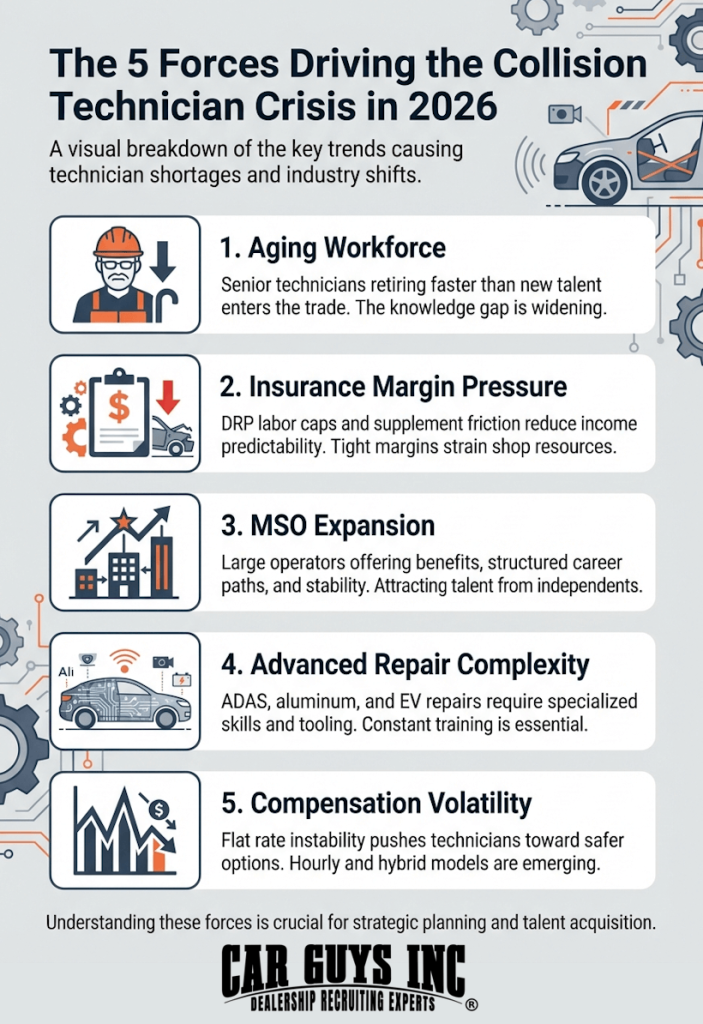
1. The Aging Workforce Problem
The average experienced body tech today is closer to retirement than to trade school.
Unlike mechanical service departments, collision repair never built a strong, consistent apprenticeship pipeline. For years, shops relied on:
- Word of mouth recruiting
- Poaching from competitors
- Promoting detailers into prep roles
That model is breaking down.
You cannot replace a 25 year veteran body tech in six months. Structural repair, aluminum work, frame pulling, blending, and refinishing are learned through years of repetition.
When senior technicians retire, production capacity disappears overnight.
2. Insurance Pressure Is Squeezing Technician Morale
DRP participation has created steady volume, but it has also introduced margin compression and production stress.
Many shops operate under programs tied to insurers such as State Farm and GEICO. While these relationships provide consistency, they also bring:
- Tight labor allowances
- Supplement friction
- Cycle time monitoring
- Cost control scrutiny
Technicians feel this pressure directly.
When flat rate hours are challenged or capped, income becomes less predictable. High producers begin evaluating other shops, or worse, other industries.
Compensation instability drives turnover more than most owners admit.
3. The Rise of MSOs Has Changed the Talent Battlefield
Multi Shop Operators backed by private equity have expanded aggressively.
Organizations like Caliber Collision and Gerber Collision & Glass offer:
- Health benefits
- Formal career paths
- Structured training
- National brand recognition
Independent shops often compete on culture and flexibility, but many cannot match benefits packages or sign on bonuses.
If your recruiting strategy still relies on “we’re a family business,” you are competing with a very different model than you were ten years ago.
4. ADAS, Aluminum, and EV Repairs Require New Skill Sets
Modern collision repair is no longer just panels and paint.
Advanced Driver Assistance Systems, aluminum construction, and electric vehicle architecture have changed repair complexity.
Brands like Tesla and Ford Motor Company have introduced repair procedures that require:
- OEM certification
- Specialized tooling
- Structural material knowledge
- Post repair calibration
The pool of technicians qualified to perform these repairs safely is small.
Shops that are not investing in training are not just falling behind operationally. They are shrinking their eligible talent pool.
5. Tool Investment Is a Barrier to Entry
Collision technicians invest heavily in their own tools.
Frame equipment, specialty aluminum tools, welders, and spray equipment are expensive. Younger workers are more hesitant to take on that financial burden without clear income upside.
Meanwhile, other skilled trades are aggressively recruiting from the same demographic pool.
If the compensation model does not justify the investment, new entrants choose different paths.
6. Poor Pay Plan Design Accelerates Turnover
Flat rate systems in collision are uniquely volatile because:
- Insurance approvals affect payable hours
- Supplements delay compensation
- Parts availability impacts flag time
When pay feels inconsistent, technicians lose trust.
And when technicians lose trust, they quietly explore options.
Pay plans are not just math. They are signals about stability and fairness.
Shops that redesign compensation to reduce volatility often improve retention without increasing total labor cost.
7. The Technician Crisis Is Actually a Visibility Problem
Many collision shops believe the market has “no talent.”
In reality, experienced technicians exist, but they are rarely actively applying on job boards.
A Level body techs typically:
- Stay employed
- Move discreetly
- Respond to targeted outreach
- Choose based on stability and culture
If your recruiting strategy relies solely on passive applicants, you are fishing in the smallest pond.
What Collision Shops Must Do in 2026
The technician shortage will not self correct.
Shops that win in the next five years will:
- Build structured apprenticeship paths
- Redesign pay plans to reduce income volatility
- Invest in OEM certifications and training
- Proactively recruit employed technicians
- Clearly communicate career growth and stability
Collision repair is becoming more technical, not less.
The shops that treat recruiting as a strategic function, not an afterthought, will protect cycle time, protect revenue, and protect market share.
The rest will continue fighting production bottlenecks while blaming the labor market.
Struggling to Find Qualified Collision Technicians?
If cycle time is slipping, production is bottlenecked, or you simply are not seeing qualified applicants anymore, the problem may not be the market. It may be your recruiting strategy. At CarGuys Inc., we help collision and body shops connect with experienced technicians who are already working in your market and quietly open to better opportunities. No headhunter fees. No recycled job board resumes. Just qualified candidates delivered directly to you.
See how the system works in a video demo, or schedule a strategy call to review your market and technician hiring needs.


CarGuys Inc. is an collision & body shop recruiting company built exclusively for the car business. From technicians and service advisors to salespeople and managers, we connect dealerships and repair shops with qualified talent faster, using nationwide reach, and years of hands-on experience.
With over 700 clients and thousands of hires, we don’t just fill positions; we help build stronger teams that drive long-term success.