Most job search advice is the same recycled list: update your resume, apply to everything, follow up after interviews. It’s not wrong, exactly. But it’s incomplete in ways that cost people real time and real opportunities. The advice that actually changes outcomes tends to come from someone who’s been through a rough search, made the mistakes, and figured out what worked after the fact.
At CarGuys Inc., we talk to automotive professionals at every stage of their careers – technicians who’ve been at the same shop for a decade, service advisors weighing a move, sales consultants wondering if there’s something better out there. The patterns in what they wished they’d known earlier are consistent. This post is an attempt to give you that perspective before you need it.
The Myth of ‘Apply Everywhere’
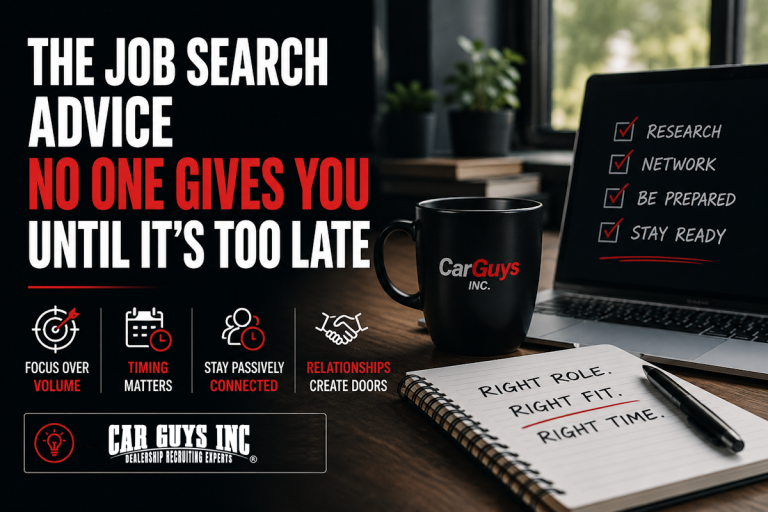
Volume feels productive. Sending out twenty applications in a weekend feels like progress. But in the automotive industry especially, high-volume applications almost always produce the same result: silence or callbacks from roles you’d never actually take.
Here’s what happens when you apply indiscriminately. You spend thirty minutes on an application for a shop you know nothing about. The hiring manager receives your resume alongside forty others, notices it doesn’t reference anything specific about their operation, and moves on. Meanwhile, the candidate who called the service manager directly, mentioned a mutual contact, or came referred by a technician already on the team gets the interview.
The math on volume looks like this: more applications don’t produce proportionally more interviews because the system isn’t linear. Most dealership hires – especially for experienced roles – happen through a much shorter path than the online application portal. The online application exists. It just isn’t where most of the real movement occurs.
A focused search means fewer applications, each of which you’ve actually thought through. It means researching the dealership, understanding the ownership group, knowing something about the service volume or the brand before you reach out. It means your communication is specific enough that the person on the other end can tell you did your homework. That specificity is what separates the applications that get a response from the ones that don’t.
Why Most Job Seekers Never Hear Back and How to Fix It
Why Timing Matters More Than Volume
The same resume sent to the same dealership can get two completely different responses depending on when it arrives. This is one of the least discussed realities of job searching, and understanding it changes how you approach the process entirely.
Dealerships hire reactively more often than they plan ahead. A technician gives two weeks’ notice on a Thursday afternoon. The service manager starts making calls Friday morning. If your resume landed in their inbox two weeks ago and made a decent impression, you might get a call before the role is ever posted. If you submitted through the job board the moment the listing went live, you’re competing with everyone else who saw the same posting.
What this means practically: staying loosely in the market, even when you’re not actively ready to move, creates a timing advantage. It means a recruiter or contact who knows you’re open to the right opportunity can reach out the moment something fits. It means you’re not starting from scratch when urgency is highest, and your judgment is most likely to be compressed by pressure.
Timing is also relevant within a search. The dealerships with the most urgent needs are often the ones most willing to move fast on compensation, negotiate on start dates, and invest in onboarding. The listings that have been up for sixty days have either passed you by, or they’re revealing something about the role itself. Following a posting’s age as part of your research – not just its existence – gives you a more accurate read on what you’re walking into.
What Recruiters Notice in the First 10 Seconds of Your Resume Review
The Hidden Value of Passive Job Searching
Passive job searching means staying visible and connected in your industry without actively pursuing a change at this time. Most people only think about their career options when something goes wrong: a pay plan gets restructured, a new manager arrives, the shop culture shifts. By the time those things happen, the urgency of the search affects the quality of the decision.
Professionals who stay passively engaged in the market have more options when the moment comes, because those options have had time to develop. This looks like:
- Keeping your resume current even when you’re not sending it anywhere, so you’re not scrambling to reconstruct two years of accomplishments under pressure.
- Occasionally reviewing what’s available in your market – not to apply, but to understand what roles are paying, which dealerships are growing, and where there might be gaps you’d be well-positioned to fill.
- Maintaining relationships with people who place candidates in your field, so that when you are ready to move, you’re not an unknown quantity to the people who can help you
- Building a professional presence that reflects your current skills and experience, so that inbound opportunities can actually find you
The candidates who land quickly when they’re ready to move are almost never starting from zero. They’ve been present enough in their professional world that the transition doesn’t require building from scratch. The search starts in the middle, not at the beginning.
You Don’t Need to Be Actively Job Hunting to Get Hired
How Relationships Quietly Shape Opportunities
The most valuable career advice most people receive comes from someone who already knows them. The job offer that fits best is often one that was never posted publicly. These aren’t revelations – most people know them abstractly. What’s harder to internalize is that relationships in your professional world are being built or neglected right now, whether you’re thinking about it or not.
In the automotive industry, this dynamic is particularly pronounced. The industry is large in terms of employment but tight in terms of how people know one another. Service managers move between stores. Technicians vouch for other technicians. A general manager who saw you work three years ago at a different dealership might be the one making hiring decisions at the next place you’d want to work.
The practical implication isn’t that you need to be constantly networking in a transactional, uncomfortable way. It’s simpler than that: do good work visibly, treat the people around you – colleagues, vendors, recruiters, customers – with consistency and professionalism, and stay connected enough that you don’t fall off the radar of people who respect your work.
When a service director has an opening and starts thinking about who they know, the candidates who come to mind are people they’ve worked with, people who’ve been referred, and people they’ve heard about through a trusted source. That mental shortlist gets populated over years, not during a job search. The people who understand this build it as a background practice rather than a crisis response.
Why Networking Still Matters in the Auto Industry
What You Can Do Differently Starting Now
None of this advice requires a career crisis to be useful. The things that make a job search go well – staying visible, understanding the market, being specific about where you apply, maintaining real relationships – are all things that can be built incrementally without urgency.
The professionals who seem to land the right jobs with relative ease usually aren’t better at job searching. They’ve just been doing a few quiet things consistently over time that give them options when options matter. They didn’t wait to feel frustrated in their current role before considering what else might fit. They weren’t starting from zero when the moment came.
It’s worth asking honestly: if you decided to make a move in the next six months, what would be in place? Would the right people know you were open to something? Would your resume accurately reflect where you are today? Would you know which dealerships or shops you’d actually want to work for and why?
If the answer to any of those is no, that’s not a problem – it’s just useful information about where to put a little time. The job search advice no one gives you early enough is usually just this: the best time to think about your next move is before you’re ready to make it.
The Difference Between a Job That Pays the Bills and One That Builds a Career
CarGuys Inc. connects skilled automotive professionals with dealerships and repair shops nationwide through intelligent matching technology. Instead of flooding candidates with irrelevant openings, we focus on fit, timing, and transparency. Upload your resume once, and when a matching opportunity arises, you will be notified. No noise. No pressure. Just the right opportunity at the right time.