
At CarGuys Inc., we work with dealerships across the country, and the service managers who consistently hit top CSI scores share one habit that rarely shows up in training manuals: they pick up the phone after the repair is done.
Why the Post-Visit Call Is the Most Underused Tool in Your Service Department
Most dealerships focus their CSI energy on the in-store experience – the write-up, the loaner process, the delivery walk-around. Those things matter. But the customer’s final impression often forms 24 to 48 hours later, when they’re driving the car and wondering whether the noise is gone or if that warning light is going to come back.
That window is where CSI scores are won or lost. A well-timed follow-up call closes the loop, catches problems before they become complaints, and tells the customer something your competitors almost never say: we still care after the transaction.
The business case is straightforward. It costs five to seven times as much to acquire a new customer as to retain an existing one. In a service department processing 300 to 500 repair orders per month, even a modest improvement in retention rates compounds quickly into measurable revenue gains. A follow-up call is not a courtesy – it is a retention strategy.
What a High-Quality Follow-Up Call Actually Looks Like
There is a difference between a box-check call and a call that actually moves the needle. The box-check version goes: “Hi, just calling to make sure everything was okay with your visit.” The customer says yes, you hang up, and nothing changes.
A high-quality follow-up call has three components:
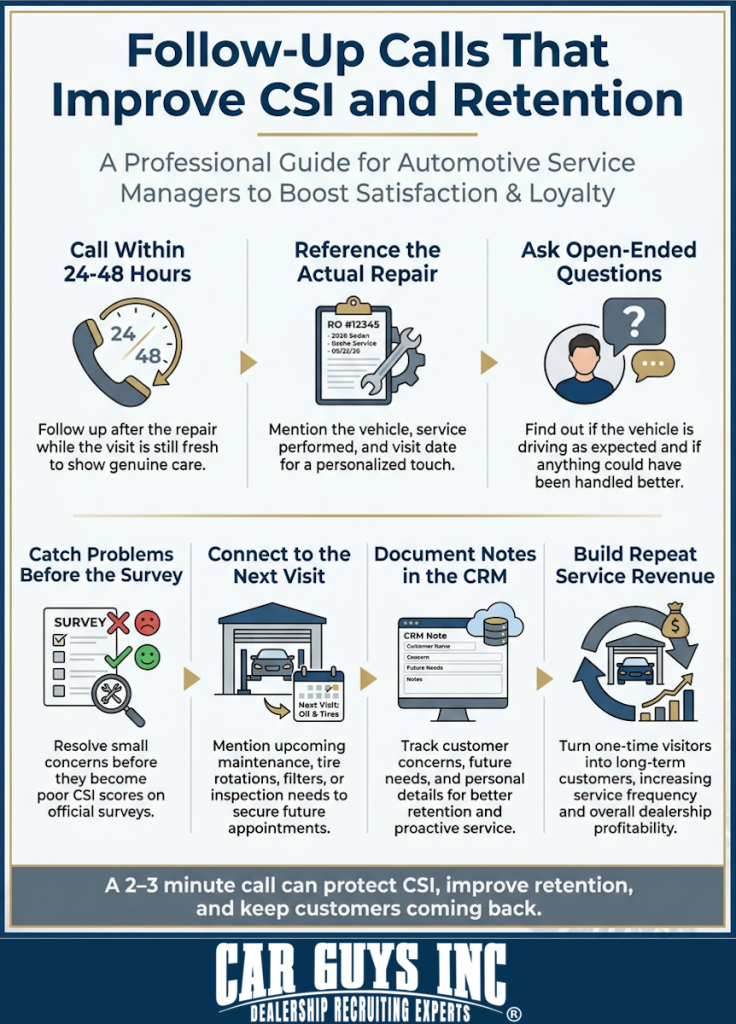
It is specific. Reference the actual work performed. “I’m calling to follow up on the brake job we completed on your Tahoe on Tuesday.” Specificity signals that this is a real call, not an auto-dialer.
It invites honest feedback. Ask open-ended questions: “Is the vehicle driving the way you expected?” or “Was there anything about the visit we could have handled better?” Customers who feel heard before they file a survey score higher – and flag problems that can still be fixed.
It connects to the next visit. If the technician noted a filter or tire rotation coming due, mention it. This is not upselling – this is continuity of care. Customers who receive a proactive heads-up about upcoming maintenance are significantly more likely to return to the same dealership.
The entire call should take two to three minutes. The return on that investment is outsized.
Who Should Be Making These Calls – and When
The timing of the follow-up call matters almost as much as the content. Industry best practice recommends an optimal window of 24 to 48 hours post-visit. Too soon feels rushed. Too late, and the customer has already moved on or, worse, already called the manufacturer hotline.
On the who question, there are two schools of thought. Some service managers prefer to have the service advisor who wrote the repair order make the call – the relationship is already established, and the advisor knows the history. Others prefer a dedicated BDC (Business Development Center) rep who is trained specifically for outbound follow-up. Both approaches work. What kills results is leaving the call to whoever has a free minute at 4:45 on a Friday.
Build the follow-up call into your advisor workflow as a non-negotiable. If you’re running an advisor team of four and each advisor completes 15 to 20 repair orders per day, you need a realistic process – not an aspiration. That might mean batching callbacks within a 30-minute window at the end of each day, or automatically routing closed repair orders to a BDC queue through your DMS.
The Direct Connection Between Follow-Up Calls and CSI Scores
OEM Customer Satisfaction Index surveys are typically sent within three to five days of a service visit. The follow-up call, made at the 24 to 48-hour mark, comes before the survey.
This timing is not coincidental – it is strategic. When a customer receives a follow-up call that resolves a concern or simply leaves them feeling valued, they are in a different frame of mind when the OEM survey arrives. They are not nursing a quiet frustration. They are not indifferent. They remember the call.
More importantly, the follow-up call catches the fixable problems. A customer who drives away with a slight vibration they didn’t mention at pick-up is likely to mark you down on the survey. If your advisor calls and asks how the car is driving, that same customer mentions the vibration – and now you have a chance to bring them back, address it, and turn a detractor into a promoter.
Service directors who track their CSI performance alongside their follow-up call completion rates almost always find a positive correlation between the two. This is not a coincidence. Customers reward businesses that demonstrate ongoing accountability.
Turning One-Time Customers Into Long-Term Revenue
Repeat service customers are the backbone of a profitable fixed ops department. An active customer who visits twice per year for routine maintenance and returns for a major repair every two to three years represents thousands of dollars in lifetime value – plus referrals.
The follow-up call is one of the cheapest and most effective ways to move a customer from “one-time visitor” to “loyal customer.” It does this by creating a touchpoint that feels personal in an industry that often feels transactional. When a service manager or advisor calls to check in, the customer files that away. Next time their check engine light comes on, they are not Googling the nearest shop – they are calling the place that called them.
To maximize this effect, document what you learn on the call in your CRM. If a customer mentions they are planning a road trip, note it and follow up before the trip with a pre-trip inspection offer. If they express concern about a noise that turned out to be normal, flag it so the advisor knows the context at the next visit. These small details are what set a service department apart from one that customers merely tolerate.
Key Takeaways for Service Managers
The follow-up call is not a feel-good activity – it is an operational lever that directly connects to three things every service manager is measured on: CSI scores, retention, and customer lifetime value. Executed consistently, it catches problems before they become survey scores, reinforces trust after the transaction, and builds the kind of repeat-visit behavior that keeps your bays full.
The managers who do this well don’t treat it as extra work. They treat it as part of the job that’s always been there – it just wasn’t being done.
CarGuys Inc. is an automotive recruiting company built exclusively for the car business. From technicians and service advisors to salespeople and managers, we connect dealerships and repair shops with qualified talent faster, using nationwide reach and years of hands-on experience.
If you want to quantify technician turnover, staffing shortages, empty bay loss, labor rate strategy, and service department profitability, visit our Service Department Calculators Hub.


With over 700 clients and thousands of hires, we don’t just fill positions.
We help build stronger teams that foster long-term success.