

CarGuys Inc. has placed sales managers across hundreds of dealerships nationwide. One pattern surfaces consistently: stores with high sales manager turnover almost always have poorly structured pay plans. Compensation is not just an HR line item – it is a management tool, and when it is built wrong, it produces exactly the wrong results.
This post is written for GMs, dealer principals, and dealer group executives who want to evaluate or redesign how their sales managers are paid. We will walk through the components of an effective pay plan, what to avoid, and provide a concrete example with real numbers to illustrate what a balanced pay plan actually looks like.
Why Pay Plan Structure Matters More Than the Dollar Amount
Most compensation conversations start with the question: “How much should we pay?” That is the wrong starting point.
A sales manager paid $180,000 under a poorly designed plan will underperform a manager paid $130,000 under a well-structured one. Why? Because the plan itself shapes behavior. What you measure and reward is what you get.
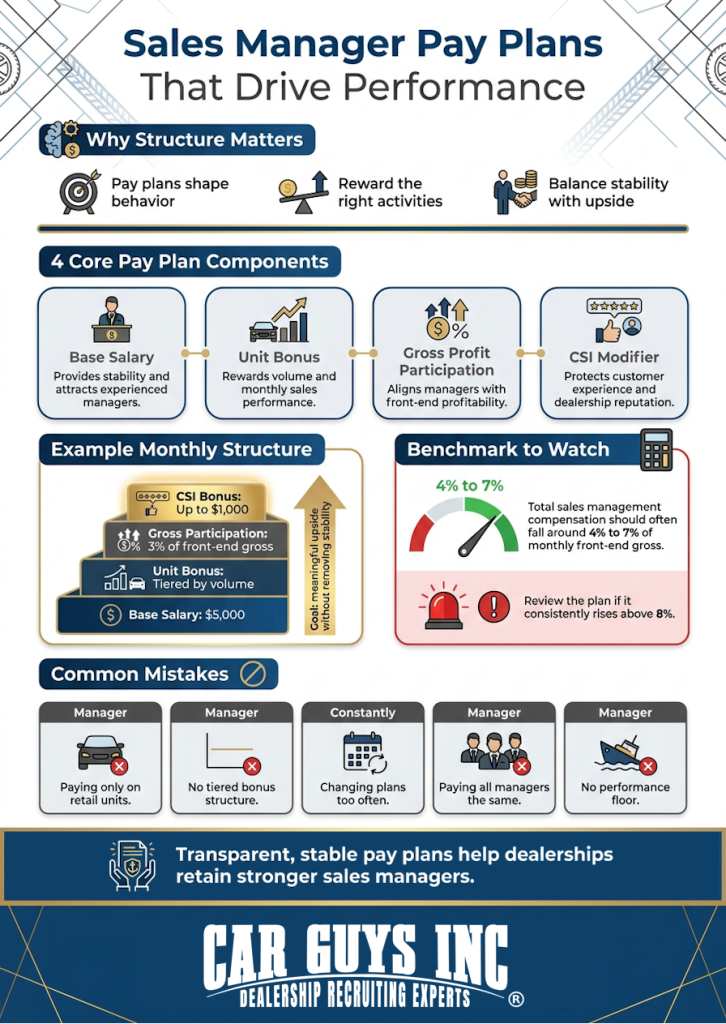
Weak pay plan structures often share the same flaws:
- They reward only units sold, ignoring gross and CSI.
- They offer no base salary, creating anxiety that drives short-term thinking.
- They are changed too frequently, eroding trust.
- They pay identically regardless of performance, removing the incentive to excel.
- They are so complex that managers cannot calculate their own earnings mid-month.
The goal of a well-designed pay plan is to align the manager’s financial interests with the store’s profitability and customer experience goals – not just to pay competitively.
The Core Components of a Sales Manager Pay Plan
Every effective sales manager’s pay plan contains four structural elements. The proportions vary by role, market, and store volume, but all four should be present.
1. Base Salary – Provides stability and attracts experienced candidates. A sales manager with no base will eventually leave for a floor salesperson role with uncapped commission. Base salary anchors the relationship.
2. Unit Bonus – Rewards volume. Typically paid as a per-unit amount that scales with performance. Flat per-unit bonuses can discourage pushing past minimums, so tiered structures are more effective.
3. Gross Profit Participation – Aligns the manager with profitability, not just activity. A manager paid only on units has no incentive to hold gross. Include both front-end (vehicle) and back-end (F&I) gross, or split F&I into a separate line if you want to encourage collaboration.
4. CSI / Performance Modifier – Protects the customer experience. A store can hit volume and gross targets while destroying its reputation. A CSI component either adds a bonus for strong scores or reduces the overall payout when scores fall below a threshold.
A Balanced Pay Plan Example: What the Numbers Actually Look Like
Below is a sample pay plan for a Sales Manager at a mid-volume franchised dealership selling approximately 120 new and used units per month combined. This is illustrative, but it reflects real-world structures used effectively in the market.
Role: Sales Manager (New & Used)
Store Volume: ~120 units/month
Target Annual Compensation: $115,000 – $145,000
| Component | Structure | Monthly Target Payout |
| Base Salary | Fixed monthly | $5,000/month ($60,000/year) |
| Unit Bonus | Tiered: $200/unit (1–40 units), $275/unit (41–60 units), $350/unit (61+ units) | $200 × 40 + $275 × 20 = $13,500 at 60 units |
| Gross Profit Participation | 3% of total front-end gross on all deals managed | 3% × $120,000 avg front gross = $3,600 |
| CSI Modifier | +$1,000 if CSI at or above regional average; $0 if below; −$500 if bottom quartile | $1,000 (if target met) |
| Total Target Monthly | $23,100 (approx. $277,200 annualized at target) |
At this dealership, with an average monthly front-end gross of $120,000 and 60 units sold, a well-performing manager takes home approximately $23,100/month. At lower performance (45 units, $90,000 gross, CSI missed), the same plan pays closer to $16,500/month. That spread – roughly 40% – is intentional. It creates meaningful upside without removing the stability the base provides.
What Percentage of Gross Should Go to Sales Management Compensation?
A useful benchmark for total sales management compensation (all managers combined) is 4% to 7% of total front-end gross, depending on store size, market, and whether the pay plan includes F&I participation.
Here is how that looks at different volume levels:
| Monthly Front-End Gross | 4% of Gross | 6% of Gross | Notes |
| $80,000 | $3,200 | $4,800 | Tight margin; base-heavy structure preferred |
| $150,000 | $6,000 | $9,000 | Room for meaningful variable comp |
| $300,000 | $12,000 | $18,000 | Multi-manager team; individual plans needed |
| $500,000+ | $20,000 | $30,000 | Group-level oversight; benchmark by role |
If your total sales management compensation consistently runs above 8% of front-end gross, that is a signal that either volume is down, gross is eroding, or the pay plan was not scaled for current production. Revisit the structure before layering on additional headcount.
Common Pay Plan Mistakes That Cost Dealerships Money and Talent
Even experienced operators make the following errors:
Paying on retail units only. Sales managers who also handle fleet or special finance deals may deprioritize those sales if they are not included in the unit count. Define what counts.
No tiered unit bonus. A flat $250 per unit applies to both unit 10 and unit 65. That removes the incentive to push past a comfortable middle. Use tiers.
Changing the plan mid-month or mid-quarter. Nothing destroys trust faster. Managers will stop trusting their own projections and start spending energy on office politics instead of production.
Paying two managers identically regardless of role or production. If one manager handles 70% of desk work and another handles 30%, identical pay breeds resentment. Build differentiation into the plan.
No performance floor. Plans with no minimum production threshold pay out variable comp even when results are poor. Set a floor – typically 70–75% of target volume – before variable comp begins.
Aligning Pay Plans with Retention Goals
Pay plan design is also a retention tool. Compensation that lacks predictability, that can be manipulated by management decisions outside the sales manager’s control, or that feels arbitrary will consistently drive good managers toward competitors.
Three retention-focused design principles worth implementing:
- Transparency: Publish the plan in writing. Every manager should be able to calculate their own earnings within a few minutes using only deal logs and gross reports.
- Stability: Commit to a plan for at least 12 months, unless there is a major structural change. Adjustments every quarter signal instability.
- Upside: Ensure that a top performer in a normal month earns meaningfully more than an average performer. If the gap is less than 20%, the plan is not differentiated enough to motivate.
The Role of Pay Plans in Reducing Turnover
Why Retention Starts with Recruitment in the Dealership Industry
When to Review and Restructure Your Sales Manager Pay Plans
Not every pay plan needs to be rebuilt annually. But there are clear signals that a review is overdue:
- Sales manager turnover exceeds one per year at a given location.
- Your top managers are being recruited away with offers 15%+ above what you’re paying.
- Variable comp is being paid out, but volume and gross are flat or declining.
- Managers complain they don’t understand how their pay is calculated.
- The plan hasn’t been reviewed since a previous GM’s tenure.
If two or more of the above are true, do not wait for turnover to force the conversation. A proactive review is far less expensive than a replacement search and the operational disruption that follows a manager’s departure.
Key Takeaways
- Structure drives behavior. Pay plans are management tools, not just compensation documents.
- All four components – base, unit bonus, gross participation, and CSI modifier – should be present in every sales manager plan.
- Benchmark total sales management comp at 4–6% of monthly front-end gross and audit if it drifts above 8%.
- Use tiered unit bonuses to reward performance at the top of the range, not just the middle.
- Transparency and plan stability are retention tools. Change plans reluctantly and only with advance notice.
About CarGuys Inc.
CarGuys Inc. is an automotive recruiting company built exclusively for the car business. From technicians and service advisors to salespeople and managers, we connect dealerships and repair shops with qualified talent faster, using nationwide reach and years of hands-on experience.


With over 800 clients and thousands of hires, we don’t just fill positions;
we help build stronger teams that foster long-term success.