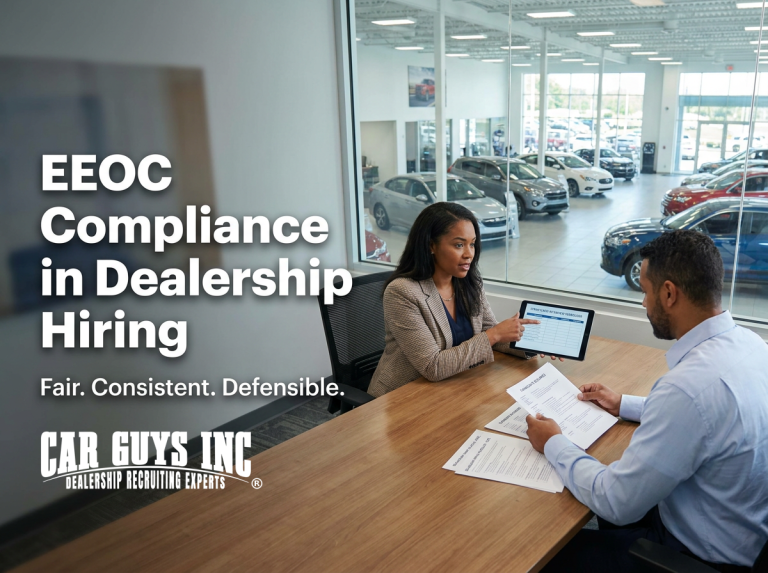
Most dealership leaders hear “EEOC compliance” and think about lawyers, paperwork, and liability. That reaction is understandable – but it misses the point. The Equal Employment Opportunity Commission’s guidelines aren’t a bureaucratic obstacle to work around. They’re a framework for building a hiring process that’s consistent, defensible, and – when executed well – more effective at finding and keeping good people.
CarGuys Inc. works with dealerships across the country, and one pattern is consistent: the shops with the fewest hiring headaches are the ones that treat compliance not as a floor but as a standard. Here’s what EEOC compliance actually requires, where dealerships most commonly go wrong, and what a compliant hiring process looks like in practice.
What the EEOC Actually Governs
The EEOC enforces federal laws prohibiting employment discrimination based on protected characteristics. For dealerships, the relevant classes include race, color, religion, sex, national origin, age (40 and older), disability, and genetic information. These protections apply to every stage of the employment relationship – from job postings and interviews to offers, pay, advancement, and termination.
The scope matters. EEOC compliance isn’t just about the moment you extend job offers. A job ad that discourages certain applicants, an interview question that reveals protected information, or a pay structure with unexplained disparities across demographic lines can all trigger a complaint or investigation.
Dealerships with 15 or more employees are subject to Title VII, the ADA, and the ADEA. Those with 20 or more employees are covered under the Age Discrimination in Employment Act. If your store meets these thresholds – and most do – EEOC compliance is not optional.
The Most Common EEOC Pitfalls in Dealership Hiring
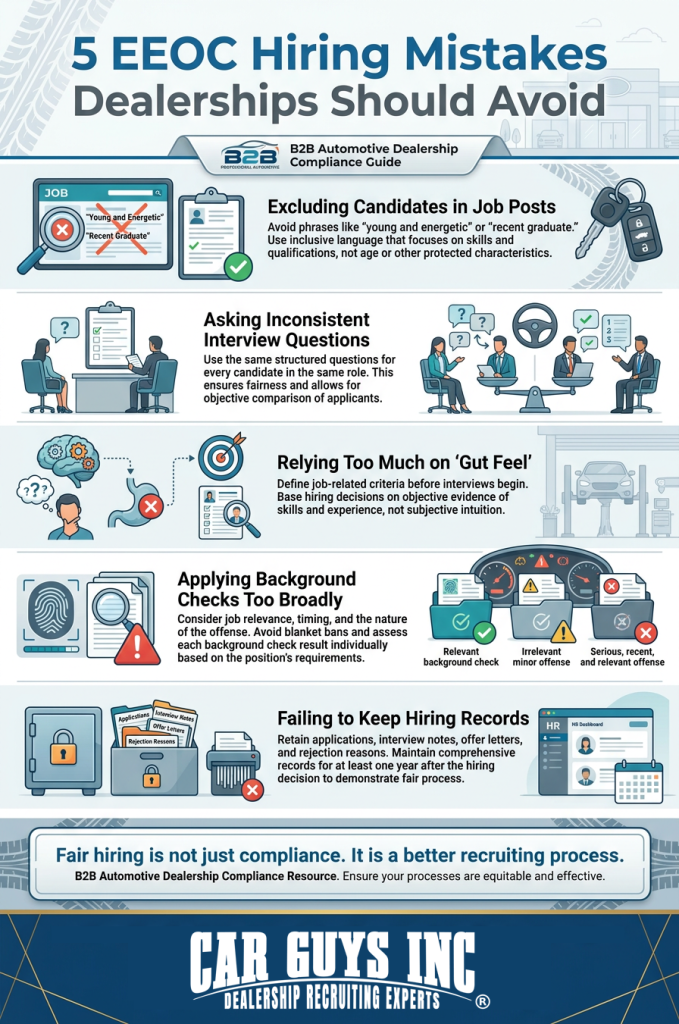
Job postings that inadvertently exclude candidates. Language matters more than most hiring managers realize. Phrases like “recent graduate,” “young and energetic,” or “native English speaker” can be construed as proxies for age or national origin discrimination. A defensible job posting describes the actual requirements of the role – and nothing else.
Unstructured interviews create inconsistency. When interviewers ask different questions, the assessment becomes subjective and impossible to document. EEOC investigators look for consistency. If one candidate is asked about their five-year plan and another is asked about childcare arrangements, that inconsistency creates exposure – even if the intent was benign.
How to Conduct Effective Interviews in the Automotive Industry
Informal screening that relies on gut feel. “Culture fit” is a legitimate consideration – but only when it’s defined and applied consistently. When interviewers can’t articulate what “fit” means beyond instinct, it becomes a liability. The same applies to social media screening: reviewing candidates’ profiles before making an offer can expose you to protected characteristics you had no legitimate reason to consider.
Criminal background checks are applied without job-relevance analysis. The EEOC has issued guidance that blanket exclusions based on criminal history can constitute disparate impact discrimination if they disproportionately screen out protected groups. Policies need to account for the nature of the offense, how recent it was, and whether it’s actually relevant to the job in question.
Recordkeeping gaps. The EEOC requires employers to retain personnel records – applications, interview notes, offer letters, and reasons for rejection – for at least 1 year from the date of the hiring decision. Many dealerships don’t have a system for this. When a complaint is filed months after a decision, the inability to produce documentation is a significant problem.
What a Compliant Hiring Process Looks Like
EEOC compliance is really a documentation and consistency problem. The dealerships that handle it well have built a repeatable process rather than relying on individual judgment.
Standardized job descriptions. Every open role should have a written description that specifies required skills, experience, physical demands, and essential functions – the last of which matters for ADA accommodation analysis. These shouldn’t be aspirational wishlists. They should reflect what the job actually requires.
Structured interview guides. Each role should have a fixed set of questions asked of every candidate in that role. Questions should focus on job-relevant competencies – problem-solving, technical skills, communication – rather than personal history. Interviewers should score candidates against the same criteria using a documented checklist, not impressions.
A clear, documented reason for every hiring decision. “We went with someone more qualified” is not enough. What did qualified mean? How was it measured? The candidate hired should meet the criteria defined before the interview process began, not retrofitted after the fact.
Accommodation processes that work in practice. The ADA requires reasonable accommodations for qualified applicants with disabilities, unless doing so would create an undue hardship. Many dealerships have a policy on paper but no real process. When a candidate discloses a disability, there should be a documented interactive process – a real conversation about what accommodation might look like and whether it’s feasible.
Regular audits of compensation and promotion data. Disparate impact complaints often arise not from hiring but from what happens after hiring. Pay discrepancies across demographic groups, promotion patterns that consistently favor certain employees over others, and disciplinary actions applied unevenly all fall within EEOC jurisdiction. Reviewing these data points annually – not just when a complaint emerges – is far less expensive than managing the alternative.
Why This Is Also a Talent Strategy
There’s a practical argument for EEOC compliance that has nothing to do with legal risk: dealerships that run fair, consistent hiring processes tend to make better hires.
When criteria are defined in advance, interviewers are evaluating candidates against the role rather than against each other’s implicit preferences. When questions are standardized, you get comparable data across candidates rather than a collection of impressions shaped by whoever was in the room. When documentation is thorough, you can identify patterns – in what’s working and what isn’t – rather than hoping each hire turns out well.
The auto industry has a documented pipeline problem across several departments, particularly technicians. Dealerships that can credibly demonstrate they evaluate all candidates fairly – regardless of background – have a broader talent pool to draw from. That’s a competitive advantage, not just a compliance checkbox.
Top Strategies for Recruiting High-Quality Automotive Technicians
What to Do If a Complaint Is Filed
Even well-run dealerships receive EEOC charges. A charge is not a finding of wrongdoing – it’s the beginning of an investigation process. The EEOC will issue a Request for Information asking for documentation related to the specific decision in question.
The dealerships that navigate this well are the ones that can produce clean records quickly. Application materials, interview notes, scoring guidelines, the criteria used to make the decision, and documentation of any similarly situated candidates who were treated consistently – these are the materials that resolve an investigation in your favor.
If your store doesn’t have these records in a retrievable format, the time to build that capability is before you need it.
Key Takeaways
EEOC compliance is not about checking boxes – it’s about building a hiring process that holds up under scrutiny because it was designed to be consistent and fair from the start. For dealerships, that means standardized postings and interviews, documented decision rationale, proper recordkeeping, and regular internal review of compensation and promotion patterns. The compliance and talent strategy work are the same.
CarGuys Inc. is an automotive recruiting company built exclusively for the car business. From technicians and service advisors to salespeople and managers, we connect dealerships and repair shops with qualified talent faster, using nationwide reach and years of hands-on experience.


With over 800 clients and thousands of hires, we don’t just fill positions;
We help build stronger teams that foster long-term success.