

Flat rate can make you very good money.
It can also quietly wreck your income, your schedule, and your sanity.
At CarGuys Inc., we have worked with nearly a thousand dealerships filled tens of thousands of auto mechanic jobs across the country. We have seen firsthand how the same flat rate number can produce completely different paychecks depending on the shop behind it.
Two dealerships can offer “$40 per flat rate hour” and deliver two entirely different outcomes. The number by itself means nothing.
If you are evaluating a flat rate offer, you need to think beyond the rate. You need to evaluate the system, the structure, and the opportunity behind it.
This guide will show you exactly how to do that.
First, Understand What a Flat Rate Technician Really Means
Flat rate means you are paid per flagged hour, not per hour you are physically in the building.
If a job pays 2.5 hours and you finish it in 1.5, you still get paid 2.5.
If that same job takes 4 hours, you still get paid 2.5.
In theory, efficiency equals higher income.
In reality, your income depends on much more than your skill level.
It depends on:
- Dispatch efficiency
- Advisor quality
- Car count
- Warranty mix
- Parts availability
- Comeback policy
- Shop management
Flat rate is a performance model. But performance only works if the shop creates opportunity.
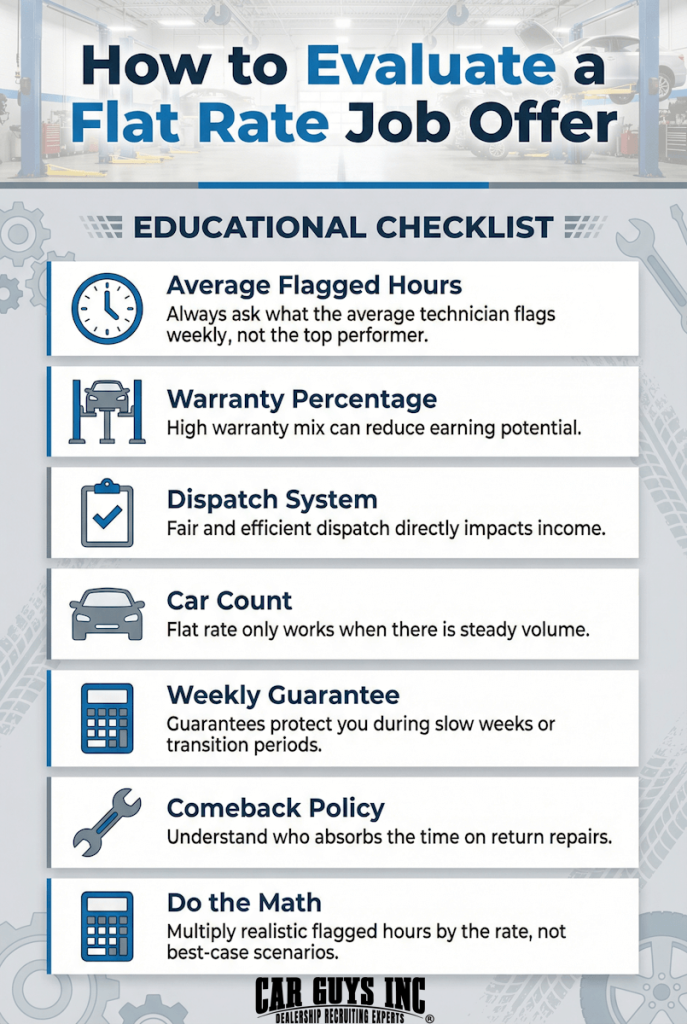
The 7 Questions Every Flat Rate Technician Should Ask Before Accepting
Do not accept a flat rate offer without asking these.
1. What Does the Average Technician Actually Flag?
Do not ask what the top producer flags.
Ask what the average tech flags in a 5-day week.
If the average technician is flagging 35 hours in a 50-hour week, that tells you something.
If the average is 45 to 50, that tells you something very different.
Your income projection should be based on the average, not the superstar.
2. What Percentage of Work Is Warranty?
Warranty work often pays fewer hours than customer pay jobs and comes with stricter procedures.
If 60 percent of the shop’s work is warranty, that affects your earning potential.
Ask for real numbers.
Warranty mix directly impacts flagging efficiency.
3. How Is Work Dispatched?
Dispatch is income.
Ask:
- Is it round robin?
- Is it skill based?
- Does management control it?
- Do certain techs get the best work?
A strong dispatcher can make a $30 rate feel like $40.
A weak or biased dispatch system can make a $38 rate feel like $25.
4. What Is the Shop’s Car Count?
Flat rate only works if there is volume.
Ask:
- How many repair orders per day?
- How many technicians?
- What is the average RO value?
If there are 25 repair orders per day and 18 technicians, do the math.
Low car count means low opportunity.
5. Is There a Weekly Guarantee?
Some shops offer:
- A 35-hour weekly guarantee
- A ramp-up guarantee for the first 60 to 90 days
- Training pay during manufacturer certification
A guarantee protects you during slow weeks, seasonal dips, or transition periods.
If there is no safety net, you are absorbing all the risk.
6. What Is the Comeback Policy?
If a vehicle returns for a related issue, who pays for that time?
Do you lose all the hours?
Does the shop split it?
Is it case by case?
Unclear comeback policies can quietly eat into your income.
You need clarity in writing.
7. What Does the Parts Department Look Like?
Backordered parts stall jobs.
Stalled jobs do not get flagged.
Ask:
- How often are parts delayed?
- Do technicians get paid partial hours if parts are unavailable?
- Is there strong communication between parts and service?
A strong parts department protects your productivity.
Red Flags in Flat Rate Offers
Be cautious if you hear:
“You can easily flag 80 hours a week.”
Without data, that is just talk.
Other warning signs:
- High technician turnover
- No written pay plan
- Vague answers about dispatch
- Management blaming techs for low hours
- No discussion of warranty mix
- Refusal to share average flag data
If a shop cannot clearly explain how you make money, that is a problem.
Do the Math Before You Decide
Here is a simple example.
$32 per flat rate hour
Average 45 flagged hours per week
45 x 32 = $1,440 per week
Approximately $74,880 per year before bonuses
Now look at the same rate with 35 flagged hours:
35 x 32 = $1,120 per week
Approximately $58,240 per year
Same rate. Very different income.
The rate is not the deciding factor. The system is.
Culture Often Beats Rate
A $30 shop with:
- Strong advisors
- Consistent car count
- Fair dispatch
- Good leadership
- Low drama
Can outperform a chaotic $38 shop.
Flat rate rewards efficiency. Efficiency requires organization.
When evaluating an offer, pay attention to:
- How clean and organized the shop is
- How advisors communicate
- How management speaks about technicians
- How long other techs have been there
Culture shows up in your paycheck.
Should You Negotiate a Flat Rate Offer?
Yes, but do it professionally.
You can negotiate:
- Rate per flat rate hour
- Signing bonus
- Tool allowance
- Relocation assistance
- Guarantee period
- Vacation structure
- Production bonus tiers
If you have certifications, strong productivity history, or brand experience, use that leverage.
Just remember, negotiation works best when you understand the numbers behind the offer.
Final Checklist Before You Accept
Before signing a flat rate offer, make sure you know:
- The average flagged hours in the shop
- The warranty percentage
- The dispatch system
- The weekly guarantee, if any
- The comeback policy
- The car count per day
- The culture and leadership style
- The growth path within the dealership
Flat rate is not good or bad by itself.
It is a performance system.
And performance only works when opportunity, management, and culture support it.
Ask the right questions. Do the math. Then make your move.
CarGuys Inc. connects skilled automotive technicians with dealerships and repair shops across the country using intelligent matching technology.
Instead of flooding candidates with irrelevant openings, we focus on fit, timing, and transparency. Upload your resume once, and when the right opportunity matches your experience, you are notified.

No noise. No pressure. Just the right opportunity at the right time.





I like that the advice feels doable, not like another impossible checklist