
A lot of companies say they care about retention, then hand onboarding almost entirely to HR.
That is where the problem starts.
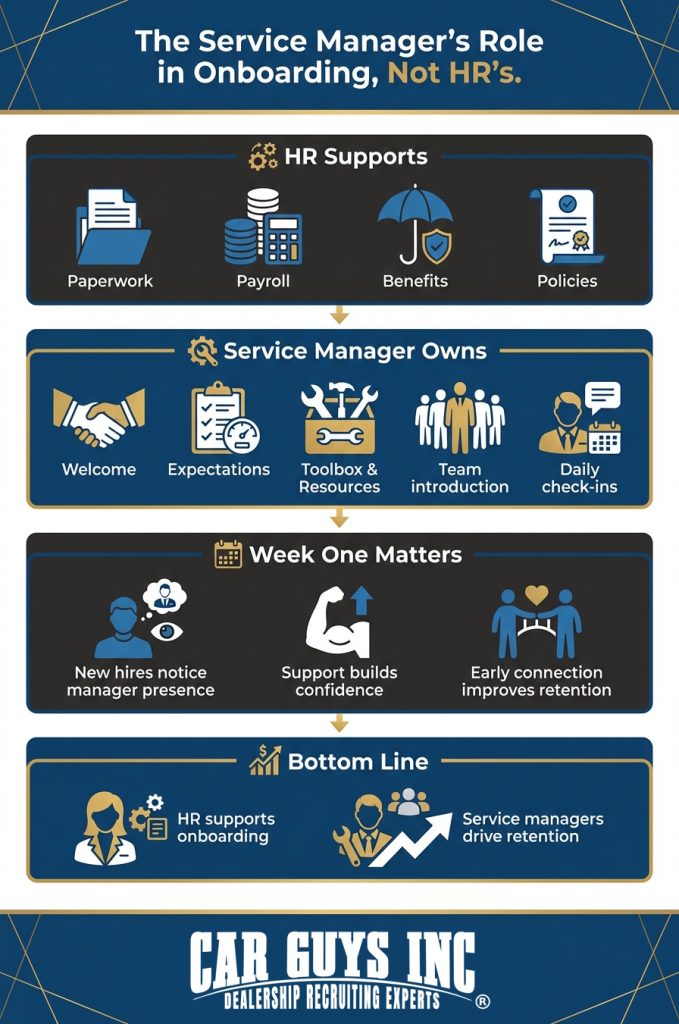
HR can handle forms, policies, payroll, and benefits setup. These things matter. But none make a new employee feel wanted, supported, or confident about joining your team. Retention is not built through paperwork. It is built through leadership, clarity, and connection.
In dealerships and repair shops, the manager has that experience.
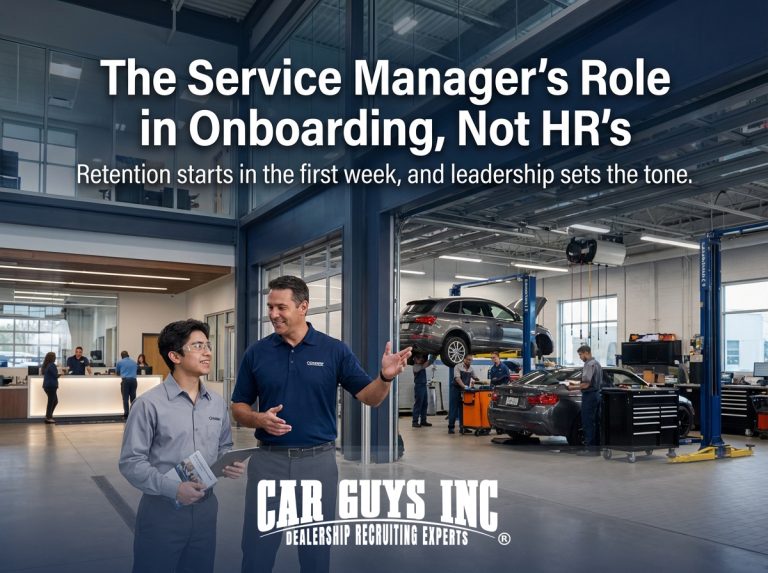
If a new technician, advisor, parts employee, or manager arrives on day one and the service manager or GM is missing, the message is immediate. Whether intended or not, it says, “You are not important enough for my time.” That feeling sets in fast. Once it does, it is hard to undo.
The first week tells new hires what kind of workplace they actually joined. It is not about what was promised in the interview. It is not what HR explained in the offer packet. The real culture shows up in how managers act once the employee starts.
HR Supports the Process, but Managers Shape the Experience
This is not a criticism of HR. Good HR teams are valuable and play an important role in creating structure for hiring and onboarding. But HR is usually not the person the employee will work beside every day. HR is not assigning work, answering job-specific questions, setting expectations, or helping the employee feel like part of the team.
Managers do that.
That is why managers own retention from the beginning.
A new hire does not stay because the tax forms were processed quickly. They stay because they feel seen, prepared, and set up to succeed. They stay because their leader made time for them. They stay because someone showed them their place, what success looks like, and who supports them.
Managers who treat onboarding as solely HR’s task create distance when connection is most needed.
The First Week Carries More Weight Than Most Leaders Realize
Most turnover problems do not begin at month six. They begin in the first few days.
New employees are always judging if they made the right choice. They notice everything. Was anyone expecting them? Is their workstation ready? Does anyone know their name? Did their manager make time for them? Are expectations clear? Do coworkers seem welcoming, or confused and indifferent?
These are not small details. They shape emotional commitment.
In the automotive world, pressure is high, and the pace is fast. Managers may think that being busy excuses weak onboarding. It does not. In fact, the faster and more demanding the environment, the more important manager-led onboarding becomes.
Busy departments do not need fewer leaders. They need more intentional leadership.
Visibility Matters More Than Perfection
Onboarding does not have to be fancy. It does not need a huge training program, a stack of branded materials, or a long formal presentation.
What it does need is a manager’s presence.
A service manager who personally greets new employees, tours the shop with them, introduces key people, explains how the department runs, and checks in throughout the first week does more for retention than any HR packet ever could.
Employees do not expect perfection; they just expect effort.
They want to know that someone noticed they arrived. They want to know who they report to, what matters most, and where to go when something is unclear. They want to feel like they were hired for a reason, not dropped into the operation and left to figure it out on their own.
A visible manager sends a simple but powerful message: “You matter here.”
That message increases buy-in early, when retention is most fragile.
New Hires Do Not Just Need Information, They Need Confidence
One of the biggest mistakes managers make is assuming onboarding is just about transferring information.
Onboarding is about building confidence. It is about building confidence!
A new employee may have the technical skill to do the job, but still feel uncertain about how things work in your store. Every team has its own rhythm, priorities, personalities, and standards. Strong management can shorten the adjustment period; a manager’s indifference can make it worse.
This is especially true with technicians and service staff. Even experienced hires lose momentum fast if they do not get clear direction, proper introductions, or early support.
Confidence grows when managers do a few basic things well:
- explain expectations clearly
- define what success looks like in the first 30 days
- Make sure tools, systems, and workflows are ready.
- introduce the employee to the team with the intention
- Check in often enough to catch frustration early.
These onboarding steps are led by leadership, not just HR.
Culture Becomes Real During Onboarding
Companies love to talk about culture during recruiting.
Onboarding reveals whether the culture aligns with recruiting promises.
If the interview promised teamwork, support, and professionalism, but the first week feels rushed or cold, the employee notices the gap at once. That gap damages trust. Once trust slips, retention is harder.
Managers are the ones who close that gap.
They are the ones who make culture real through their behavior. If they are prepared, engaged, and intentional, the employee feels it. If they are distracted, absent, or uninvolved, the employee feels that too.
A new hire will forgive a lot during the first week. What they usually will not forgive is feeling ignored.
Good Onboarding Protects the Hiring Investment
Every hire costs time, money, and operational energy.
There is ad spend. There is recruiter effort and interview time. Productivity drops during the vacancy. There is also the cost of getting the new person up to speed. When a new technician leaves quickly, the investment disappears. The team must start over.
How Much Does Technician Turnover Cost? Our Technician Turnover Cost Calculator helps show the financial impact of an open technician position by estimating weekly revenue loss, total lost revenue during the vacancy, and the additional cost of replacing that employee.
That is why onboarding cannot be treated like an administrative step.
It is a vital retention tool.
Managers who stay visible and engaged during the early days protect the investment the business just made. They reduce confusion, build trust more quickly, and increase the odds that the employee sticks around long enough to contribute at a high level.
This matters more in service departments and repair shops. When retention breaks down, it leads to lost hours, delayed work, stressed teams, and frustrated customers.
If leadership wants better retention, it has to stop viewing onboarding as a handoff to HR and start viewing it as part of management performance.
What Strong Manager-Led Onboarding Actually Looks Like
It usually looks simpler than people think.
It means the manager is present on day one. The employee is expected, welcomed, and introduced properly. The work area, systems, and schedule are ready. Expectations are explained clearly. There are short check-ins throughout the first week, not silence.
It also means the manager pays attention to the emotional side of the transition. Is the employee settling in? Do they seem unsure? Have they connected with the team? Are there early frustrations that can be solved before they become reasons to leave?
That is leadership.
HR can help build the process. Managers bring it to life.
The Bottom Line
HR can support onboarding, but managers own retention.
If the service manager, shop foreman, department head, or GM is invisible during the first week, the new employee feels it immediately. When people feel disposable early, they are much more likely to leave.
The businesses that keep good people do not just hire well; they also retain them. They are on board well. More specifically, they lead well during onboarding.
That is the difference.
Because in the end, employees do not stay because forms were completed. They stay because someone made them feel like joining the team was the right move.
CarGuys Inc. is an automotive recruiting agency built exclusively for the car business. From technicians and service advisors to salespeople and managers, we connect dealerships and repair shops with qualified talent faster, using nationwide reach and years of hands-on experience.


Ready to measure the true impact of onboarding and retention? Visit our Service Department Calculators Hub today to analyze your numbers and make data-driven improvements.
With over 700 clients and thousands of hires, we don’t just fill positions:
We help build stronger teams that drive long-term success.