Dealerships spend significant time and money recruiting talent, yet many still lose new hires within the first 90 days. While turnover is often blamed on pay plans, workload, or “fit,” the real issue frequently shows up much earlier.
Onboarding.
More specifically, onboarding that treats every role the same.
Technicians, service advisors, salespeople, and managers all walk into a dealership with different expectations, pressures, and learning curves. When onboarding is generic, confusion replaces confidence, and early exits follow.
Retention does not improve because you hire better people. It improves when those people are shown how to succeed in their specific role from day one.
Why One-Size-Fits-All Onboarding Fails in Dealerships
Most dealerships onboard for efficiency, not effectiveness. New hires receive paperwork, logins, a quick tour, and a loose expectation to “figure it out.”
This approach creates predictable problems:
- Role-specific stress points are ignored
- Productivity is delayed
- Confidence erodes early
- Managers are forced to fix preventable issues later
According to SHRM, new employees who experience poor onboarding are twice as likely to look for another job within their first six months. In an industry already facing talent shortages, that is a costly mistake.
When onboarding ignores the role, the role eventually walks out.
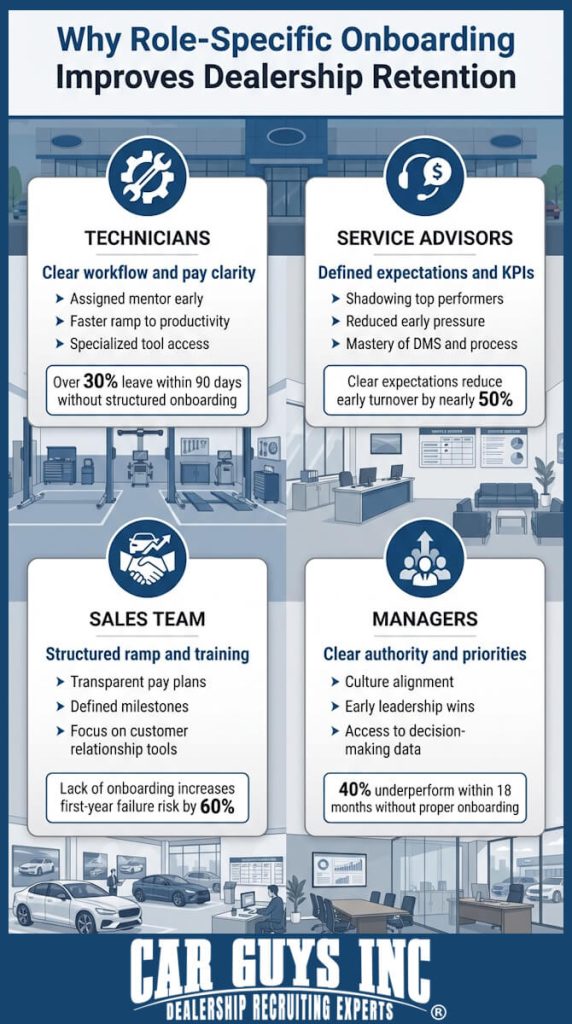
Technicians: Where Chaos Kills Retention Early
Technicians do not leave because the work is hard. They leave because the system feels chaotic.
Common Early Failure Points
- No clear dispatch or workflow explanation
- Flat rate expectations not fully understood
- Lack of a mentor or go-to person
- Unclear bay assignments, tool access, or approval processes
What Effective Technician Onboarding Includes
- A walkthrough of how work flows through the shop
- Clear explanation of pay structure and flagged hours
- Defined expectations for the first 30 days
- Assigned lead tech or mentor for early questions
Stats
- Transportation industry data shows that over 30 percent of technician turnover happens within the first 90 days
- Dealerships with structured technician onboarding report shorter ramp time and higher first-year retention, according to NADA workforce studies
Technicians who understand how to win early stay longer.
Service Advisors: Pressure Without Clarity Drives Early Exits
Service advisors often face immediate performance pressure with minimal guidance. They are expected to produce before confidence has time to develop.
Common Early Failure Points
- Thrown into the DMS with limited hands-on training
- Vague or conflicting KPI expectations
- Pay plans explained once, then assumed understood
- No time to observe top performers
What Effective Advisor Onboarding Includes
- Shadowing high-performing advisors
- Clear explanation of metrics, pay plans, and expectations
- Realistic ramp period without full pressure
- Alignment between service manager expectations and daily reality
Stats
- Several studies show service advisors who lack structured onboarding are significantly more likely to leave within six months
- Gallup reports that employees who clearly understand performance expectations are nearly 50 percent less likely to seek new employment
Advisors quit confusion long before they quit the job.
Sales Team: No Roadmap Means No Patience
Dealership salespeople are competitive, motivated, and results driven, but early failure often has nothing to do with effort.
Common Early Failure Points
- Inconsistent training
- Unclear lead flow process
- Pay plans not fully understood
- No defined milestones for progress
What Effective Sales Onboarding Includes
- Structured training timeline
- Clear expectations for each phase of ramp up
- Transparent compensation breakdown
- Defined coaching touchpoints
Stats
- Sales employees who lack structured onboarding are 60 percent more likely to miss quota in their first year
- Companies with formal sales onboarding see higher confidence, faster productivity, and stronger retention
Salespeople stay when they know how to catch up and win.
Managers: The Quiet Retention Risk
Managers are often assumed to be fully ready on day one. This assumption leads to silent struggles that eventually become visible failures.
Common Early Failure Points
- No clarity on decision authority
- Misalignment with ownership expectations
- Lack of cultural context
- No defined early priorities
What Effective Manager Onboarding Includes
- Clear expectations from ownership or the GM
- Alignment on leadership style and culture
- Defined early wins and priorities
- Relationship building across departments
Stats
- Nearly 40 percent of new managers fail or underperform within the first 18 months
- Poor onboarding is consistently cited as a primary factor in early leadership failure
Managers fail quietly before they fail publicly.
The Retention Impact of Role-Specific Onboarding
When onboarding is built around the job, not just the process, dealerships see measurable improvements:
- Faster confidence and engagement
- Shorter time to productivity
- Fewer early resignations
- Less strain on senior staff
- Stronger manager employee relationships
According to HR studies, employees who experience effective onboarding are up to 69 percent more likely to stay for three years.
Retention becomes a natural outcome, not a constant struggle.
Recruiting Gets Them In the Door. Onboarding Keeps Them There.
Dealerships often respond to turnover by recruiting harder, spending more, and posting more jobs. But when early attrition continues, recruiting is not the problem.
Onboarding is.
The best recruiting strategy in the world cannot overcome an onboarding process that leaves new hires confused, unsupported, or overwhelmed.
Role-specific onboarding finishes the job recruiting starts.
CarGuys Inc. is an automotive recruiting agency built exclusively for the car business. From technicians and service advisors to salespeople and managers, we connect dealerships and repair shops with qualified talent faster, using nationwide reach, and years of hands-on experience.

With over 700 clients and thousands of hires, we don’t just fill positions;
we help build stronger teams that drive long-term success.