The vehicle under the hood has changed. Here’s what that means for your career.
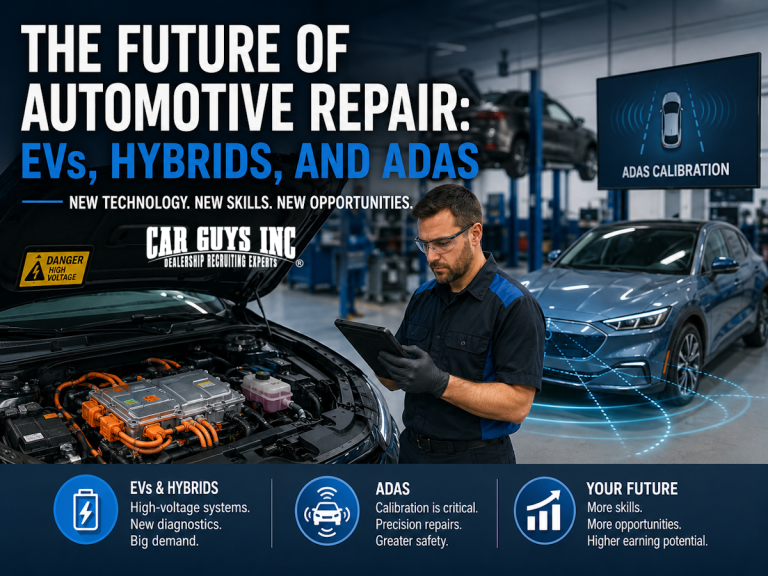
If you’ve been turning wrenches for more than a few years, you’ve already noticed the shift. The vehicles rolling into service bays look different, sound different, and are diagnosed differently than anything the industry has trained most technicians to handle. Electric vehicles, hybrids, and advanced driver assistance systems aren’t a distant forecast anymore – they’re in the lane right now, and the future of automotive repair is being written by the technicians who choose to get ahead of them.
At CarGuys Inc., we place automotive professionals across dealerships and independent shops nationwide, and the demand signal we’re seeing from employers is clear: shops are actively hunting for technicians who understand connected cars, high-voltage systems, hybrid powertrains, and ADAS calibration. The talent gap is real, the pay premiums are real, and the window to position yourself as an early specialist is still open – but it won’t stay that way.
What’s Actually Changing in the Future of Automotive Repair
The combustion engine isn’t disappearing overnight. But its share of the service mix is shrinking, and the vehicles filling that gap bring entirely different failure modes, safety requirements, and diagnostic demands.
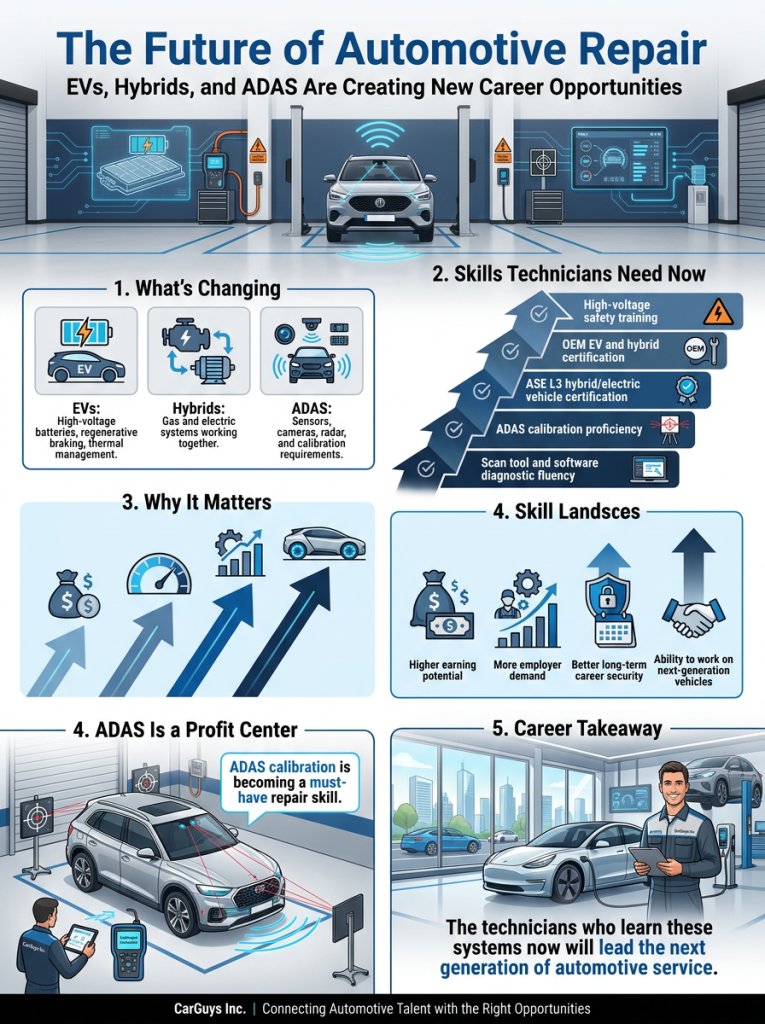
Battery electric vehicles (BEVs) eliminate the traditional drivetrain but introduce high-voltage battery packs, thermal management systems, regenerative braking, and software-defined powertrain controls, requiring a fundamentally different diagnostic approach. A multimeter and a vacuum gauge won’t get you very far.
Plug-in hybrids and conventional hybrids present their own complexity: two powertrains that must communicate seamlessly, high-voltage systems sitting alongside conventional 12-volt architecture, and brake systems that blend regenerative and hydraulic inputs in ways that aren’t always intuitive to diagnose.
Then there’s ADAS – advanced driver assistance systems – which now appear on everything from budget sedans to heavy-duty trucks. Lane keep assist, automatic emergency braking, adaptive cruise control, blind spot monitoring, 360-degree camera systems: every one of these requires precise calibration after any suspension work, windshield replacement, or collision repair. A car that leaves your bay with a misaligned front radar isn’t just a comeback – it’s a liability.
The industry isn’t asking technicians to become software engineers. But it is asking them to think differently about how vehicles fail, how systems interact, and how to verify a repair is complete in a way that a test drive alone can’t confirm.
Why an EV Technician Career Pays More Than Most Techs Realize
Specialization has always commanded a premium in the trades. A master tech earns more than a lube tech. A diesel specialist earns more than a general service advisor. The same principle applies here – with a twist: EV and hybrid certification is still rare enough that shops are offering meaningful pay increases just to attract someone who has it.
Dealerships with dedicated EV service capacity are not only competing for customers – they’re competing for the technicians who can actually service those vehicles. OEM brands with aggressive electrification roadmaps are requiring dealer certification for warranty work, meaning a certified EV tech isn’t just more employable; they’re often the only person in the shop authorized to perform certain repairs.
On the ADAS side, calibration work is emerging as a distinct profit center for shops that invest in the equipment and training. Static and dynamic calibrations can bill at $150 to $400 per procedure – work that didn’t exist at scale five years ago and now comes through the door on nearly every significant repair job. Technicians who can perform and document calibrations competently are worth considerably more than their uncertified counterparts.
The Hybrid Vehicle Repair and EV Skills Worth Building Right Now
You don’t need to scrap your existing knowledge base. Most of what makes a skilled technician skilled – systematic diagnostic thinking, clean workmanship, attention to detail, the ability to follow a repair procedure precisely – transfers directly into EV and hybrid work. What you’re adding is a new layer of technical vocabulary and a set of safety disciplines that are non-negotiable when high-voltage systems are involved.
The most marketable skills to develop, in rough order of accessibility:
- High-voltage safety training. This is the foundational requirement for any EV or hybrid work. OSHA and OEM programs both cover the protocols for working safely around 400V-800V systems. Without this, most employers won’t authorize you to open a battery enclosure, regardless of your experience level.
- OEM-specific EV/hybrid certification. Every major manufacturer offers technician training through their dealer network. If you’re currently at a franchised dealership, this training is likely available to you – often at no cost. Ask your service manager what programs are active. If they don’t know, that’s a signal too.
- ASE certifications in hybrid and EV systems. The ASE L3 (Light Duty Hybrid/Electric Vehicle Specialist) is the most widely recognized independent credential in this space. It carries weight with employers who aren’t affiliated with your brand and validates your expertise across platforms.
- ADAS calibration proficiency. Training through your scan tool or alignment equipment provider (Autel, Hunter, Snap-on, Bosch, and others all offer this) gives you a working knowledge of both static and dynamic calibration procedures. Pair this with a thorough understanding of OEM reset requirements, and you become the person who prevents comebacks – exactly who service managers want on their team.
- Software and scan tool fluency. Modern vehicle diagnostics are software-intensive. Comfort with OEM scan tools, module programming, over-the-air update management, and network communication diagnostics (CAN, LIN, Ethernet) is increasingly expected at the master tech level, particularly for EVs.
None of this requires going back to school full-time. Most of it can be built incrementally through OEM programs, community college night courses, and online platforms like the NPTC or I-CAR – while you continue working.
What Dealerships and Shops Are Actually Looking For
This is where the reality of this shift intersects directly with your career. Service departments are under real pressure to meet EV service demand without the trained staff to handle it. A 2023 survey by the National Automobile Dealers Association found that more than 60% of dealerships identified EV technician availability as a significant operational concern – and that number has grown as EV sales volumes have climbed.
For technicians, that pressure translates directly into leverage. Shops that are struggling to handle warranty work on EVs or turning away ADAS calibrations because no one is trained are motivated to pay more, offer better schedules, and invest in the equipment and training that keep skilled people from walking out the door.
- How to Evaluate a Technician – Hourly / Guarantee + Bonus Job Offer
- How to Evaluate a Flat Rate Technician Job Offer
The technicians who are best positioned right now aren’t waiting for their current shop to offer the training. They’re seeking it out, building credentials, and making themselves visible to employers who need exactly what they’re developing. The demand is already there. The supply is still catching up.
The Technicians Who Move First Will Define the Next Generation of Automotive Service
Every major shift in automotive technology has created a generation of specialists who built careers on the skills others were slow to develop. The technicians who got ahead of fuel injection when carburetors were still the norm. The ones who learned scan tool diagnostics before OBD-II were mandatory. The diesel specialists who certified early when emissions regulations rewrote the powertrain landscape.
EVs, hybrids, and ADAS represent that same moment – and it’s happening right now. The technicians who build these skills over the next two to three years will be the ones dealerships are competing to hire in five years. The window for early-mover advantage is still open, but it is narrowing.
Your existing experience is not a liability in this transition. It’s your foundation. The diagnostic mindset, the customer interaction skills, the shop floor credibility you’ve built – none of that goes away. What changes is the technology layer on top of it. And that layer, with the right training and the right employer, is entirely learnable.
Find an Employer Who Invests in What You’re Building
CarGuys Inc. connects skilled automotive professionals with dealerships and repair shops nationwide through intelligent matching technology. Instead of flooding candidates with irrelevant openings, we focus on fit, timing, and transparency.


Upload your resume once, and when a matching opportunity arises, you will be notified. No noise. No pressure. Just the right opportunity at the right time.