
Sales consultant pay plans are a hot topic in dealerships. Each store uses commission, draw, flats, mini deals, bonuses, or gross-based pay. Yet, many dealerships face the same problems: turnover, inconsistent production, weak gross, poor culture, and frustration on both sides.
The issue is usually not whether a dealership has a pay plan. The issue is whether the pay plan was built to support a specific business goal.
Many stores lose focus here. A pay plan might be inherited, patched together over time, or copied from another rooftop. Often, little thought is given to the behaviors these plans actually reward. Leadership may want retention, teamwork, strong gross, or future managers, but the pay plan may encourage the opposite.
There is no single perfect pay plan for every dealership because different plans produce different results. To achieve a specific outcome, design your pay plan to support that goal. The key takeaway: Align your pay plan with the results you want to achieve.
Jump to the outcome you want to improve:
Why Sales Consultant Pay Plans Cause So Much Confusion
Part of the confusion stems from the many moving parts in dealership sales compensation, which is rarely simple. One store may pay a front-end commission with a draw. Another may use flats plus volume bonuses. Yet another may emphasize gross, back-end, accessories, CSI, or a mix of all of the above. While many of these plans can look reasonable on paper, in practice, they often produce very different cultures and employee behaviors.
Another reason for the confusion is that dealerships often discuss pay components rather than business objectives. The conversation becomes about whether the commission percentage is fair, whether minis are too low, or whether volume bonuses should kick in at 10 or 12 units. Those details matter, but they are not the first question a store should ask.
The better question is this: what result are you trying to create? This shift in focus is essential as you move from dissecting pay components to considering the bigger picture.
A sales pay plan is not just a compensation model. It is a behavior model. It tells the floor what matters. It shapes urgency, loyalty, teamwork, risk tolerance, and even how long good people stay. If leadership is not clear about the outcome it wants, the pay plan often ends up rewarding whatever is easiest to measure rather than what the business actually needs.
The Core Pieces of a Dealership Sales Pay Plan
Before looking at goal-based strategies, it helps to define the basic tools dealerships typically use.
Commission is usually a percentage of front-end gross, and in some stores, it may also include back-end gross. This structure tends to tie earnings directly to deal profitability.
Draw is an advantage against commission. It helps provide salespeople with income stability while keeping a commission-based environment.
Flat pay is a fixed amount per sale, no matter the gross. Stores use it to emphasize volume and consistency.
Mini deals are minimum commissions for low-gross transactions. They ensure salespeople get some compensation when profits are thin.
Volume bonuses reward higher unit counts at set thresholds. They can serve as strong production accelerators.
Gross-based bonuses reward consultants for maintaining a specified average front-end or overall gross performance.
Spiffs and performance bonuses target short-term goals. They might help sell aged inventory, improve appointment show rates, push a model, or boost product penetration.
None of these tools is right or wrong. They are just tools. The real question is what behavior they encourage when combined into a full pay plan.
Start With the Goal, Not the Pay Components
Too many stores build pay plans backward. They start with the math, the percentages, or what they think the local market is doing, then hope the desired results follow. A better approach is to define the goal first.
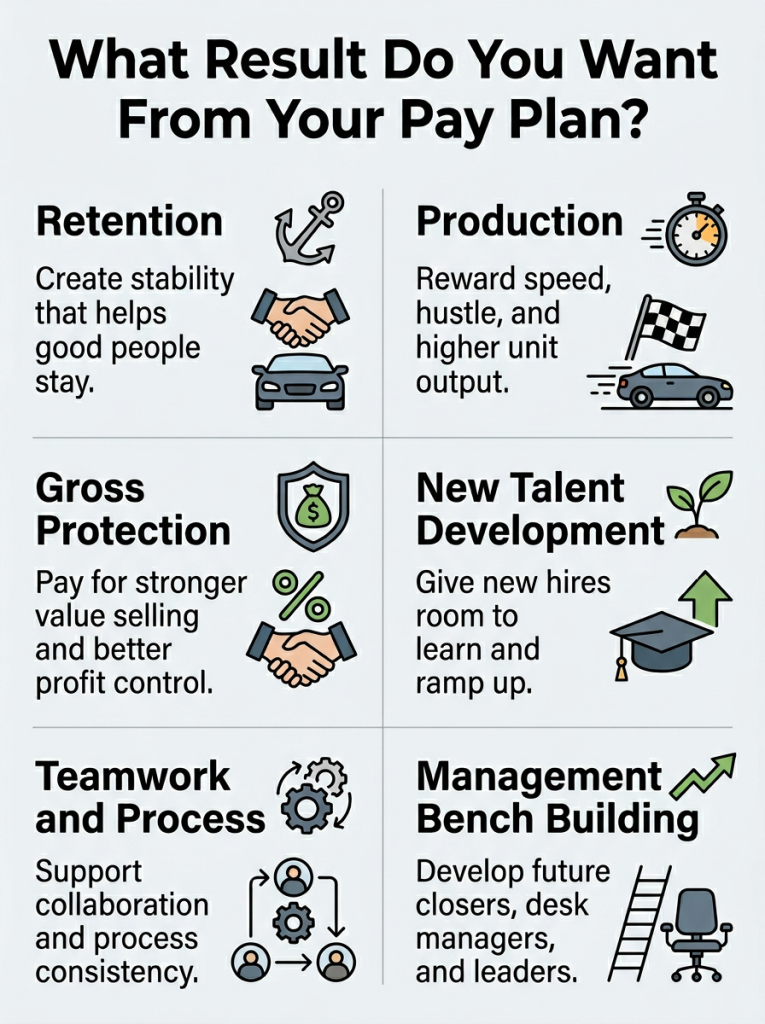
What does the dealership want to achieve? Is it improved retention and reduced rehiring? Is maximum unit output from a competitive floor the goal? Does leadership want to hold front-end gross? Is developing young talent to build future managers a focus? Maybe the aim is a process-driven, team-oriented environment?
Each of those goals points toward a different compensation design.
Not every dealership needs a totally different plan. Leadership should understand that compensation drives behavior. If the pay plan aims for one outcome but management expects another, disappointment is likely.
If You Want Better Retention, Consider a Stability-Focused Pay Plan
Some dealerships have a turnover problem that never seems to go away. They hire constantly, train constantly, and lose people constantly. In those stores, the problem is often blamed on the labor market, a younger generation, or a lack of work ethic. Sometimes those factors matter. But sometimes the pay plan itself quietly creates instability.
A retention-focused pay plan is built to help more people survive, especially during the first several months. It often includes a modest draw or predictable income support, fair flat or commission rates, and bonuses that feel achievable rather than extreme. The goal is not to eliminate performance pressure. The goal is to make the job sustainable enough that solid people stay long enough to become productive.
This plan brings a calmer floor, less panic, and less desperation selling. Onboarding improves. Customer experience becomes more consistent because salespeople avoid burnout mode.
The tradeoff is that a stability-focused plan may feel less exciting to highly aggressive top producers. If the structure is too soft, it can also reduce urgency. That is why ‘retention-focused’ does not mean ‘passive’. It still needs standards, accountability, and a reason for stronger people to keep pushing.
Stores with high churn should not use hyper-aggressive pay plans. They can worsen problems. Sometimes, offering more stability improves long-term performance more than adjusting commissions.
If You Want Maximum Output, Consider a Production-Focused Pay Plan
Some stores work at a fast pace. They see high traffic, strong marketing, and aggressive sales leadership. Moving units is central to their business model. A production-focused pay plan often fits well in these conditions.
This structure rewards salespeople for volume. It may include flats, mini-deals, stair-step bonuses, and aggressive accelerators after certain unit thresholds. The goal is to create urgency and reward those who handle speed, pressure, and consistent follow-up.
This plan creates a clear gap between top and bottom performers. Those who work the CRM, handle appointments, and close deals rise quickly. Others may fall behind or leave.
That may be acceptable if the dealership values output above all else. The tradeoff is obvious: these plans can create a cutthroat environment, increase turnover among average performers, and prioritize unit count over deal quality. If management says it wants teamwork and culture but pays almost entirely for individual production, the compensation model usually wins.
Production-focused plans work best if leadership accepts sharp performance gaps and seeks urgency over stability.
If You Want to Protect Gross, Consider a Gross-Focused Pay Plan
Some dealerships care less about units and more about gross erosion. Leadership may believe that salespeople give away too much, fail to build value, or rely on discounts. In such cases, a gross-focused pay plan may be a better fit.
This plan often ties a meaningful part of compensation to front-end gross. Sometimes, it also ties back to the back-end performance. Smaller flats or minis may be included, but profit-holding drives real earning power. Some stores add bonuses on average gross thresholds to reinforce the behavior further.
Gross-focused plans reward negotiation skill, better value presentation, and attention to deal structure. They work well if desk process, store positioning, and customer experience all support holding gross.
A risk is that not every salesperson controls gross. Sometimes, the desk controls nearly everything. Sales consultants may feel judged by results they cannot influence. This can cause frustration and distrust between the floor and management.
Gross-focused plans are harder on new salespeople, especially in price-shopped markets. To make a profit, the process must support that goal. A gross-based pay plan without a culture of gross protection often leads to resentment.
If You Want to Develop New Talent, Consider a Ramp-Up Pay Plan
Many dealerships want to develop talent. Yet, their compensation model says otherwise. A new salesperson gets a quick orientation and a complicated pay plan. They must perform like veterans within weeks. When this does not happen, leadership deems the hire weak.
In reality, some stores fail new talent because the pay structure leaves no room for a learning curve.
A ramp-up pay plan is designed to help newer salespeople survive long enough to become productive. It often includes training pay, a short-term guarantee, simpler flats early on, and milestone-based incentives tied to activity, appointments, follow-up, and product knowledge. Over time, the employee transitions to a more comprehensive commission or performance-based plan.
This model tends to improve early retention and create a more coachable environment. It also makes it easier for dealerships to build a deeper internal talent pipeline rather than relying only on experienced hires from the outside.
The tradeoff is that it requires more from management. Leadership has to train, coach, inspect, and develop people. A ramp-up plan will not solve anything if the dealership is not willing to invest in the process. It can also allow weaker hires to linger too long when standards are unclear.
Still, if a store wants to grow green talent, the pay plan has to leave room for learning, not just survival.
If You Want Better Teamwork and Process Compliance, Consider a Balanced Plan
Some dealerships do not just want results from individual consultants. They want stronger teamwork between sales, BDC, desk, and management. They want CRM follow-up to actually happen, handoffs to improve, and a more consistent customer experience from start to finish.
That kind of outcome usually requires a more balanced pay plan.
A balanced structure often combines individual earnings with team-based bonuses or store-level performance targets. It may include incentives tied to CSI, appointment show rates, CRM compliance, or department-wide volume. The goal is not to eliminate personal accountability. The goal is to ensure the compensation model supports collaboration rather than undermines it.
This kind of plan can reduce floor politics, encourage better cooperation, and help align the sales team with the rest of the operation. It may also foster a more professional, process-driven environment.
Of course, the downside is that top producers sometimes resent any structure that makes them feel tied to weaker performers. Team bonuses can also fall flat if accountability is inconsistent. If underperformance is tolerated, stronger people often lose patience quickly.
Still, if leadership talks about teamwork but pays almost entirely for isolated heroics, the message to the floor is clear. What management says matters less than what compensation rewards.
If You Want to Build a Management Bench, Consider a Growth-Oriented Pay Plan
Some dealerships want more than short-term sales production. They want to identify future closers, finance talent, desk managers, and sales leaders. In those stores, the pay plan should support not only performance, but progression.
A growth-oriented pay plan provides ambitious people with a clear path forward. That path may include milestone incentives, higher earning opportunities as responsibility increases, and clear advancement from salesperson to senior salesperson, closer, F&I, or management. The exact structure can vary, but the principle stays the same: high-potential employees need to see both opportunity and upside.
When done well, this model can create a stronger internal pipeline and reduce the need to recruit every leader from outside the organization. It also helps ambitious people buy into the store’s future.
However, this is where some dealerships create their own retention problem. A store may intentionally keep pay lean early, believing that hungry people will prove themselves, move up fast, and create a strong internal bench. In the short term, that can absolutely surface talent. It can quickly identify ambition, resilience, and adaptability.
The problem comes later. If promoted people still feel underpaid, the dealership may end up functioning like a training ground for competitors. High performers rise through the system, gain experience, realize their market value, and leave for a store with stronger retention economics.
That is why a bench-building model has to include real financial progression, not just more responsibility and a better title.
What Happens When the Goal and the Pay Plan Do Not Match
This is where many dealership pay plans quietly fail. Leadership says it wants one thing, but compensation rewards another.
A dealer may say the store wants retention, yet the plan is built like a survival contest. A GM may say teamwork matters, but the pay plan rewards only individual heroics. A desk manager may want stronger gross, while the process and pricing strategy trains the floor to chase units at all costs. A dealership may say it wants to develop new hires, but the compensation model only works for seasoned closers who can survive immediate pressure.
In each case, the pay plan is shaping behavior, whether leadership intended it or not.
This mismatch creates confusion on the floor. Salespeople hear one message in meetings and experience another in payroll. That is when trust erodes. People start optimizing for whatever gets paid, not for whatever management says it values.
The dealerships with the healthiest compensation systems are usually the ones where the goal, the process, and the pay plan all point in the same direction.
Questions to Ask Before Changing a Sales Consultant’s Pay Plan
Before adjusting commission percentages, changing mini deals, or adding another bonus tier, leadership should step back and ask a few basic questions.
What problem are we actually trying to solve? Is it turnover, weak production, shrinking gross, lack of teamwork, or a thin management bench?
What behavior do we want to reward more of? Faster follow-up, better closing, stronger gross protection, better process discipline, or longer employee retention?
Can a solid, dependable performer realistically survive on this plan, or does it only work for the top 10 percent?
Does management actually support the behavior that the pay plan is supposed to reward?
Are we trying to build a long-term team, or are we comfortable running a higher-churn, high-separation environment?
Those questions matter because the pay plan is not just a financial structure. It is an operating decision.
The Best Sales Pay Plan Matches the Store’s Real Objective
There is no one-size-fits-all pay plan for dealership sales consultants. A retention-focused store may need a very different structure than a high-volume, high-pressure operation. A gross-protecting store will likely pay differently than one trying to develop new talent. A dealership that wants to build future managers internally has different compensation needs than a store willing to live with constant turnover.
That is why the smartest way to look at sales pay plans is not through the lens of right versus wrong. It is through the lens of alignment.
If you want a specific outcome, your pay plan should increase the likelihood of it.
Compensation will always influence behavior. The question is whether it is influencing the right behavior for the business you are trying to build.
CarGuys Inc. is a dealership sales-department recruitment agency built exclusively for the car business. From technicians and service advisors to salespeople and managers, we connect dealerships and repair shops with qualified talent faster, using nationwide reach and years of hands-on experience.


With over 700 clients and thousands of hires, we don’t just fill positions;
we help build stronger teams that drive long-term success.