If you have ever applied for a job, felt confident about your experience, and then heard nothing, you are not alone.
🚫No rejection.
🚫No update.
🚫No explanation.
Just silence.
Most job seekers assume this means they were not qualified or that they did something wrong. In reality, the lack of response usually has very little to do with talent and everything to do with how modern hiring actually works.
Silence Is the System, Not a Personal Failure
Hiring today is noisy.
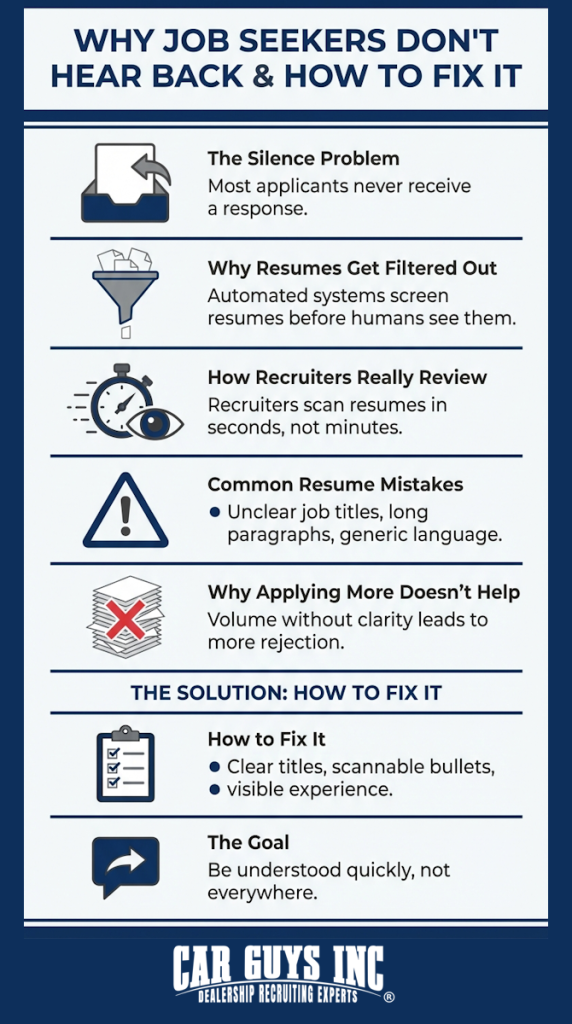
Recruiters and hiring managers receive far more applications than they can realistically review. Many roles attract hundreds of candidates within days. Some attract thousands.
In that environment, silence becomes the default outcome.
Not because you were bad, but because you were filtered out before a human ever made a decision.
Most Resumes Never Reach a Human
One of the biggest misconceptions in job searching is believing every resume gets reviewed.
It does not.
Most companies use automated systems to screen resumes before a recruiter ever sees them. These systems look for patterns, keywords, and structure. If your resume does not align quickly, it is removed from consideration automatically.
That means a strong candidate can be rejected simply because their resume is unclear, outdated, or hard to scan.
The Real Reason Recruiters Skip Resumes
Recruiters are not reading resumes line by line.
They are scanning.
In many cases, they spend less than ten seconds deciding whether to continue or move on. If they cannot quickly understand what you do, what level you operate at, and why you fit the role, they move forward without you.
This is not laziness. It is survival in a high volume system.
Common Mistakes That Lead to Silence
Most job seekers repeat the same mistakes without realizing it.
Some of the most common include:
- Generic job titles that do not match what employers search for
- Long paragraphs instead of scannable bullet points
- Listing responsibilities instead of outcomes
- Applying broadly without tailoring the resume to the role
- Assuming effort matters more than clarity
None of these reflect intelligence or capability, but they do affect visibility.
Why Applying More Rarely Solves the Problem
When people stop hearing back, their instinct is to apply more.
➕More applications.
➕More resumes.
➕More hours spent searching.
Unfortunately, volume without clarity often produces the same result faster.
If your resume is not working, applying to more roles only increases the number of times it is filtered out.
Fixing the signal matters more than increasing the noise.
How to Make Your Resume Work for You
A strong resume does one thing well.
It makes the recruiter’s job easier.
That means:
- Clear job titles that reflect your actual role
- Bullet points that show impact, not just duties
- Language that mirrors how the job is described
- A structure that highlights what matters first
The goal is not to impress. The goal is to be understood quickly.
Visibility Matters More Than Perfection
Many job seekers wait to apply until everything feels perfect.
The resume.
The timing.
The role.
Meanwhile, recruiters are reaching out to candidates who are visible, current, and easy to assess.
You do not need a perfect resume and cover letter. You need a readable one.
You do not need to apply everywhere. You need to be discoverable where hiring actually happens.
Silence Is Often a Signal, Not a Verdict
Not hearing back does not mean you are unqualified.
It usually means:
- Your resume did not pass an automated screen
- A recruiter could not quickly see the fit
- The role was already in progress internally
- Timing did not align
Understanding this removes much of the emotional weight from the process.
How to Fix the Problem Long Term
The most effective job seekers focus on preparation, not panic.
They:
- Update their resume regularly, not only when unhappy
- Make their experience easy to scan and understand
- Stay visible even when not actively applying
- Improve clarity instead of increasing volume
This approach does not guarantee instant results, but it dramatically improves response rates over time.
Use AI as a Screening Partner
Your resume does not get reviewed in isolation. It is evaluated against a specific role.
When you upload your resume and job description AI can help identify:
- Whether your experience clearly matches the role requirements
- Gaps between what the employer wants and what your resume highlights
- Keywords and phrases recruiters expect to see
- Sections of your resume that should be emphasized or de-emphasized
- Areas where clarity matters more than adding content
This mirrors how applicant tracking systems and recruiters actually evaluate candidates.
AI Prompt:
Review my resume as if you are a recruiter screening candidates for the job description below.
Compare my resume directly against the role requirements and focus on:
- How clearly my current role and experience align with this position
- Whether my job titles and skills match what the employer is searching for
- What would cause my resume to be filtered out or skipped
- Which sections should be reordered or emphasized
- Any missing keywords or concepts that affect visibility
Provide specific, actionable feedback to improve clarity, relevance, and recruiter readability.
First, summarize whether I would likely be screened in or out, and why.
When used this way, AI stops being a writing tool and starts functioning like a screening partner.
The Goal Is Not to Hear Back From Everyone
The goal is to hear back from the right ones.
Job searching is not a measure of your worth. It is a system, and systems can be learned.
When you understand how silence happens, you can stop taking it personally and start fixing what actually matters.
And once you do, hearing back becomes far more common than being ignored.
CarGuys Inc. connects skilled automotive professionals with dealerships and repair shops across the country using intelligent matching technology.
Instead of flooding candidates with irrelevant openings, we focus on fit, timing, and transparency. Upload your resume once, and when the right opportunity matches your experience, you are notified.
No noise. No pressure. Just the right opportunity at the right time.