
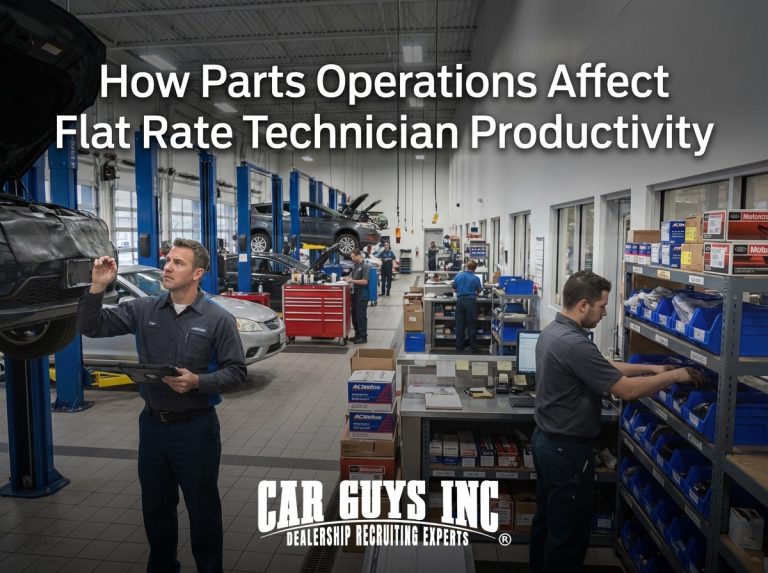
In most dealerships and repair shops, technician productivity gets judged by billed hours, flagged hours, efficiency, and turnaround time. However, one of the biggest factors affecting all of those numbers often sits outside the technician’s control: parts inventory.
A technician can be skilled, motivated, and capable of producing strong flat rate hours, but if the right parts are not available when needed, productivity drops fast. Every missing component, delayed special order, mislabeled bin, or disorganized shelf can turn a productive repair day into wasted time, stalled repair orders, and frustrated staff.
This is why parts operations are not just a back-end function. They directly affect technician output, service department throughput, customer satisfaction, and profitability. If service managers want stronger technician performance, they cannot look only at the shop floor. They also have to look at how well parts and service work together.
Technician Productivity Depends on More Than Technician Skill
When managers talk about technician productivity, the conversation usually centers around labor performance, skill level, training, dispatching, and bay utilization. Those matter, of course. Still, even the best technician cannot maintain strong flat rate efficiency if the workflow keeps getting interrupted by parts issues.
A technician loses momentum every time work stops because a part is unavailable, incorrect, hard to locate, or delayed. That interruption creates dead time that often cannot be recovered later in the day. In a flat rate environment, those small delays add up quickly and can quietly drag down billed hours across the entire shop.
This is where many operations miss the real issue. They assume the productivity problem lives with the technician, when in reality the root cause may be poor inventory accuracy, weak bin organization, or a lack of alignment between service and parts.
How efficient is your shop? Use out Technician Productivity Calculator to find out now.
Lost Billed Hours Due to Missing Parts
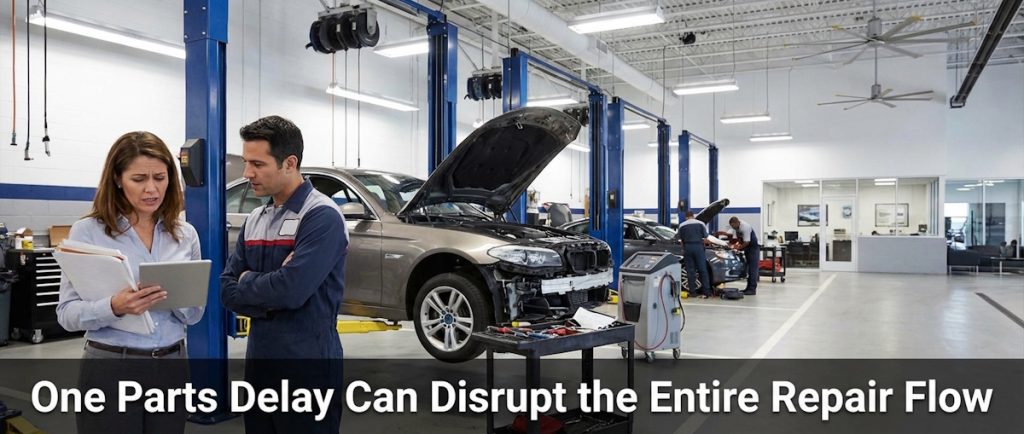
Missing parts create one of the most expensive forms of downtime in a service department. A vehicle is already in the shop, the technician has begun the job, and then progress stops because a needed part is not available.
From that moment forward, productivity suffers in several ways.
First, the technician loses time diagnosing, disassembling, and preparing the job without being able to complete it. Second, they have to stop, clean up, move on, and mentally reset for a different repair. Third, when the part finally arrives, the technician has to re-engage with that original job, which usually creates more inefficiency than if the work had flowed straight through the first time.
In a flat rate model, that disruption matters. Technicians make money by producing billed hours, not by waiting, rechecking parts status, or repeatedly touching incomplete jobs. When missing parts become common, technician morale often suffers right alongside productivity.
For the service department, the impact is broader. Fewer completed repairs mean fewer billed labor hours, slower vehicle turnaround, reduced daily throughput, and lower revenue per bay.
Delayed Repair Orders Increase Comeback Risk
Delayed repair orders do more than hold up a single job. They create friction throughout the operation.
When an RO gets delayed for parts, the vehicle may sit on the lot, take up space, require repeated updates, and create uncertainty for both the customer and the advisor. If multiple repair orders stall this way, the service lane starts to feel congested and reactive. Advisors spend more time chasing updates, customers grow impatient, and technicians lose rhythm.
The longer a repair stays open, the more opportunities there are for mistakes. Notes get missed. Parts get mixed up. The vehicle may change hands more than once. A technician may need to revisit prior work after several other jobs have already passed through the bay. All of that increases the risk of errors and comebacks.
Comebacks are especially damaging because they hit both labor and trust. They consume technician time that could have gone toward new billed work, and they weaken the customer’s confidence in the repair experience. In many cases, what looks like a technician performance issue actually began with a parts-related delay that disrupted the repair process.
Poor Bin Management Slows Technicians Down
Not every productivity problem comes from a part being out of stock. Sometimes the part is in the building, but poor bin management makes it functionally unavailable.
If technicians or parts staff cannot quickly find the right item, verify it, and get it to the bay, time gets wasted just the same. A part sitting in the wrong location, labeled incorrectly, buried behind obsolete parts inventory, or separated from related components can cause unnecessary delays that chip away at efficiency all day long.
Poor bin management slows operations in ways that are easy to overlook because each individual delay may seem small. Maybe it takes five extra minutes to locate a part. Maybe the wrong box was pulled first. Maybe a technician walks back and forth multiple times waiting for clarification. Maybe a fast-moving item was not replenished where it should have been.
These are not harmless little inconveniences. In a busy shop, repeated delays like this can cost hours of productive labor over the course of a week. They also create frustration between departments, especially when technicians feel like they are ready to work but the system around them keeps slowing them down.
Strong bin management does the opposite. It supports faster parts retrieval, cleaner handoffs, fewer interruptions, and more consistent technician workflow.
Flat Rate Efficiency Suffers When Flow Breaks Down
Flat rate technicians perform best when work moves continuously. They need a steady stream of repair orders, the right information, the right approvals, and the right parts at the right time. Once that flow breaks, efficiency drops.
This is why parts operations should be viewed as a productivity lever, not just an inventory responsibility. A well-run parts department helps technicians stay in motion. A poorly run one creates stop-and-start conditions that make strong flagging almost impossible.
When that happens, the consequences extend beyond daily numbers. Skilled technicians notice operational friction. If they consistently lose earning opportunities because of parts delays, they may become disengaged or start looking elsewhere. In a competitive hiring market, shops and dealerships cannot afford to let preventable inefficiencies drive away productive technicians.
Protecting technician productivity is not only about hiring better people. It is also about removing the operational barriers that keep good people from producing at a high level.
Why Service Managers Must Align With Parts Managers
Service managers and parts managers cannot operate in separate lanes if the goal is better productivity. Their departments are too interconnected.
Service drives demand. Parts supports execution. If the two are not aligned, technicians feel the pain first.
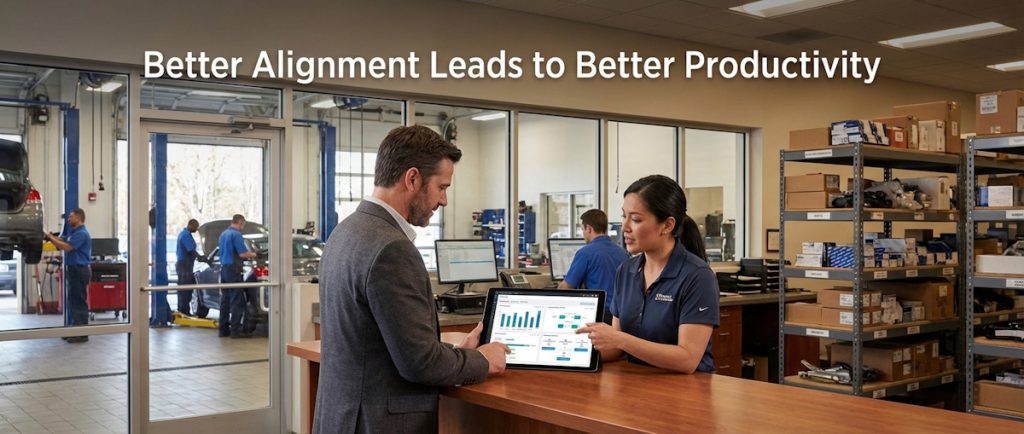
Strong alignment starts with shared visibility. Parts managers need to understand which repairs are most common, which parts move fastest, where delays are happening, and which shortages repeatedly affect shop throughput. Service managers need visibility into inventory realities, fill rates, special-order timing, and recurring breakdowns in parts availability.
Without that communication, both departments tend to optimize for their own metrics instead of overall shop performance. Parts may focus heavily on inventory control while service focuses on speed, but the real win comes when both sides work toward technician efficiency, faster cycle time, and smoother repair flow.
This alignment becomes even more important in high-volume environments where a small breakdown can affect multiple repair orders in the same day. The more moving pieces a department has, the more costly poor coordination becomes.
Signs Your Parts Operation Is Hurting Technician Output
Many leaders do not realize how much inventory and organization issues are hurting productivity until the warning signs pile up. Common indicators include:
- Technicians frequently waiting on parts after diagnosis has already begun
- Repair orders staying open longer than expected because of parts delays
- Advisors repeatedly checking status on the same vehicles
- Technicians leaving bays to chase down parts information
- Parts that show in stock but cannot be located quickly
- Repeated mis-pulls or incorrect parts being issued
- Growing frustration between technicians, advisors, and parts staff
- Comebacks or rework tied to disrupted repair flow
When these patterns show up regularly, the issue is usually not isolated. It is a system problem, and system problems require process fixes, not blame.
How to Improve Productivity Through Better Parts Operations
Improving technician productivity through parts does not always require a major overhaul. Often, the biggest gains come from tightening a few core processes.
Start by identifying the most common causes of delay. Look at where technicians lose time waiting, where parts errors happen most often, and which repair orders get held up repeatedly. Then review bin organization, labeling, stocking strategy, and handoff procedures.
Cycle counts and inventory accuracy matter, but so does usability. An inventory system can look acceptable on paper and still slow down the shop in practice if parts are hard to find or poorly organized.
It also helps to create tighter feedback loops between technicians, advisors, service managers, and parts managers. If technicians repeatedly lose time because of the same issue, leadership should know about it quickly. Small recurring friction points often reveal the biggest opportunities for improvement.
Finally, leadership should evaluate parts performance not only by inventory metrics, but by operational impact. The question is not just whether the part is in stock. The question is whether the parts process helps technicians complete more work, more smoothly, with fewer interruptions.
Better Parts Operations Lead to Better Shop Performance
When parts inventory is accurate, bins are organized, and communication between service and parts is tight, technician productivity improves. Repairs move faster. ROs stay cleaner. Advisors spend less time chasing updates. Customers experience fewer delays. Technicians flag more hours. The department generates more revenue with less friction.
That is why parts operations deserve more strategic attention than they often get. They are not just a support function. They are part of the productivity engine.
Service managers who want stronger flat rate efficiency need to view parts as an operational partner, not a separate department. When service and parts align, technicians can do what they do best: stay productive, complete repairs efficiently, and keep the shop moving.
CarGuys Inc. is an automotive recruiting agency built exclusively for the car business. From technicians and service advisors to salespeople and managers, we connect dealerships and repair shops with qualified talent faster, using nationwide reach, and years of hands-on experience.

If you want to quantify technician turnover, staffing shortages, empty bay loss, labor rate strategy, and service department profitability, visit our Service Department Calculators Hub.
With over 700 clients and thousands of hires, we don’t just fill positions;
we help build stronger teams that drive long-term success.