
Most dealership managers hear the phrase “employment contract” and immediately think of executives, lawyers, and thick documents full of fine print.
That assumption is risky.
In reality, dealership managers deal with employment contracts every single day, often without realizing it. Pay plans, offer letters, emails, and even casual promises can all create obligations that are enforceable and expensive when misunderstood.
This post breaks down what actually counts as an employment contract in a dealership, where managers get tripped up, and how to protect the store without becoming a legal expert.
Employment Contracts Are Not Just for Executives
Many managers believe contracts only apply to GMs, directors, or corporate roles. In dealerships, contracts show up in much simpler and more common forms.
Examples include:
- Written pay plans for salespeople, technicians, or advisors
- Offer letters outlining pay, schedules, or future reviews
- Emails confirming bonuses, guarantees, or role changes
- Policy acknowledgements tied to compensation or termination
If it is written, relied upon, and connected to employment terms, it can function as a contract.
The risk is not that managers use these tools. The risk is using them casually.
At-Will Employment Does Not Mean “No Rules”
At-will employment is often misunderstood at the management level.
Yes, at-will generally means employment can be ended by either party. No, it does not mean managers can promise anything today and change it tomorrow without consequences.
At-will status can be weakened by:
- Written promises of continued employment
- Guaranteed pay periods or earnings
- Language suggesting permanence or entitlement
- Inconsistent application of policies
When managers unintentionally contradict at-will language, they create confusion and exposure that HR and ownership have to clean up later.
Where Managers Accidentally Create Contracts
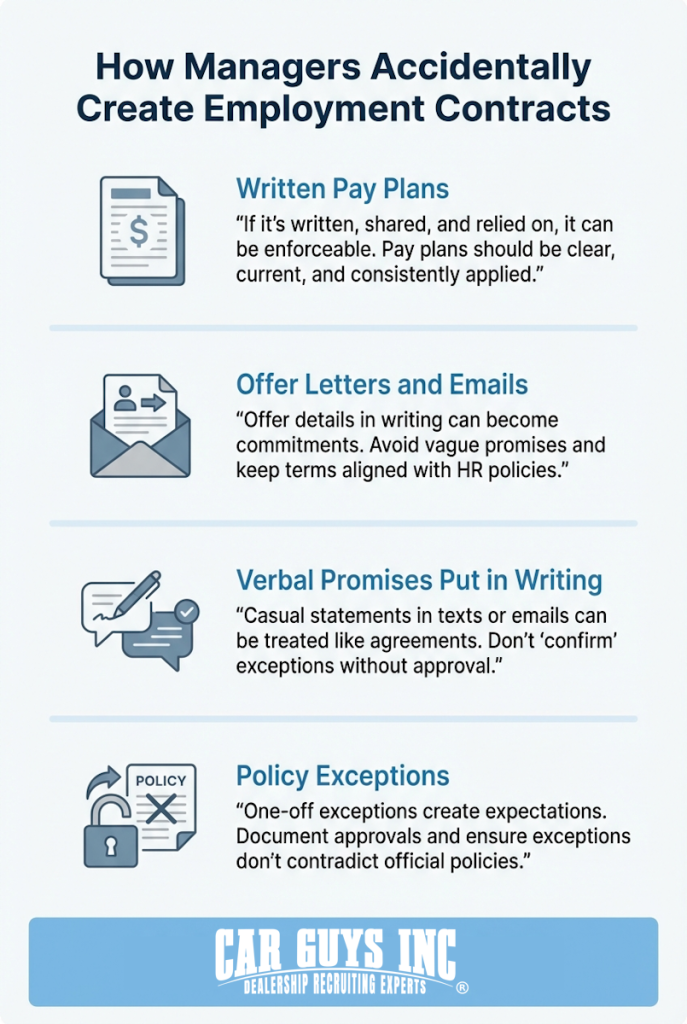
Most problems do not come from formal agreements. They come from everyday communication.
Common examples:
- “We’ll make you whole this month and adjust next month”
- “Let’s revisit your pay in 90 days”
- “This draw is temporary”
- “You’re basically guaranteed these hours”
When these statements are written down, or repeated consistently, they can be interpreted as commitments, not casual comments.
Managers rarely intend to lock the dealership into anything. Unfortunately, intent matters less than documentation.
What Managers Should Never Put in Writing
Certain phrases create outsized risk when included in offer letters, emails, or texts.
Managers should avoid language that:
- Guarantees future pay, promotions, or tenure
- Promises specific outcomes without conditions
- Suggests exceptions that are not documented elsewhere
- Overrides existing policies or pay plans
Even well-meaning reassurance can be problematic if it contradicts official documents or past practice.
Clarity protects everyone. Over-promising does not.
Why This Matters Operationally, Not Just Legally
Employment contract misunderstandings rarely stay contained.
They lead to:
- Pay disputes that kill morale
- Managers spending time in conflict instead of leading
- Inconsistent treatment across departments
- Turnover that feels avoidable in hindsight
Most dealership disputes do not start with termination. They start with confusion.
Clear expectations reduce drama, reduce turnover, and reduce surprises for both managers and employees.
The Manager’s Role vs HR’s Role
Managers are often the face of the dealership during hiring and compensation discussions. That does not mean managers should be creating or modifying employment terms on the fly.
A healthy division looks like this:
- HR defines official documents, policies, and pay plans
- Managers explain and reinforce those terms consistently
- Any exceptions go through a defined approval process
When managers and HR are misaligned, employees notice immediately.
Contracts Are Already Part of Your Job
The takeaway is simple.
If you manage people in a dealership, you are already dealing with employment contracts. Whether those contracts protect the store or expose it depends on how clearly expectations are set and communicated.
In the next article, we will go deeper into where dealerships see the most conflict, pay plans, draws, guarantees, and handshake agreements that quietly turn into disputes.
Getting this right is not about being legalistic. It is about being intentional.
CarGuys Inc. is an dealership staffing agency built exclusively for the car business. From technicians and service advisors to salespeople and managers, we connect dealerships and repair shops with qualified talent faster, using nationwide reach, and years of hands-on experience.

With over 700 clients and over 5,000 hires, we don’t just fill positions;
we help build stronger teams that drive long-term success.