

Most dealerships and repair shops agree on one thing. Background checks matter.
They protect the business, the team, and the customer experience. However, many hiring teams unknowingly lose strong candidates because of how those checks are handled, not because they exist.
When a candidate disappears late in the process, the assumption is often that the market is dry or the candidate was not serious. In reality, the hiring process itself may be creating unnecessary friction.
The goal is not to eliminate background checks. The goal is to run them in a way that protects the business without pushing good people out the door.
Why good candidates walk away at the final stage
Most hiring fallout does not happen at the job posting or interview stage. It happens right before the finish line.
This is where candidates feel the most pressure and uncertainty. They have likely interviewed elsewhere, may already have another offer, and are weighing how each employer operates.
When a background check feels rushed, invasive, or poorly explained, candidates start asking themselves hard questions.
- Is this employer disorganized
- Is this process going to get worse
- Is this worth the wait
For technicians, service advisors, sales professionals, managers, and even support roles, speed and clarity matter. The background check phase often becomes the tipping point.
Mistake one, running checks too early
One of the most common mistakes is initiating a background check during early screening.
At this stage, there is no mutual commitment. The candidate is still evaluating options, and the employer is still deciding fit.
Early checks create two problems.
First, they feel intrusive. Second, they signal mistrust before trust has been earned on either side.
Best practice is simple.
Run background checks after a conditional offer is made.
This signals respect, professionalism, and intent. Candidates are far more receptive once they understand that both sides are moving forward together.
Mistake two, lack of transparency
Candidates are rarely afraid of background checks. They are afraid of surprises.
When no one explains what is being checked, how long it takes, or how the results are used, candidates fill in the gaps themselves. Usually with worst case assumptions.
Strong hiring teams set expectations early.
They explain that a background check is part of the final step. They share what is being reviewed. They give a clear timeline.
This applies to every role, from entry level to leadership. Transparency builds trust and keeps candidates engaged through the final stages.
Mistake three, treating all roles the same
Not every position carries the same level of risk or responsibility.
A master technician, a porter, a service advisor, and a sales manager should not always be evaluated using identical criteria.
The mistake is not having standards. The mistake is ignoring relevance.
Smart operators tailor their background checks based on role requirements.
They focus on what actually impacts job performance and business risk. They avoid automatically disqualifying candidates for issues that have no bearing on the role.
This approach expands the candidate pool without lowering the bar.
Mistake four, slow processing
In today’s hiring market, speed is leverage.
If your background check process takes a week or longer, you are competing at a disadvantage. Candidates do not pause their job search while waiting for paperwork.
For technicians especially, speed matters, delays often mean losing them to a shop that moves faster.
Efficient teams reduce friction by choosing faster providers, running checks in parallel with onboarding steps, and clearly communicating timelines.
Speed does not mean cutting corners. It means respecting the candidate’s time.
The silent problem no one talks about
Most candidates who drop out never say why.
- They do not complain.
- They do not negotiate.
- They simply stop responding.
From the employer’s side, this looks like ghosting. From the candidate’s side, it feels like opting out of a process that became too heavy or uncertain.
Background checks often become the final straw, not because of what they uncover, but because of how they are handled.
A better framework for background checks
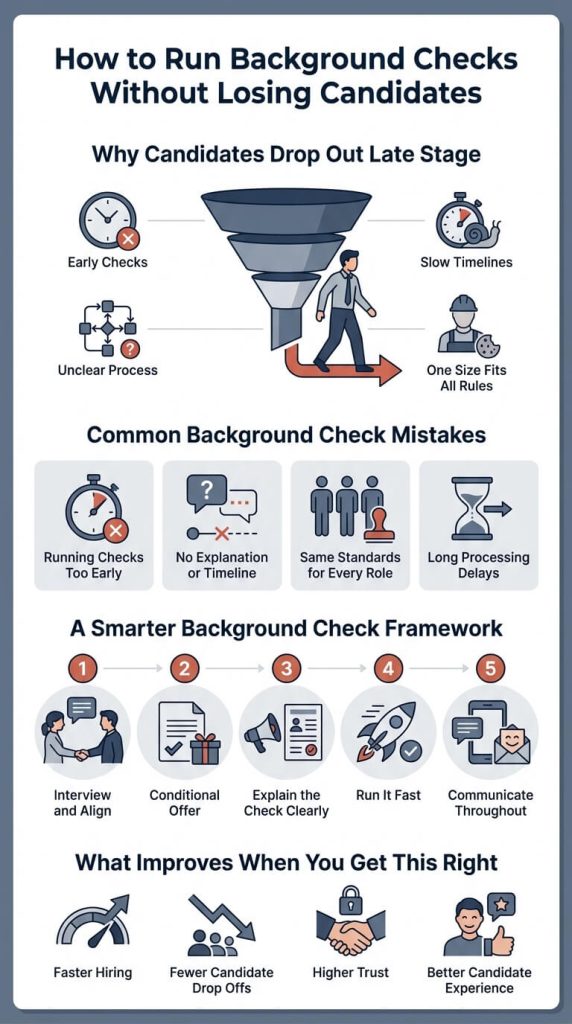
Well run hiring processes follow a simple framework.
- First, build interest and alignment early
- Second, make a conditional offer
- Third, explain the background check clearly
- Fourth, run it quickly and consistently
- Fifth, communicate throughout
This framework works across all dealership and shop roles. It protects the business while keeping candidates engaged through the finish line.
The bigger picture
Background checks are not the enemy of hiring. Poor sequencing and poor communication are.
When dealerships and repair shops treat background checks as part of a thoughtful, structured hiring system, fewer candidates fall out late. Hiring becomes faster, smoother, and more predictable.
In a competitive market, the shops that win are not the ones that skip steps. They are the ones that run them the right way.
CarGuys Inc. is an automotive recruiting company built exclusively for the car business. From technicians and service advisors to salespeople and managers, we connect dealerships and repair shops with qualified talent faster, using AI-powered tools, nationwide reach, and years of hands-on experience.
With over 700 clients and thousands of hires, we don’t just fill positions; we help build stronger teams that drive long-term success.