You have a job offer sitting in front of you. Maybe it came after a recruiter reached out, or you applied directly and made it through the interview process. Either way, this is the moment that matters. Before you sign anything, you need to know exactly what you are agreeing to, what you are walking into, and whether this opportunity actually moves your career forward.
At CarGuys Inc., we work with parts managers across the country every day, and we have seen candidates accept offers that looked great on the surface but left them frustrated within six months. We have also seen people walk away from dealerships that would have been exactly the right fit, simply because they did not know what questions to ask. This guide will help you slow down, evaluate clearly, and make a decision you feel confident about.
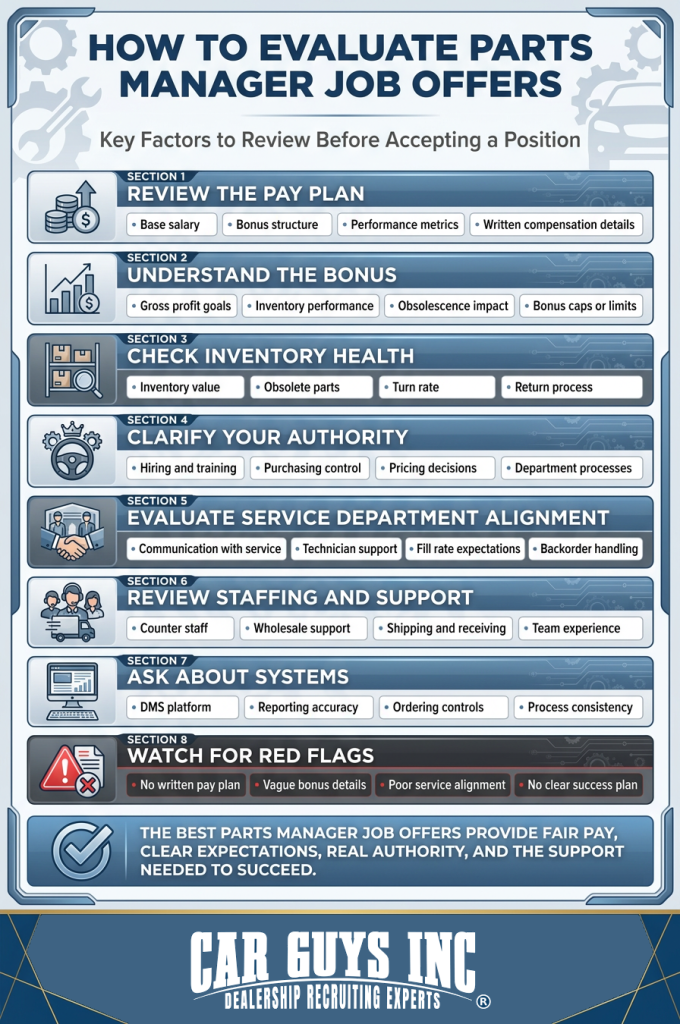
Start With Total Compensation, Not Just Base Salary
The base salary number is just the beginning. Parts manager compensation at dealerships varies significantly by store volume, ownership group, and pay plan structure. A $60,000 base at one store might be worth far more than a $75,000 base somewhere else when you factor in what else is on the table.
Here is what to review carefully:
- Bonus structure: Is there a monthly or quarterly bonus tied to department gross profit, fill rates, inventory turns, or customer satisfaction? Ask for specifics and examples of what team members earned in the past 12 months.
- Benefits package: Health, dental, vision, and life insurance premiums vary widely. A higher salary with poor benefits coverage can cost you more out of pocket than a modest salary with strong coverage.
- Paid time off: How much vacation time do you start with? Does it grow with tenure? Are there paid holidays?
- Retirement plan: Does the dealership offer a 401(k)? Is there an employer match, and when does it vest?
- Vehicle allowance or demo: Some stores offer a vehicle allowance or demo for managers. If it is offered, understand the terms and any associated tax implications.
When you have all these numbers in front of you, calculate your total annual compensation package, not just what appears on the first line.
Understand the Pay Plan and How It Actually Works
This is where many candidates make a costly mistake. Pay plans in the parts department can be structured in ways that sound generous but are difficult to hit in practice. Before you accept any offer tied to performance, ask for a breakdown of how the plan is calculated and what the average parts manager at that store earned in the past year.
Key questions to ask:
- What metrics determine my bonus, and how is each one measured?
- What was the department’s gross profit last year, and what is the target for the current year?
- Are there caps on what I can earn through bonuses?
- Is my bonus tied to the performance of other departments, like service absorption rates?
If the manager before you was there for years and consistently earned at or near the cap, that is a good sign. If the store cannot give you a clear answer on what recent parts managers actually took home, that warrants a follow-up conversation before you move forward.
Evaluate the Dealership’s Operational Health
Your income as a parts manager is directly tied to the dealership’s performance. A store with high service volume, strong wholesale business, and a well-managed inventory gives you something to work with. A struggling store, even with a compelling offer, puts you in a difficult position from day one.
Look at the following signals:
- Service department capacity: A busy service drive means consistent internal parts demand. Ask about technician headcount and bay count.
- Wholesale business: Does the store actively pursue wholesale accounts? This can significantly increase your department’s volume and affect your bonus.
- Inventory management: Ask how the previous manager handled obsolescence. A parts department with a large percentage of dead stock signals past problems that you would inherit.
- DMS platform: What dealer management system do they use? If you are experienced with a specific platform, getting up to speed on a new one takes time and can affect early performance.
You are not just evaluating a job. You are evaluating the environment in which you will be expected to perform.
Read the Culture Before You Read the Contract
Compensation matters, but so does the day-to-day reality of where you are going. A parts manager role can be deeply rewarding when leadership is supportive and expectations are clear. It can be frustrating when communication is poor, and the service department views parts as an obstacle rather than a partner.
During your interview and any follow-up conversations, pay attention to how people talk about the store. Ask to meet the service director or fixed ops manager, since that relationship will define a significant portion of your experience. Ask questions like:
- How does the parts department collaborate with the service team?
- What does success look like in this role in the first 90 days?
- What happened with the previous parts manager, and how long were they in the role?
Understanding high turnover in the parts department is worth doing before you start. Sometimes the last person simply wasn’t a fit. Sometimes there is a structural problem that keeps cycling through managers. You want to know which situation you are walking into.
Assess the Growth Opportunity, Not Just the Role
A parts manager position is not always the end of the road – for some candidates, it is a stepping stone into fixed operations management, general management, or even ownership track programs. Whether or not advancement matters to you right now, it is worth understanding the dealership’s long-term expectations for this role.
Ask directly:
- Is there a path to Fixed-Ops director or other leadership roles at this store or within the ownership group?
- Does the ownership group have multiple points, and does that create internal mobility?
- Are there training or certification opportunities supported by the dealership?
Even if you are not actively chasing a promotion, a dealership that invests in its people will almost always treat you better than one that views the parts manager as a replaceable utility.
Know Your Walk-Away Number Before You Sit Down to Negotiate
Before you respond to any offer, clarify your own requirements. What is the minimum compensation package you would accept? What specific terms, if missing, would cause you to decline? Having this clarity in advance keeps you from making an emotional decision in the moment.
If the initial offer is below what you need, negotiate. Most dealerships expect it. Come prepared with data on market compensation for your region and experience level, speak specifically about the value you bring, and focus on total compensation rather than any single component. A well-prepared, confident counteroffer is rarely penalized.
If the dealership is unwilling to move on any terms, that tells you something about how they operate and what you would experience once you are in the role.
CarGuys Inc. connects skilled automotive professionals with dealerships and repair shops nationwide through intelligent matching technology. Instead of flooding candidates with irrelevant openings, we focus on fit, timing, and transparency.
Upload your resume once, and when a matching opportunity arises, you will be notified. No noise. No pressure. Just the right opportunity at the right time.