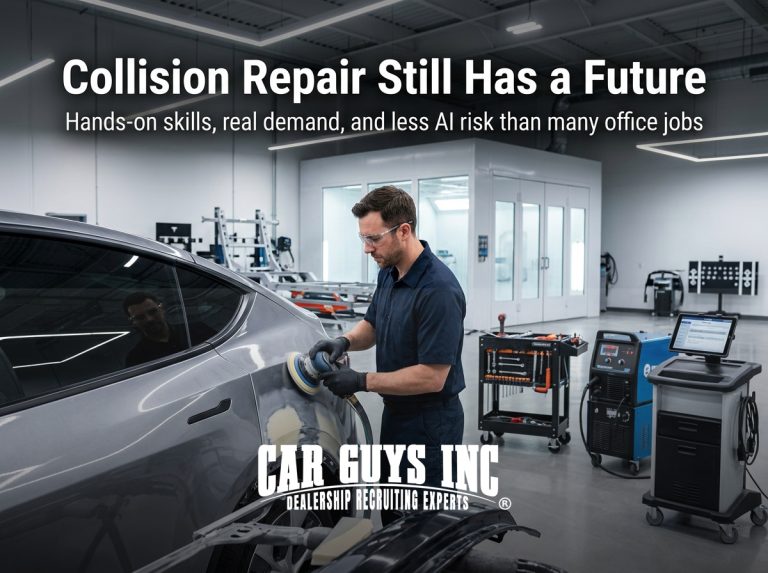
For people who like working with their hands, solving problems, and seeing the results of their work at the end of the day, collision repair still deserves a serious look.
It may not get talked about as much as tech, healthcare, or remote office jobs. Still, collision repair remains one of the more practical skilled-trade career paths in the automotive world. The field offers steady demand, a hands-on work environment, and several ways to grow your income and skill set over time. While the U.S. Bureau of Labor Statistics projects only modest growth for automotive body and glass repairers from 2024 to 2034, about 16,000 openings per year are still expected, mostly driven by replacement needs as workers retire or leave the field.
Why collision repair still makes sense
Cars are not getting simpler. In many ways, they are becoming harder to repair properly.
A modern collision repair technician is no longer just pulling dents and replacing panels. Today’s vehicles often include sensors, cameras, radar systems, advanced materials, and complex manufacturer repair procedures. That raises the skill ceiling. This is good news for people willing to learn. NHTSA notes that driver assistance technologies are a major part of modern vehicle safety. I-CAR highlights that ADAS calibrations and scanning are now critical to proper repair work.
Collision repair now moves away from the stereotype of ‘just body work.’ It is a blend of structural repair, refinishing, diagnostics, and safety-centered repair planning. Shops need people who can adapt and train for changing vehicle technology, not just those who do repairs the same way for 20 years. ASE’s current collision repair certification tracks reflect that range. They include structural analysis, painting, refinishing, non-structural analysis, mechanical and electrical components, and damage analysis.
The real advantage is that skilled trades are harder to outsource
One big reason collision repair still looks smart is simple: the work has to be done in the real world, on real vehicles, by trained people.
Many white-collar workers wonder if software or AI could replace them. That is a fair question. But collision repair is different. You cannot fully automate disassembly, structural measuring, welding, refinishing, panel alignment, quality control, or post-repair verification from a laptop. Even when software helps, someone still must do the repair safely and correctly.
That gives collision repair a level of protection many desk-based roles do not have.
What about AI? Will it replace collision repair jobs?
The honest answer is:
AI will probably change collision repair, but it is far more likely to assist technicians than replace them.
AI and software are already helping with estimating, workflow management, image capture, documentation, parts identification, and repair planning. Schools are even being trained to estimate and integrate diagnostic tools, as that software is now part of modern repair operations.
But the actual repair side still depends on physical skill, judgment, and accountability. A vehicle with collision damage is not a spreadsheet. It has hidden damage, fitment issues, OEM procedures, calibration requirements, refinishing variables, and safety consequences. I-CAR notes that ADAS calibration can serve as a final quality check and even reveal improper repairs that could interfere with sensor performance.
So the better question is not, “Will AI eliminate collision repair jobs?”
It is, “Which collision repair workers will benefit most from AI?”
The answer is the people who can combine hands-on skills with modern tool use. In other words, technicians, estimators, and repair planners who know how to use technology will become more valuable. Those who resist learning may struggle more than those who embrace it.
That is actually a bullish sign for the career.
Job security is still there, but it looks different now.
Collision repair may not have explosive projected job growth on paper, but job security is not just about headline growth rates. It is also about replacement demand, barriers to entry, and how hard a role is to automate.
The Bureau of Labor Statistics projects the occupation will grow 2 percent from 2024 to 2034. Roughly 16,000 openings are expected each year. In plain English, shops will continue to need people, especially as older workers leave the trade.
On top of that, industry groups continue to describe a technician shortage in collision repair. The Collision Repair Education Foundation has repeatedly pointed to an ongoing shortage and the need to strengthen the pipeline of trained workers entering the field.
So while this is not the kind of career where everyone works from home and talks about disruption all day, it is the kind of career where useful skills can keep you employed for a long time.
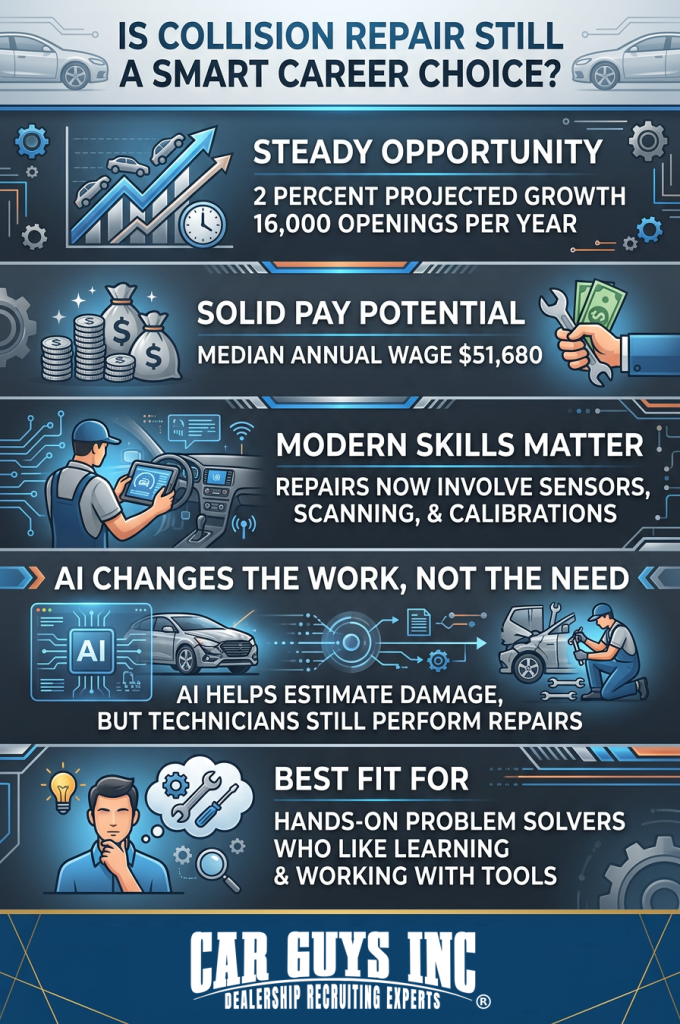
So, who is a good fit for collision repair? Consider these qualities:
Collision repair can be a smart choice for someone who:
- prefers hands-on work over sitting behind a desk
- likes solving practical problems
- enjoys working with tools, equipment, and visible results
- wants a career path that can grow with training and certifications
- is comfortable learning new technology over time
It can be especially attractive for people who want a more direct route into a skilled trade without spending years in a traditional four-year college path.
The downside is that it is not for everyone.
A smart career choice that isn’t right for everyone.
Collision repair can be physically demanding. It requires attention to detail, patience, and a willingness to follow procedures. The environment can be fast-paced, and the standard for safe, correct repair is only getting higher. People looking for a low-effort job or a career with no ongoing learning curve may not enjoy it.
That said, for the right person, those same demands are what make the career valuable.
Final thoughts
Yes, collision repair is still a smart career choice, especially for people who want practical, durable skills in a world where many jobs are becoming easier to automate.
AI will absolutely influence the industry. It will improve estimating, documentation, diagnostics, and workflow. But it is not about to replace the need for trained professionals who can inspect damage, repair vehicles correctly, restore safety systems, and stand behind their work. Current repair complexity, especially around ADAS and OEM procedures, arguably makes skilled collision professionals more important, not less.
For someone who is willing to train, adapt, and keep learning, collision repair still looks like a career with staying power.
CarGuys Inc. connects skilled automotive professionals with dealerships and repair shops nationwide through intelligent matching technology.
Instead of flooding candidates with irrelevant openings, we focus on fit, timing, and transparency. Upload your resume once, and when a matching opportunity arises, you are notified.
No noise. No pressure. Just the right opportunity at the right time.