
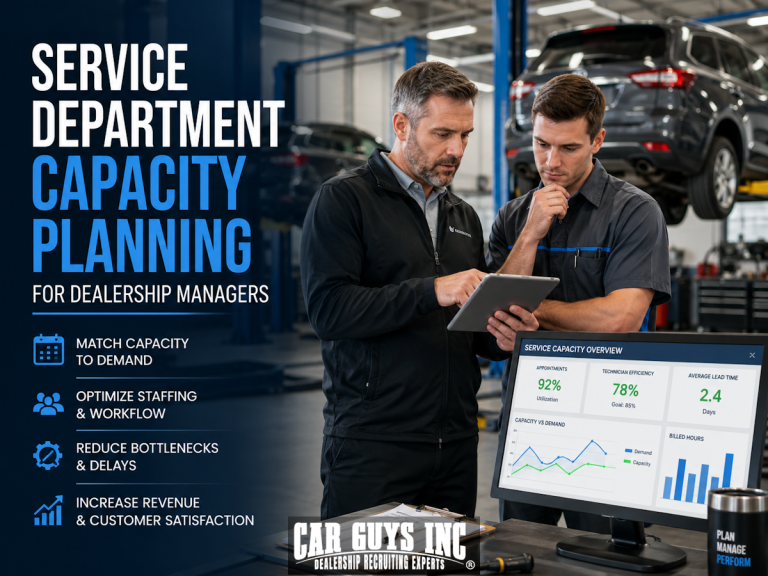
At first glance, a busy service department, with packed schedules, hustling advisors, and productive technicians, looks successful. However, experienced dealership managers know that simply being busy does not mean the department is operating at its best capacity.
When demand outpaces capacity, issues surface quickly. Lead times grow, technicians are stretched, advisors struggle, parts cause slowdowns, customers wait, and steady service revenue becomes harder to capture.
Capacity planning is essential for service departments. It allows managers to assess whether their team can keep up with demand, pinpoint where slowdowns occur, and make timely adjustments to staffing, scheduling, or workflow. By planning ahead, managers can address potential issues before they impact revenue, customer satisfaction, or technician retention.
What Service Department Capacity Planning Really Means
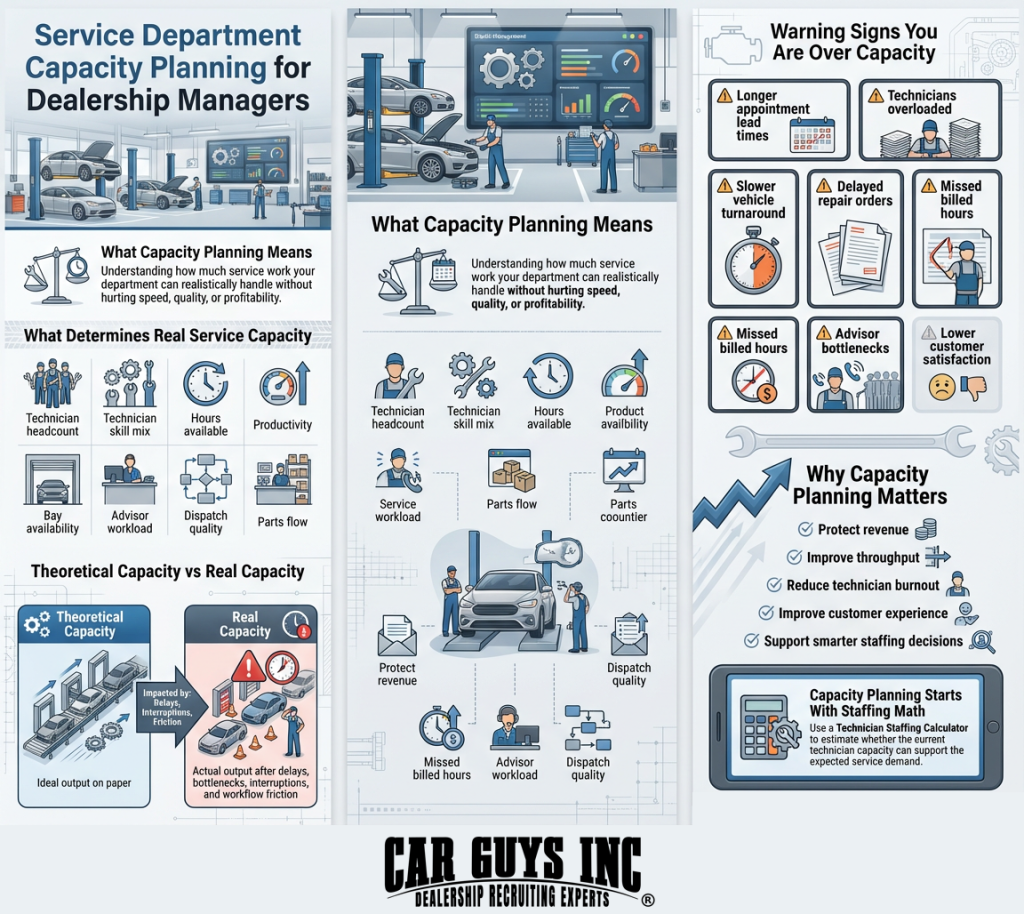
Capacity planning in a service department is about understanding how much work your team can take on without compromising quality, speed, or profitability.
This may sound straightforward, but many dealerships underestimate just how many factors influence capacity. It goes beyond counting service bays or technicians; the real measure is how well the team turns demand into completed work efficiently.
A department may look large on paper, but still struggle with capacity if technicians are unevenly loaded, advisors are overwhelmed, dispatch is inconsistent, or parts availability slows repair flow. On the other hand, a well-managed store with fewer resources can sometimes outperform a larger department simply because it plans and manages capacity more effectively.
Ultimately, capacity planning helps managers answer a critical question: How much service work can this department reliably and profitably support in day-to-day operations?
Why Capacity Problems Hurt Revenue Before They Become Obvious
One of the biggest mistakes in fixed ops is assuming capacity is fine until the department feels broken. By the time the schedule is packed several days out, technicians are frustrated, and customers are waiting too long, the capacity problem has already been hurting performance for a while.
Revenue loss often starts earlier.
When a department operates beyond what it can handle, billed hours often drop. Technicians get pulled in several directions, repair jobs are delayed waiting for parts, and advisors may not have time to fully present or manage recommended work. Routine maintenance can crowd out more profitable repairs, and dispatching becomes reactive instead of strategic. While the shop appears busy, this doesn’t always translate to efficient workflow or maximum profit.
Capacity strain also affects customer experience. When lead times rise and vehicle turnaround slows, the dealership is less convenient. Customers may delay repairs, decline work, or take vehicles elsewhere. Even when demand is high, the department may struggle to convert it into completed labor sales.
Capacity issues don’t begin when the calendar is packed; they start as soon as the department struggles to keep up with demand smoothly.
The Difference Between Theoretical Capacity and Real Capacity
Many managers get confused by this distinction.
Theoretical capacity is the output a department could reach if everything went perfectly, with no real-world interruptions. For example, 10 technicians working 8 hours each would seem to provide 80 technician hours per day; but that’s just an ideal scenario.
Real capacity is different; it’s what the department can actually achieve once everyday delays and challenges are factored in.
That friction includes things like:
- Uneven technician skill levels
- Delays in dispatch
- Poor appointment spacing
- Unavailable or late-arriving parts
- Waiting on approvals
- Interjections from comebacks
- Diagnostic complexity
- Shop layout inefficiencies
- Advisor overload
- Warranty work that ties up time differently than customer-pay work
That’s why two shops with the same number of employees can have vastly different outcomes. One may turn available hours into billed work, while the other loses time because of workflow issues.
Managers who plan based on theoretical capacity assume they have more room than they actually do, leading to overscheduling, technician frustration, and lost work.
The Core Inputs That Determine Service Department Capacity
To plan service capacity properly, managers need to view the department as a system, not just a headcount.
Technician headcount
The total number of technicians matters, but headcount alone is not enough. A store with the right number of technicians can still be under-capacity if the team lacks the right experience mix or if a few strong producers are carrying too much of the load.
Technician skill mix
Not all labor demand is the same. Quick service work, diagnostics, heavy line repairs, warranty jobs, and internal work place different demands on the shop. If the department has too many entry-level technicians and not enough experienced diagnostic talent, capacity may look acceptable on paper. However, the repair flow can still slow down in practice.
Hours available
Managers should know how many technician hours are actually available, taking into account schedules, attendance, training time, vacations, and other factors. Gross capacity calculations built on unrealistic availability assumptions can distort planning.
Productivity and efficiency
A technician who is clocked in for 8 hours does not automatically produce 8 billed hours. Productivity and efficiency are critical multipliers in real capacity. If the store does not account for how technician time converts into completed work, capacity planning becomes guesswork.
Bay availability
Bays matter, but they do not define capacity on their own. A dealership can have enough bays and still create bottlenecks if technicians are waiting, repairs are stalled, or vehicles are stacked inefficiently.
Advisor workload
A packed advisor schedule can quietly limit throughput. When advisors are overloaded, write-ups slow down. Communication suffers, approvals lag, and upsell opportunities get missed. Capacity planning should include the front-end workload that supports the shop.
Dispatch quality
Poor dispatch can destroy capacity even when staffing looks adequate. If high-skill work is routed poorly, jobs sit. Technicians may spend too much time waiting or switching tasks. The department loses productive hours without realizing it.
Parts flow
Parts operations have a major impact on service capacity. Missing parts or delays in locating items can stall jobs that should be moving quickly through the shop. Poor coordination between service and parts can amplify these issues.
Work mix
A department heavily weighted toward maintenance work operates differently than one with a large volume of diagnostics, warranty repairs, and heavy line jobs. Managers need to understand what kinds of work are filling the schedule, not just how full it looks.
Why Bay Count Alone Can Be Misleading
Bay count is one of the most common shortcuts managers use when thinking about capacity, but it often creates a false sense of understanding.
A dealership might have ample space and still underperform if its limiting factor is not the building but technician skill, advisor load, dispatch, or parts. Filling more appointments to use open bays doesn’t always increase effective capacity; it just adds pressure.
The opposite can also happen. Some departments assume they need more space when what they really need is better workflow. If vehicles sit too long waiting for approvals or parts, bays become storage rather than production space. That is not a building problem. It is a process problem.
Capacity planning becomes more accurate when the bay count is viewed as one variable among many, rather than the central answer.
Warning Signs That Your Department Is Running Past Capacity
Many service departments do not formally measure capacity, yet they still exhibit clear warning signs when demand outpaces execution.
Here are some of the most common indicators:
- Appointment lead times keep getting longer.
- Technicians are busy, but billed hours are not rising proportionally.
- Advisors seem overloaded, and follow-up slows down.
- Repair orders remain open longer than expected.
- Customers wait too long for updates or for their vehicles to be completed.
- High-value work gets delayed by poor schedule balance.
- The comeback risk increases as technicians rush or get interrupted.
- Morale starts slipping because the shop feels constantly behind.
- Managers spend more time putting out fires than planning workload.
These signs matter because they often show up before leadership fully connects them to capacity planning. Without that connection, managers may blame performance issues on isolated staff problems. In reality, the department may be trying to do more than it can cleanly support.
Capacity Planning Starts With Technician Staffing Math
A large part of service department capacity planning comes down to staffing. Dealership managers often know the shop feels overloaded, but they have not translated that pressure into technician-hour demand and staffing requirements.
That is where math becomes useful.
If your department expects a certain volume of repair orders, labor hours, or billed work each week, you need to know whether your current technician team can realistically support that workload at your actual productivity levels. If not, the store will start absorbing the gap through delays, rushed work, burnout, or lost repair opportunities.
If you are trying to estimate whether your current team can support expected service demand, our Technician Staffing Calculator can help you translate workload assumptions into staffing needs. It is a practical way to evaluate technician capacity before delays, overload, and lost labor sales become bigger problems.
How Technician Productivity Changes Real Capacity
Two departments with the same number of technicians can have very different service capacity because technician productivity changes the output of the entire system.
That matters because many dealerships first look to headcount when performance slips. However, the issue is not always a raw shortage of technicians. Sometimes the bigger issue is that technician time is being diluted by poor workflow, inconsistent dispatch, or operational friction.
For example, if a department assumes every technician can generate a certain level of billed hours, but actual productivity is much lower, the store will overestimate its ability to absorb work. That leads to overscheduling and frustration.
On the other hand, departments that improve shop flow, reduce avoidable delays, and better align work to technician strengths may increase usable capacity without immediately adding headcount.
That does not mean productivity improvements replace hiring. It means managers should understand both sides of the equation. Capacity planning is stronger when it considers how technician performance and operational design work together.
Common Capacity Planning Mistakes in Dealership Service Departments
Even experienced managers can miss the mark if capacity planning is based on assumptions instead of actual operating conditions.
Treating every technician the same
A department with 12 technicians does not necessarily have 12 equal producers. Experience, skill level, work mix, and consistency all affect output. Planning capacity as though every technician contributes the same way leads to distorted expectations.
Confusing busyness with efficiency
A busy shop is not always an efficient one. Technicians can be constantly occupied while the department still loses billed hours due to service drive bottlenecks, interruptions, or poor coordination.
Ignoring front-end bottlenecks
Capacity does not start in the shop alone. Advisors, appointment flow, and communication processes all influence how effectively the department can move vehicles through service.
Planning for average demand only
Average demand can hide peak-period stress. Capacity planning should account for the heavier days and weeks that expose staffing and workflow weaknesses.
Waiting too long to act
Some stores wait until lead times are already excessive and technicians are frustrated before addressing capacity. By then, revenue loss and customer friction are already happening.
Assuming hiring is the only answer
Hiring matters, but it is not the only lever. Some departments need more technicians. Others need better schedule discipline, stronger dispatch, improved advisor capacity, or tighter coordination with parts.
How Better Capacity Planning Supports Growth
Dealership managers often focus on service department growth in terms of car count, labor sales, and technician recruiting. Those are important, but sustaining growth becomes much harder without a capacity-planning mindset.
A department that does not understand its true capacity tends to grow reactively. It takes in more demand, fills the schedule, and then struggles to maintain speed, consistency, and customer experience. That eventually puts pressure on the team and limits long-term performance.
A department with stronger capacity planning is better positioned to grow cleanly. It can identify gaps earlier, adjust staffing more intentionally, protect technician productivity, and improve the customer experience, rather than letting volume create chaos.
That kind of planning helps managers make smarter decisions about hiring, scheduling, lane management, shop process, and service profitability. It also creates a stronger foundation for fixed ops leadership because decisions are tied to workload reality, not just instinct.
Final Thoughts
Service department capacity planning gives dealership managers a more disciplined way to manage demand, staffing, and performance. Instead of waiting until the department feels overloaded, managers can use capacity planning to understand how much work the operation can truly support, where bottlenecks are forming, and what changes are needed to protect throughput and profitability.
The goal is not just to stay busy. The goal is to build a service department that can handle demand efficiently, profitably, and consistently.
And for many dealerships, that starts with better technician staffing math, stronger productivity visibility, and a clearer understanding of where real capacity ends.
CarGuys Inc. is an automotive recruiting agency built exclusively for the car business. From technicians and service advisors to salespeople and managers, we connect dealerships and repair shops with qualified talent faster, using nationwide reach and years of hands-on experience.
If you want to quantify technician turnover, staffing shortages, empty bay loss, labor rate strategy, and service department profitability, visit our Service Department Calculators Hub.
With over 700 clients and thousands of hires, we don’t just fill positions; we help build stronger teams that drive long-term success.