

Why Compensation Design Matters More Than Most Dealers Admit
Most dealerships and repair shops do not lose people because of the work. They lose people because of the pay plan.
When turnover happens, leadership often points to the market, the younger workforce, or a lack of loyalty. But when you talk directly to salespeople, service advisors, technicians, and managers, a different story comes out.
They leave because pay feels unstable, unclear, or unfair.
Pay plans do more than determine income. They quietly shape behavior, trust, and long term commitment.
Pay Plans Are Not Just Math
They Are Signals
Every pay plan sends a message.
It tells your team what matters.
It tells them what is safe.
It tells them whether leadership is playing the long game or the short one.
When pay plans change often, feel unpredictable, or reward the wrong behaviors, turnover is not a surprise. It is a predictable outcome.
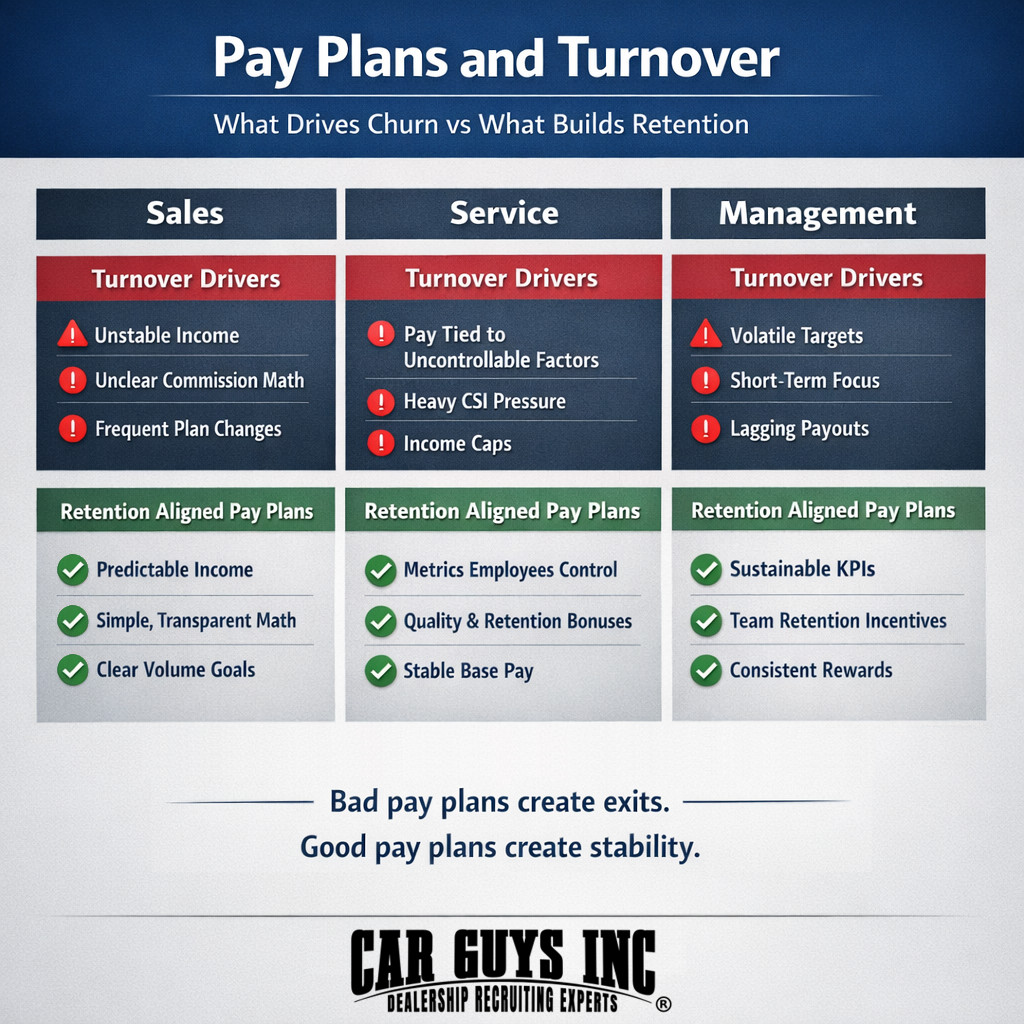
Sales Pay Plans and the Revolving Door
Sales departments are often the loudest example of pay plan driven turnover.
Where Sales Pay Plans Go Wrong
Many stores rely on plans that look aggressive on paper but fall apart in real life.
Common issues include:
- Income that swings wildly month to month
- Commission math that only desk managers understand
- Plans that reward volume but ignore effort and consistency
- Frequent mid year changes when leadership gets nervous
Salespeople can live with pressure. What they cannot live with is uncertainty.
When a rep cannot reasonably predict their paycheck, they start looking elsewhere, even if they are producing.
What Retention Friendly Sales Plans Have in Common
Stores that keep strong sales teams usually share a few traits:
- Simple commission structures that reps can calculate themselves
- A base or floor that protects against slow months
- Clear upside for performance without punishing the middle
- Stability across the year, not constant adjustments
The goal is not to eliminate competition. The goal is to remove fear.
Service Advisors Carry the Most Risk
And Feel It First
Service advisors sit at the center of the store. When pay plans break down, they feel it immediately.
Why Advisors Burn Out
Advisors often leave not because they cannot sell, but because the plan works against them.
Common problems include:
- Pay tied to technician productivity they cannot control
- CSI tied too tightly to compensation
- Caps that stop experienced advisors from growing
- No reward for consistency, quality, or customer retention
Over time, advisors stop trusting the plan. Once trust is gone, turnover follows.
What Keeps Advisors Long Term
Strong service pay plans share these traits:
- A real base pay that smooths seasonality
- Commission tied to metrics advisors influence directly
- Incentives for write up quality and retention, not just gross
- Separation between advisor performance and shop bottlenecks
Good advisors want to build something. Pay plans should reward that mindset.
Technician Pay Plans and the Stability Problem
Technicians do not leave because they dislike working with cars. Technicians leave because their income feels unpredictable.
Where Technician Pay Plans Break Down
Flat rate plans create problems when volume is inconsistent or poorly managed.
Common issues include:
- Flag hour volatility
- Unpaid diagnostic and training time
- No protection during slow periods
- No incentive for mentoring or quality work
When techs feel punished for things outside their control, they stop believing the system is fair.
Retention Focused Technician Pay Structures
Shops that retain strong techs usually offer:
- Guaranteed minimum hours
- Pay for diagnostic time and training
- Tiered progression tied to skill growth
- Performance upside without income whiplash
Stability does not kill motivation. It allows it to grow.
Management Pay Plans Shape Culture
Whether You Intend Them To or Not
Managers rarely leave because of workload. They leave because their incentives conflict with reality.
Why Managers Check Out or Move On
Management pay plans often fail when:
- Bonuses are tied to metrics they cannot fully control
- Compensation ignores team stability and development
- Payouts lag too far behind performance
- Short term fixes are rewarded over long term health
When managers feel trapped between leadership demands and team burnout, turnover spreads downward.
Better Management Incentives Reduce Churn
Strong management plans include:
- Predictable salary foundations
- Bonuses tied to sustainable KPIs
- Incentives for retention and development
- Clear connection between decisions and pay
Managers who feel supported build teams that stay.
The Hidden Cost of Bad Pay Plans
Turnover is expensive. But the real damage is not recruiting costs.
It is:
- Lost productivity
- Broken customer relationships
- Training time wasted
- Cultural instability
- Top performers leaving first
Stores that constantly hire are usually fixing the wrong problem.
Final Thought
Hiring better people helps.
Better pay plans keep them.
Pay plans are one of the most powerful retention tools you have, yet they are often treated as an afterthought. When compensation is designed for stability, transparency, and fairness, turnover slows naturally.
Not because people got softer.
Because the system finally works.
We often work with our clients beyond hiring, helping them evaluate and adjust pay plans that are contributing to unnecessary turnover.
If you would like to better understand how compensation design affects retention in your sales, service, or management teams, watch this short video or schedule a call to see if our approach is a fit for your shop.


CarGuys Inc. is an automotive recruitment agency built exclusively for the car business. From technicians and service advisors to salespeople and managers, we connect dealerships and repair shops with qualified talent faster, using AI-powered tools, nationwide reach, and years of hands-on experience.
With over 700 clients and thousands of hires, we don’t just fill positions;
we help build stronger teams that drive long-term success.