
CarGuys Inc. has worked directly with dealerships and job seekers across the country in a highly competitive labor market. Through thousands of placements and long-term hiring partnerships, one pattern appears repeatedly. The dealerships that retain talent most effectively are not necessarily the ones offering the highest pay. They are the ones that create clarity from the start.
One of the most overlooked tools for creating that clarity is the employment agreement.
Too often, employment contracts are treated purely as legal protection. Something drafted by attorneys and stored away in case of disputes. In reality, well-structured agreements can play a far more strategic role inside a dealership organization. When designed correctly, they set expectations, reduce misunderstandings, and provide employees with a clear understanding of how success is defined.
This post looks at how dealerships can use employment contracts not just to manage risk, but to support retention, stability, and long-term employee engagement.
Retention Problems Often Start With Unclear Expectations
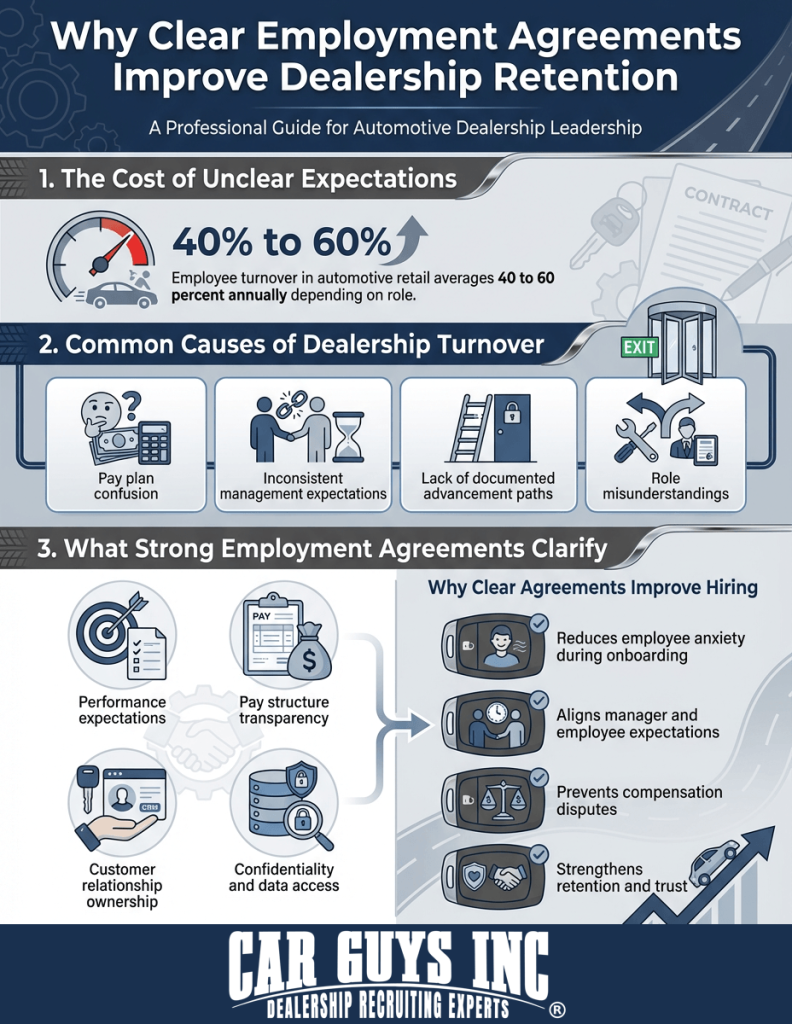
Most employees do not leave because of one bad day. They leave because expectations slowly drift apart.
Over time, what was assumed during the hiring process becomes interpreted differently by managers and employees. When that happens, friction grows.
Common friction points include:
- Unclear performance benchmarks
- Confusion around pay progression
- Unwritten rules that only some employees understand
- Different standards applied across departments
- Compensation plans that evolve without clear documentation
Written agreements reduce this ambiguity. They make expectations visible, consistent, and easier to reinforce.
When employees understand how performance is measured, what advancement looks like, and how compensation works, they are far less likely to feel blindsided later.
One Size Does Not Fit All in Dealership Roles
Dealership operations are highly specialized environments. Yet many stores still use generic employment agreements that treat every position the same.
A technician’s role differs significantly from a service advisor’s responsibilities. A sales professional’s compensation plan is different from a fixed operations manager’s performance structure.
Each role carries different:
- Performance drivers
- Compensation models
- Customer relationships
- Data and system access
- Operational risk exposure
Strong dealerships reflect these differences in their employment agreements and with role specific onboarding. Weak ones rely on copy and paste templates.
Tailored agreements clarify responsibilities and reduce internal resentment. When expectations are role specific, accountability becomes easier for both employees and managers.
Non-Competes Are Not the Only Way to Protect the Business
For many years, dealerships relied heavily on non-compete agreements to protect their workforce. Today, that approach is becoming less reliable.
Regulatory scrutiny continues to increase, and enforcement varies widely by state. Dealerships that depend solely on non-competes may find themselves exposed.
More sustainable alternatives include:
- Non-solicitation agreements that protect customer relationships
- Clear definitions of customer ownership and account access
- Confidentiality agreements tied to CRM, DMS, and dealership data
- Defined compensation growth paths that reward tenure
Employees are more likely to stay when their long-term opportunity inside the dealership is clear. Retention improves when leaving would mean rebuilding progress elsewhere, not when employees feel restricted.
Contracts Build Trust When They Are Honest
Employees can quickly sense when an agreement exists only to protect the dealership.
Effective agreements feel balanced. They should:
- Explain expectations in clear, plain language
- Reflect how the dealership actually operates
- Avoid unrealistic promises or vague compensation descriptions
- Define what success looks like within the role
When agreements feel fair and transparent, enforcement becomes rare. Employees follow rules they understand and believe in.
When contracts feel misleading, they become a source of distrust.
Why Managers Play a Critical Role
Even the best employment agreements fail if managers undermine them.
Managers act as the bridge between written expectations and day-to-day reality. When managers make informal exceptions, side promises, or inconsistent decisions, written agreements lose credibility.
Retention improves when managers:
- Reinforce expectations consistently
- Avoid making verbal promises that contradict written terms
- Escalate exceptions rather than improvising solutions
- Treat agreements as operational tools, not legal paperwork
The most effective dealerships ensure that department leaders understand the agreements they are responsible for enforcing.
Contracts as a Competitive Advantage in Hiring
In a tight labor market, clarity itself becomes a recruiting advantage.
Skilled technicians, advisors, and managers evaluate opportunities carefully. They want to understand how compensation works, what advancement looks like, and how performance is measured.
Dealerships that can clearly explain:
- Pay structure
- Bonus opportunities
- Career progression
- Department expectations
stand out quickly during the hiring process.
Ambiguity creates anxiety. Clarity creates confidence.
The most attractive workplaces reduce uncertainty from the very beginning.
Where Many Dealerships Get It Wrong
Across the industry, several common mistakes appear repeatedly:
- Agreements written by attorneys but never reviewed by operational leadership
- Compensation plans referenced but not clearly explained
- Policies that exist on paper but are applied inconsistently
- Generic agreements used across multiple roles
These gaps often create frustration long after the hiring process is complete.
Dealerships that periodically review their agreements alongside HR, legal counsel, and department leadership maintain far stronger alignment.
Wrapping It Up
Employment contracts will not fix a broken culture. But unclear agreements will absolutely accelerate turnover.
Dealerships that treat agreements as operational tools gain a powerful advantage. Expectations remain consistent, compensation structures are understood, and employees have a clearer path forward.
Over the years, CarGuys Inc. has seen firsthand how clarity in hiring and role expectations strengthens both recruitment and retention across dealership teams.
When agreements are designed thoughtfully, they do more than protect the business. They align expectations, strengthen trust, and create stability across departments.
That is not simply legal protection.
That is leadership.
CarGuys Inc. is an automotive recruiting company built exclusively for the car business. From technicians and service advisors to salespeople and managers, we connect dealerships and repair shops with qualified talent faster, using nationwide reach, and years of hands-on experience.

With over 700 clients and thousands of hires, we don’t just fill positions;
we help build stronger teams that drive long-term success.