
If you walked into your dealership and found $150,000 sitting in a locked room collecting dust, you would demand answers. Yet many dealerships have exactly that sitting on their parts shelves. Obsolete parts inventory is one of the most silent profit killers in fixed operations.
It does not show up as a loud problem like declining car count or technician turnover. Instead, it quietly freezes working capital, distorts financial statements, and reduces overall return on investment. The worst part? Most dealerships underestimate how much they are carrying.
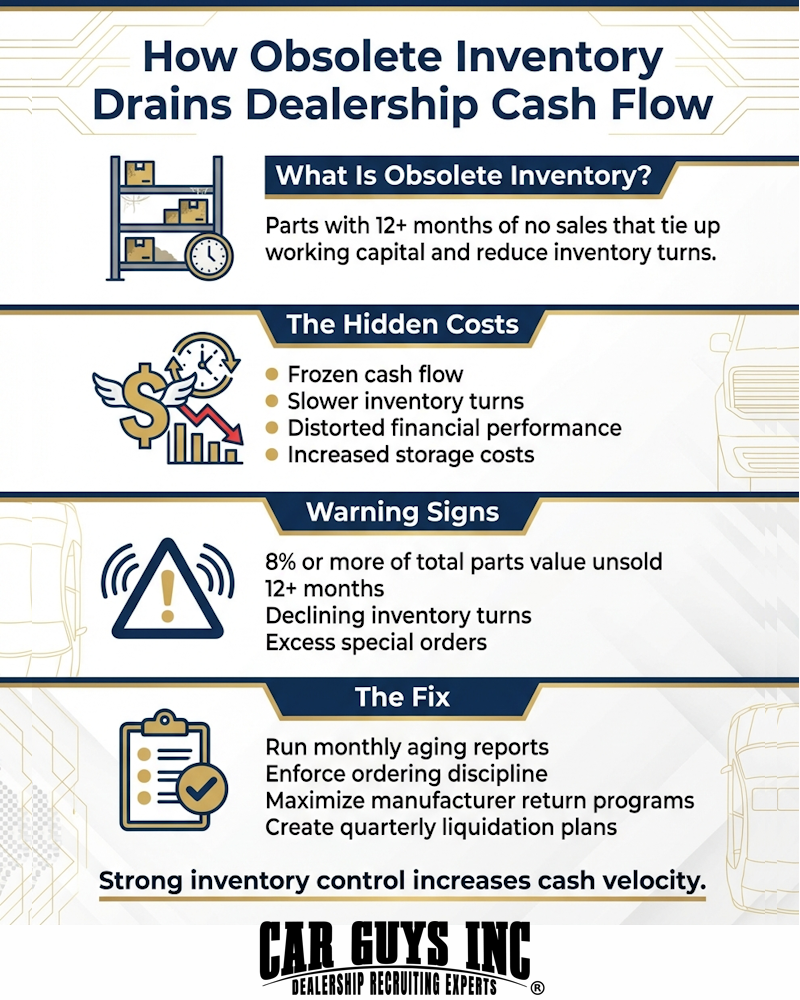
What Is Obsolete Inventory?
Obsolete inventory refers to parts that:
- Have not sold in 12 months or more
- Are tied to discontinued models
- Cannot be returned to the manufacturer
- Are damaged, misordered, or improperly stocked
It is inventory that is unlikely to generate revenue but still shows up as an asset on your balance sheet.
And that is where the problem begins.
The Real Cost of Obsolete Parts Inventory
Obsolete parts are not just taking up shelf space. They are costing you in multiple ways:
1. Frozen Cash Flow
Every dollar tied up in dead inventory is a dollar you cannot use to:
- Invest in technician hiring
- Upgrade equipment
- Improve marketing
- Reduce debt
For many mid-sized dealerships, obsolete inventory can represent 8 percent to 15 percent of total parts inventory. In larger stores, that number can easily exceed six figures.
That is money that should be working for you.
2. Distorted Financial Performance
Because inventory is listed as an asset, high parts inventory can create the illusion of strength.
But when a significant portion is unsellable, it inflates your balance sheet and masks underperformance.
Your true ROI on parts shrinks.
Your inventory declines.
Your return on assets drops.
3. Reduced Inventory Turns
Healthy parts departments typically target 6 to 8 turns per year, depending on brand and market.
When obsolete parts inventory builds up:
- Turns slow down
- Carrying costs increase
- Storage space becomes inefficient
- Ordering discipline erodes
Slow turns equal slow money.
Why Obsolescence Happens
Most obsolete parts inventory is not the result of negligence. It is the result of:
- Over ordering to hit manufacturer incentives
- Poor forecasting
- Model year changes
- Staff turnover in the parts department
- Lack of monthly aging reviews
- Service department communication gaps
It builds gradually, then suddenly becomes a serious financial drag.
How To Calculate Your True Obsolescence Rate
Start with a simple formula:
Obsolescence Percentage = Parts with 12+ months no sales ÷ Total Parts Inventory Value
If your number is:
- Under 5 percent → Strong control
- 5 to 8 percent → Manageable but watch closely
- 8 to 12 percent → Cash flow concern
- 12 percent or higher → Immediate action required
Many dealers are surprised when they run the numbers honestly.
5 Practical Steps To Reduce Obsolete Inventory
1. Run Monthly Aging Reports
Make it non negotiable. Review 9 month and 12 month non movers.
2. Enforce Ordering Discipline
Limit special order abuse and reduce speculative stocking.
3. Maximize Manufacturer Return Programs
Understand deadlines and maximize return credits.
4. Create a Quarterly Liquidation Plan
Bundle and discount slow moving parts.
Use wholesale channels.
List online where applicable.
5. Align Parts and Service Incentives
If service does not communicate future demand, parts cannot forecast properly.
Shared accountability reduces excess.
The Bigger Strategic Picture
An efficient parts department directly impacts:
- Technician productivity
- Repair order cycle time
- Customer satisfaction
- Overall fixed ops profitability
Dead inventory reduces flexibility.
Strong inventory control increases cash velocity.
And in today’s market, liquidity matters.
The Leadership Question
Here is the uncomfortable truth:
Many parts managers were promoted for technical knowledge, not financial management.
Inventory control requires:
- Data analysis
- Forecast modeling
- Vendor negotiation
- Cross department coordination
If you are not reviewing obsolescence monthly at the leadership level, you are likely bleeding capital quietly.
Final Thought
Empty service bays are visible.
Underperforming technicians are visible.
Obsolete inventory is invisible.
But it may be one of the most expensive problems in your entire dealership.
The dealers who win in fixed operations are not just the ones who sell more. They are the ones who move money faster.
See how dealerships are improving inventory control, increasing parts turns, and freeing up cash flow with a smarter hiring and recruiting system. Watch the demo to see how the right talent can transform your parts department performance.

If your parts department is carrying more inventory than it should or struggling with turnover, let’s talk. Schedule a quick strategy call and we’ll walk through how to strengthen your team and improve fixed ops performance.

CarGuys Inc. is an parts department recruiting company built exclusively for the car business. From technicians and service advisors to salespeople and managers, we connect dealerships and repair shops with qualified talent faster, using nationwide reach, and years of hands-on experience.
With over 700 clients and thousands of hires, we don’t just fill positions; we help build stronger teams that drive long-term success.