
At first glance, hourly pay may seem safer than flat rate. In some cases, it is.
However, sometimes hourly pay only appears lower risk, while hiding expectations, offering a weak bonus structure, or limiting your earning potential.
Two shops might both advertise “$32 per hour plus bonus,” yet the actual paycheck, daily experience, and career prospects can vary dramatically.
The hourly rate alone doesn’t give you the full picture.
If you are evaluating an hourly or guarantee + bonus technician job offer, you need to look at the full compensation system behind it.
Let’s break down what really matters when it comes to pay plans.
First, Understand What Hourly / Guarantee + Bonus Really Means
In an hourly model, you are paid for the hours you are on the clock.
You’ll have a steadier income than with flat rate; especially when things are slow or you’re still learning the ropes.
In a guarantee + bonus model, you usually receive a base hourly wage or weekly guarantee, then earn additional pay when you hit certain productivity, flagging, efficiency, quality, or team performance goals.
It might sound straightforward, but every detail can affect your paycheck.
Your income may depend on:
- Whether the hourly rate is truly stable
- How the bonus is calculated
- Whether the bonus targets are realistic
- How work is dispatched
- How much non-billable work are you expected to do
- Whether training, diagnostics, warranty, and shop support tasks are built into the plan
- How consistent is the car count
- Whether the shop uses the pay plan to control labor costs instead of rewarding performance
Hourly pay can be great—but only if the shop sets fair rules and the bonus actually rewards your hard work.
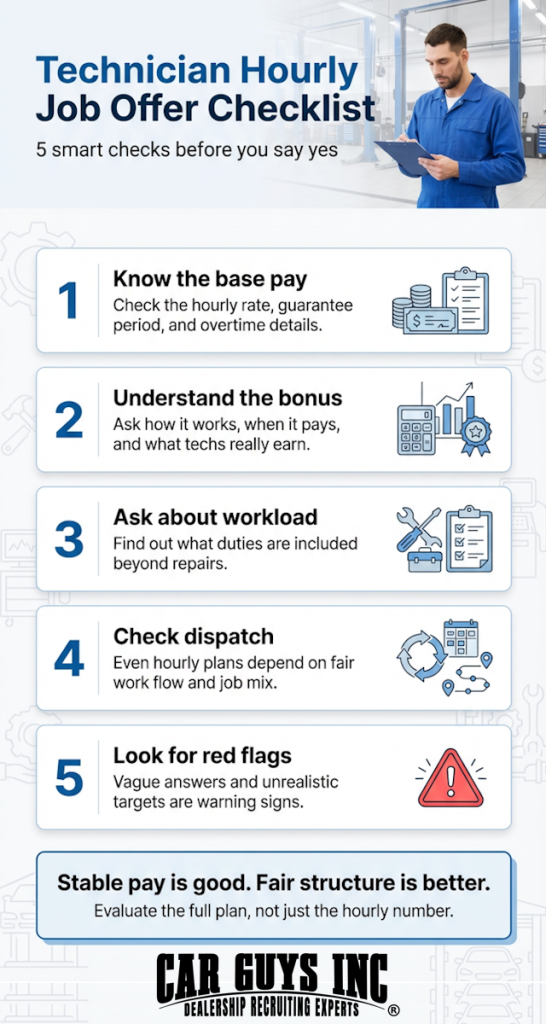
The 7 Questions Every Technician Should Ask Before Accepting
Do not accept an hourly or guaranteed + bonus offer without asking these questions.
1. What Is the Guaranteed Pay, Exactly?
Do not stop at the phrase “hourly plus bonus.”
Ask:
- What is the exact hourly rate?
- Is the guarantee based on 40 hours?
- Is overtime available?
- Are there any deductions, conditions, or probationary periods associated with the guarantee?
- Does the guarantee ever change after 30, 60, or 90 days?
Some shops advertise a strong guarantee, then quietly reduce it once onboarding ends.
You need to know what your stable income really is, not just what it appears to be in the interview.
2. How Does the Bonus Actually Work?
This is one of the biggest areas where candidates get vague answers.
Ask:
- Is the bonus based on flagged hours?
- Efficiency?
- Productivity?
- Team output?
- CSI?
- Comeback rate?
- Attendance?
- Sales of additional work?
- Monthly gross profit?
Then ask for examples.
A bonus plan is only useful if you understand:
- What triggers it
- How often does it pay out
- What the average technician actually earns from it
- Whether the target is realistic
If the bonus plan sounds confusing or management can’t explain it, that’s a big red flag.
3. What Does the Average Technician Make Under This Plan?
Do not ask what the best tech makes.
Ask what the average technician with similar experience earns in a normal month.
That gives you a more honest picture of what this pay plan produces in the real world.
A shop may offer:
- $30 per hour
- Plus a monthly bonus
- Plus “great upside”
But if the average technician earns only a small bonus once in a while, the real compensation is mostly the hourly rate.
You want real-world earnings, not recruiting language.
4. What Are the Expectations Beyond Turning Wrenches?
Hourly technicians are often expected to take on more non-billable duties than flat-rate technicians.
Ask whether you will be expected to:
- Help other technicians
- Perform shop cleanup
- Handle road tests
- Assist with diagnostics
- Do training during paid time
- Wait on parts
- Support service advisors
- Handle internal or warranty-heavy work
This is not automatically bad.
In a fair hourly system, some of that is built into the pay structure.
But if the shop expects you to do everything while keeping bonus targets high, the pay plan may be stacked against you.
5. How Realistic Are the Bonus Targets?
A bonus should reward good performance. It should not feel like a carrot that is always just out of reach.
Ask:
- How many technicians hit the bonus last month?
- What percentage of the shop typically qualifies?
- What was the average bonus payout?
- Is the target based on individual performance or team performance?
- What causes technicians to miss the bonus most often?
If only one or two people ever hit the number, that is not really a bonus program. It is a recruiting tool.
6. How Is Work Dispatched and Measured?
Even in hourly shops, dispatch still matters.
If your bonus depends on productivity, flag hours, or efficiency, then your income is still tied to opportunity.
Ask:
- Is dispatch fair?
- Is work assigned by skill level?
- Do certain technicians get the best jobs?
- How are diagnostics handled?
- How much warranty work is in the mix?
- Are inspection opportunities consistent?
An hourly guarantee can protect the floor.
The dispatch system often determines the ceiling.
7. What Is the Long-Term Growth Path?
Hourly, guarantee, and bonus plans are often used for entry-level, used-car, express, maintenance, or transitional technician roles.
That can be a good thing if there is a clear path forward.
Ask:
- Is this role meant to stay hourly long-term?
- Is there a path to a higher bonus tier?
- Is there a path to a flat rate later if I want it?
- Are manufacturer training and certifications supported?
- How do raises happen?
Look for a pay plan that works now and keeps you moving forward as your career grows.
Automotive Mechanic and Technician Openings
Red Flags in Hourly / Guarantee + Bonus Offers
Be cautious if you hear: “We have a great bonus plan.”
That means nothing unless they can explain it clearly.
Other warning signs:
- No written pay plan
- Vague answers on how the bonus is earned
- Bonus tied to too many factors outside your control
- Targets that almost nobody hits
- Guarantee that drops off quickly without explanation
- Heavy workload with little upside
- Management cannot tell you what average techs actually earn
- Constant talk about “teamwork” used to justify the unpaid extra responsibility
Complicated pay plans usually mean trouble.
Do the Math Before You Decide
Here is a simple example.
Offer A
$32 per hour @ 40 hours per week with an average monthly bonus: $600
Base weekly pay:40 x 32 = $1,280
Approximate annual base pay:$1,280 x 52 = $66,560
Annual bonus: $600 x 12 = $7,200
Approximate annual total: $73,760
Now compare that to another offer.
Offer B
$29 per hour @ 40 hours per week with an average monthly bonus: $1,200
Base weekly pay:40 x 29 = $1,160
Approximate annual base pay:$1,160 x 52 = $60,320
Annual bonus: $1,200 x 12 = $14,400
Approximate annual total: $74,720
At first glance, Offer A looks better because the hourly rate is higher.
But the full pay structure may tell a different story.
That is why you need to evaluate the real compensation system, not just the base number.
Don’t Trade All Your Upside for a Steady Paycheck
A guaranteed paycheck can reduce stress.
That matters.
If you are leaving a chaotic shop, switching brands, relocating, or stepping into a dealership with uncertain volume, an hourly or guarantee + bonus may be the smarter move.
But stability alone does not make an offer good.
A low-ceiling pay plan can keep you comfortable while quietly capping your growth.
When evaluating an hourly offer, ask yourself:
- Is this plan protecting me, or limiting me?
- Is the bonus realistic enough to matter?
- Does the shop create a path to higher earnings?
- Does the workload match the compensation?
The best hourly plans provide both consistency and upside.
Culture Still Matters
Just like flat rate, culture shows up in your paycheck.
A strong hourly shop with:
- Clear expectations
- Fair dispatch
- Solid advisors
- Good parts support
- Respect for technicians
- Real training opportunities
Can outperform a higher-paying offer in a disorganized environment.
Pay matters.
But so is working for people who have your back and run a tight ship.
Watch how management talks about the team.
Watch how organized the shop is.
Watch for signs of people being rushed, frustrated, or burned out.
That tells you a lot.
Should You Negotiate an Hourly / Guarantee + Bonus Offer?
Yes, especially if you are an experienced certified technician.
You can negotiate:
- Hourly base rate
- Guarantee period
- Bonus thresholds
- Signing bonus
- Tool allowance
- Training pay
- Relocation assistance
- Review timeline for raises
- Vacation structure
If you have certifications, dealership experience, diagnostic strength, EV training, or a strong productivity history, use that leverage.
Just be professional and specific.
The more clearly you understand the pay plan, the better you can negotiate it.
Flat Rate vs. Hourly / Guarantee + Bonus
Not every technician should choose the same model.
- The shop has a strong car count
- Dispatch is fair
- Warranty mix is manageable
- You are highly efficient
- You want more upside
Hourly or guarantee + bonus may be better if:
- You want a more predictable income
- You are entering a new brand or store
- The role includes diagnostics, used cars, or mixed tasks
- The shop offers a realistic bonus structure
- You value stability while still keeping some upside
Neither pay model is automatically better.
The better choice depends on the shop, the structure, and your goals.
Final Checklist Before You Accept
Before signing an hourly or guarantee + bonus offer, make sure you know:
- The exact hourly rate or weekly guarantee
- Whether the guarantee changes after onboarding
- How the bonus is calculated
- How often is the bonus paid
- What the average technician actually earns
- Whether the bonus goals are realistic
- What non-billable responsibilities are expected
- How work is dispatched
- What the long-term growth path looks like
- Whether the culture supports technician success
Hourly or guarantee + bonus can be a great technician pay model.
But only when the structure is transparent, the expectations are fair, and the upside is real.
Ask the right questions. Do the math. Then make your move.
CarGuys Inc. connects skilled automotive professionals with dealerships and repair shops nationwide through intelligent matching technology.
Instead of flooding candidates with irrelevant openings, we focus on fit, timing, and transparency. Upload your resume once, and when a matching opportunity arises, you are notified.


No noise. No pressure. Just the right opportunity at the right time.