
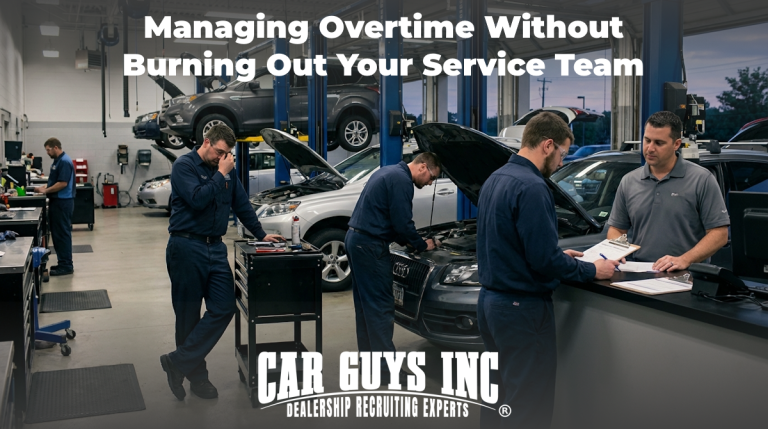
We work directly with service advisors and technicians across the country, and many of them are already employed. They reach out to us every day while still working full time, quietly searching for an exit.
This is happening even during a nationwide shortage. Thousands of skilled technicians and advisors are actively looking for new roles, not because they want to leave the industry, but because the workload has become unsustainable.
Overtime has become normal in many service departments. Late nights, weekend pushes, and extended hours are often framed as commitment or doing what it takes to keep cars moving.
The problem is that chronic overtime is rarely a sign of strength. Most of the time, it is a warning signal that something in the operation is out of balance.
When overtime becomes routine instead of occasional, burnout follows.
Productivity slips. Mistakes increase. And eventually, your best technician quits.
This post explains why overtime happens, what it really costs, and how strong service leaders manage workload without burning out their teams.
Why Overtime Has Become the Default in Service Departments
Service departments are under more pressure than ever. Demand is high, customer expectations continue to rise, and staffing has not kept pace.
Several forces are driving overtime:
- Service advisor and technician shortages
- Backlogged appointments and packed schedules
- Pressure to maximize bay utilization
- Hiring perceived as slower or riskier than approving extra hours
On the surface, overtime feels like the fastest solution. You already have trained people, the work still gets done, and revenue continues to flow.
The issue is that this approach only works short term.
Overtime Is a Warning Sign, Not a Productivity Strategy
Occasional overtime is normal. Seasonal service drive bottlenecks, unexpected absences, or short term promotions can justify extra hours.
Chronic overtime is different.
When overtime shows up week after week, it usually means:
- The shop is understaffed for its current workload
- Dispatch and scheduling are overloaded
- Too much production is concentrated on too few people
- Expectations are disconnected from realistic capacity
High performing service departments track overtime the same way they track CSI or hours per RO. It is a diagnostic metric, not a badge of honor.
The Real Cost of Overtime Most Shops Never Calculate
Most leaders only see the payroll impact. That is only the visible portion of the cost.
Hidden overtime costs include:
- Fatigue driven mistakes and comebacks
- Rushed inspections that miss legitimate upsells
- Declining customer experience late in the day
- Lower morale and disengagement
Over time, these issues quietly erode profitability.
The most expensive cost often appears later as turnover. When a burned out technician or advisor leaves, productivity, momentum, and experience leave with them.
A Note on Flat Rate Pay and Why It Complicates Overtime
Before going further, it is important to acknowledge flat rate pay, because it changes how overtime shows up and how burnout develops.
In flat rate environments, overtime does not always appear as overtime pay.
Technicians may stay late to flag enough hours to hit income targets, even when payroll numbers look controlled.
This means burnout can exist even when:
- Labor percentages look healthy
- Flagged hours appear strong
- Overtime costs seem minimal
Flat rate does not cause burnout by itself. Understaffing does. Flat rate simply masks the problem longer and amplifies the pressure when staffing is off.
Because flat rate deserves a deeper and more focused discussion, we will address it in a separate post. For the rest of this article, the focus remains on overtime as an operational signal, regardless of pay structure.
The Myth of the “Hero” Technician or Advisor
Every service department has them. The technician who always stays late. The advisor who absorbs overflow without complaint. The person management relies on when things get tight.
This hero culture feels productive, but it is risky.
High performers typically absorb the most overtime. Over time, they become single points of failure. When they finally leave, the impact is immediate:
- Production drops
- Stress spreads across the team
- Managers scramble to recover
Sustainable operations are not built on heroics. They are built on balanced capacity.
Why Longer Hours Do Not Equal Higher Throughput
There is a point where more hours stop producing more results.
As fatigue sets in:
- Repair order completion slows
- Errors and rework increase
- Communication quality drops
- Customer trust erodes
Throughput depends on consistency, not endurance. Departments that rely on overtime to hit numbers often experience diminishing returns that are easy to miss until problems surface.
Overtime is often the first sign that capacity and demand are out of alignment. For service leaders, the question is not how long your team can keep pushing, but how capacity can be stabilized before burnout sets in.
CarGuys Inc. is a service department recruiting company built exclusively for the car business. From technicians and service advisors to salespeople and managers, we connect dealerships and repair shops with qualified talent faster, using AI-powered tools, nationwide reach, and years of hands-on experience.
With over 700 clients and thousands of hires, we don’t just fill positions;
we help build stronger teams that drive long-term success.