
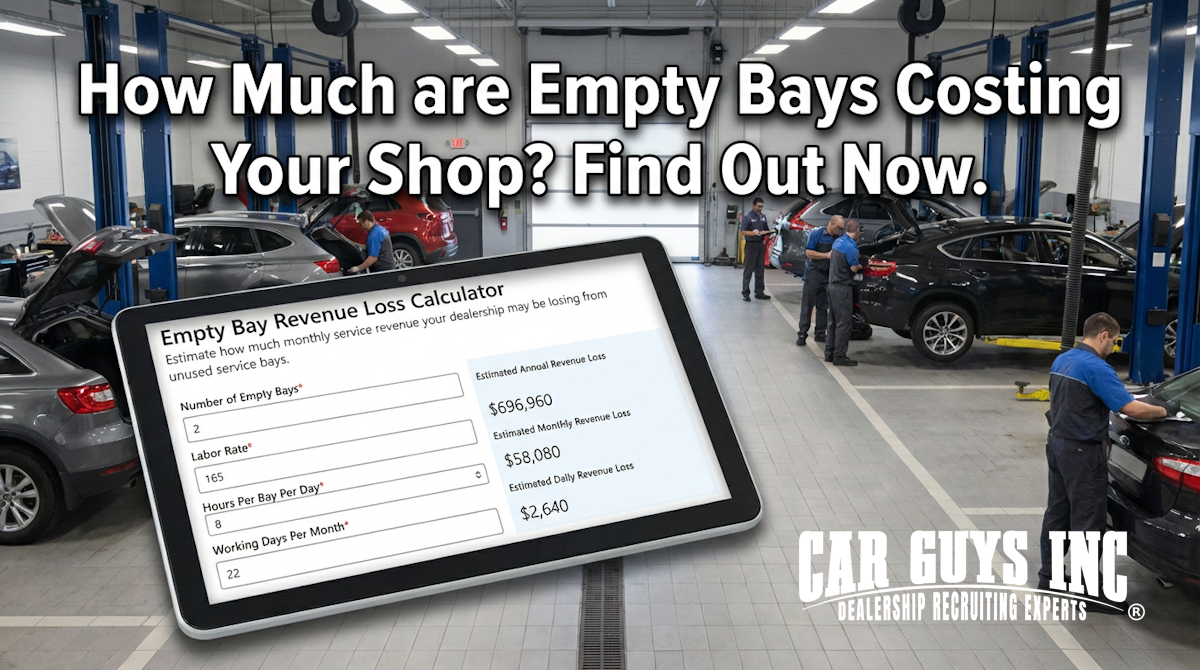
Service bays generate the majority of revenue inside a dealership service department. When those bays sit empty due to technician shortages or scheduling issues, the financial impact adds up quickly.
One empty service bay can cost a dealership $250,000 – $500,000 per year.
The Empty Bay Revenue Loss Calculator below estimates how much potential service revenue your dealership may be losing when service bays remain unused.


The results above estimate the potential revenue your dealership could generate if every service bay were operating at full capacity.
Even one empty service bay can represent thousands of dollars in lost revenue each month. When multiple bays remain unused due to technician shortages, scheduling gaps, or workflow issues, the impact can reach hundreds of thousands of dollars annually.
Typical Dealership Service Department Benchmarks
If you’re unsure what numbers to enter into the calculator, the following ranges reflect typical dealership service department averages in the United States. Actual results will vary depending on the dealership brand, geographic location, and technician productivity levels.
Average Dealership Labor Rates
Labor rates vary widely depending on the franchise brand, market demand, and regional labor costs.
Typical dealership labor rate ranges:
| Shop Type | Typical Labor Rate |
|---|---|
| Rural / Small Market Dealers | $110 – $145 per hour |
| Average U.S. Dealership | $140 – $185 per hour |
| Large Metro / Luxury Brands | $180 – $240+ per hour |
Most franchise dealerships today fall in the $150 – $180 per hour range, with luxury brands often exceeding $200 per hour.
Average Hours Per Bay Per Day
This number represents how many billable labor hours each service bay produces per day.
While a technician may physically work an 8 hour shift, flat rate productivity often results in more billed hours.
Typical ranges:
| Performance Level | Hours Per Bay Per Day |
|---|---|
| Low Productivity Shop | 6 – 7 hours |
| Average Dealership | 8 – 10 hours |
| High Performance Service Department | 10 – 13+ hours |
Many high performing service departments operate around 9 – 11 billed hours per bay per day.
Average Working Days Per Month
This number depends on whether the service department operates 5, 6, or 7 days per week.
5 Day Service Department
Typical schedule: Monday – Friday
| Metric | Average |
|---|---|
| Working Days Per Month | 20 – 22 |
| Annual Working Days | 250 – 260 |
Most dealerships using a 5 day service schedule average 21 working days per month.
6 Day Service Department
Typical schedule: Monday – Saturday
| Metric | Average |
|---|---|
| Working Days Per Month | 24 – 26 |
| Annual Working Days | 300 – 312 |
Most six day service departments average 25 working days per month.
7 Day Service Department
Some large metro or high volume dealerships operate service departments seven days per week.
| Metric | Average |
|---|---|
| Working Days Per Month | 28 – 31 |
| Annual Working Days | 360 – 365 |
Most seven day operations average 30 working days per month.
Why Empty Service Bays Cost Dealerships More Than They Realize
An empty service bay might not seem like a major problem at first glance. However, when a bay sits unused for hours or days, the financial impact adds up quickly. Service departments are one of the most profitable parts of most dealerships, and every available bay represents a revenue opportunity. When those bays are idle, that opportunity disappears.
The calculator above helps estimate the potential revenue your dealership could be losing when service bays go unused. By entering a few simple numbers such as labor rate, working hours, and the number of empty bays, you can quickly see how much service revenue may be slipping away each day, month, and year.
For many dealerships, the results can be surprising.
Service Departments Depend on Throughput
A well-run service department is designed around efficiency and throughput. Each service bay is a production unit. When a technician is actively working in that space, repairs and maintenance services are being completed, labor hours are billed, and customers are being served.
When bays remain empty, however, the entire system slows down.
Service managers typically focus on several core performance KPI metrics including technician productivity, effective labor rate, and repair order volume. Yet one of the most overlooked metrics is simply how many service bays are actually being used.
Even a small number of empty bays can significantly reduce overall department performance.
For example, if a dealership has two empty service bays during a typical workday, the lost labor opportunity compounds quickly over the course of a month. Multiply that by an entire year, and the potential lost revenue becomes substantial.
The Financial Impact of Technician Shortages
One of the most common reasons service bays remain empty is a shortage of qualified technicians. Many dealerships across the country struggle to keep their service departments fully staffed. When a technician leaves, retires, or moves to another shop, that service bay often sits unused until a replacement is found.
The challenge is that hiring technicians is rarely immediate. Recruiting, interviewing, and onboarding can take weeks or even months. During that time, the dealership continues operating below its full service capacity.
In practical terms, every open technician position usually translates into an empty service bay.
That means the dealership is not only losing the labor revenue associated with that technician but may also be losing additional revenue from parts sales, inspections, and recommended services that would normally be generated during repair orders.

Idle Bays Affect More Than Labor Revenue
The revenue loss from an empty bay extends beyond labor hours alone. A typical repair order often includes additional services such as parts replacement, fluid services, alignments, inspections, and maintenance packages.
When service bays are unused, those related revenue opportunities disappear as well.
Over time, this can impact several areas of the dealership:
- Reduced service department revenue
- Lower parts department sales
- Slower customer throughput
- Longer appointment wait times
- Missed upsell opportunities
Customers who cannot get service appointments quickly may even choose to visit independent repair shops instead. That means the dealership loses not only immediate revenue but potentially long-term customer relationships.
Why Service Capacity Planning Matters
Understanding the capacity of your service department is essential for maintaining consistent profitability. Capacity planning helps dealerships determine how many technicians they need, how many service bays should be in operation, and how efficiently work is flowing through the shop.
This is where tools like the Empty Bay Revenue Loss Calculator become valuable.
By estimating the potential revenue impact of unused bays, service managers and dealership leadership can better understand the true cost of operating below full capacity.
Rather than viewing an open technician position as a simple staffing issue, the dealership can see it as a measurable financial loss that grows every day the position remains unfilled.
Small Gaps Turn Into Large Losses
One of the biggest surprises for many dealership service managers is how quickly small inefficiencies turn into major financial losses. An empty bay might only represent a few hours of unused labor in a single day, but over weeks and months that idle capacity compounds.
Even conservative labor rates can result in tens or hundreds of thousands of dollars in lost annual revenue.
That is why successful service departments constantly monitor staffing levels, technician productivity, and service bay utilization.
When bays remain empty for extended periods of time, it usually signals a deeper issue that needs attention.
Improving Service Bay Utilization
Dealerships that consistently maintain high service bay utilization tend to focus on several key operational areas.
First, they maintain a strong technician recruiting pipeline so open positions can be filled quickly. Waiting until a technician leaves before starting the hiring process often leads to long periods of lost capacity.
Second, they track service department metrics closely. Understanding technician productivity, efficiency, and repair order flow helps identify potential bottlenecks that could be leaving bays unused.
Third, they ensure service advisors are effectively scheduling work and keeping technicians consistently supplied with repair orders.
When these systems are working together, service bays remain active throughout the day and the department operates closer to its full revenue potential.
Using Data to Make Better Decisions
The purpose of this calculator is not simply to highlight lost revenue. It is meant to provide dealership managers with clearer visibility into the financial impact of service department capacity.
When leadership teams can see the estimated cost of empty bays, it becomes easier to prioritize solutions such as technician recruiting, workflow improvements, and scheduling adjustments.
Small improvements in service bay utilization can often produce meaningful increases in service department profitability.
Understanding the numbers is the first step toward making those improvements.
By using the calculator above, you can estimate how much revenue unused service bays may be costing your dealership and begin identifying opportunities to keep your service department operating at its full potential.
Frequently Asked Questions
How much revenue does a dealership service bay generate?
A typical dealership service bay can generate between $250,000 and $500,000 in annual labor revenue, depending on the labor rate, technician productivity, and shop utilization.
What is the average dealership labor rate?
Labor rates vary by region and brand, but most U.S. dealerships charge between $140 and $185 per hour. Luxury and metropolitan dealerships often exceed $200 per hour.
How many hours should a technician produce per day?
Most dealership technicians bill between 8 and 10 hours per day. Highly productive technicians can exceed 12 billed hours per day, depending on shop efficiency and workflow.
Why do dealerships struggle with empty service bays?
Empty service bays are usually caused by technician shortages, scheduling inefficiencies, or service advisor bottlenecks. When technicians leave and positions remain open, service bays often sit unused until replacements are hired.
How much revenue does a missing technician cost?
A missing technician can cost a dealership hundreds of thousands of dollars per year in lost labor revenue, parts sales, and service opportunities.
CarGuys Inc. is an dealership recruiting agency built exclusively for the car business. From technicians and service advisors to salespeople and managers, we connect dealerships and repair shops with qualified talent faster, using nationwide reach, and years of hands-on experience.

With over 700 clients and thousands of hires, we don’t just fill positions;
we help build stronger teams that drive long-term success.