
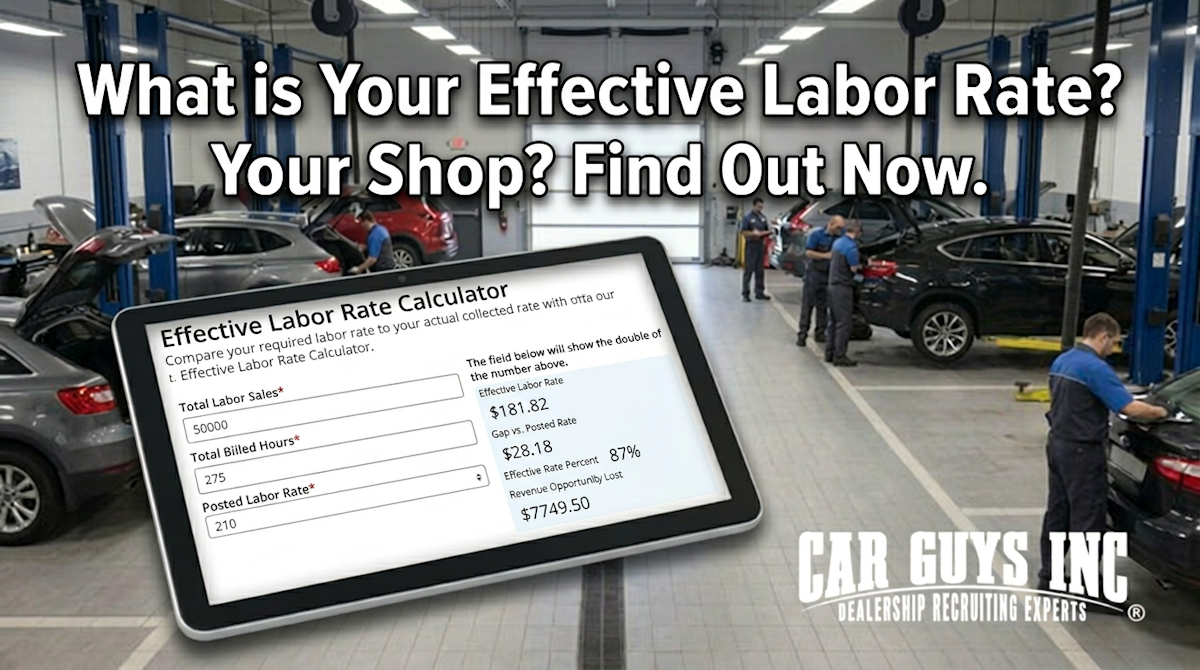
Your posted labor rate is only part of the picture. What really matters in fixed ops is the average labor rate your service department actually collects across billed hours. That is where an Effective Labor Rate Calculator becomes valuable.
Many dealerships and repair shops believe they are performing at one labor rate because that is what appears on the wall, on the menu, or in management reports. However, the labor rate collected on completed repair orders can be much lower once discounts, warranty mix, internal work, missed operations, and advisor write-up habits are factored in. Over time, even a small gap between the posted labor rate and the effective labor rate can create major revenue leakage.
To compare your actual collected labor rate with the rate needed to support overhead and profit goals, try our Service Labor Rate Calculator.


An effective labor rate calculator does more than generate a number. It gives your fixed ops team a clearer view of how well labor is being priced, written, and sold in the real world.
A store may post a labor rate of $210 per hour, but if the effective labor rate is only $180, that means the department is not collecting its full labor potential. In some cases, that difference may come from normal warranty or internal work mix. In other cases, it may point to avoidable problems such as excessive discounting, weak estimating, poor job coding, or missed billed hours.
Used regularly, this calculator can help identify hidden profit leaks in the service drive and shop. It can also support better conversations between fixed ops leaders, service managers, advisors, and ownership when reviewing labor performance.
Industry Benchmarks for Calculator Input Values
The best input values depend on your market, labor mix, and type of operation, but the following ranges can help users estimate realistic numbers when testing the calculator.
Total Labor Sales
This is the total labor dollars generated over the period being reviewed, often weekly or monthly.
Typical examples:
- Smaller independent repair shop: $10,000 to $30,000 per month
- Mid-sized repair shop or small dealership service department: $25,000 to $80,000 per month
- Larger dealership service department: $75,000 to $250,000+ per month
Total Billed Hours
This is the total number of labor hours sold during the same period.
Typical examples:
- Small repair shop: 60 to 180 billed hours
- Mid-sized operation: 150 to 500 billed hours
- Large dealership service department: 400 to 1,500+ billed hours
Posted Labor Rate
This is the standard retail door rate before discounts, labor mix adjustments, warranty reimbursement, and internal work are considered.
Typical examples:
- Independent repair shop: $120 to $190 per hour
- Domestic dealership: $140 to $220 per hour
- Luxury or high-cost metro dealership: $180 to $300+ per hour
What Is a Healthy Effective Labor Rate?
Many service departments do not capture 100 percent of their posted labor rate. A more realistic goal is to understand how close the collected rate is to the posted rate.
General reference ranges:
- 95% to 100% of posted rate: Excellent
- 90% to 94% of posted rate: Strong
- 85% to 89% of posted rate: Moderate leakage
- Below 85%: Significant room for improvement
How Effective Labor Rate Impacts Dealership and Repair Shop Profitability
What Is Effective Labor Rate?
Effective labor rate is the average labor dollars collected per billed hour. It is calculated by dividing total labor sales by total billed hours. Unlike the posted labor rate, this number reflects what the business is actually realizing across completed work.
This makes effective labor rate one of the most practical fixed ops KPIs for both dealerships and independent repair shops. It connects pricing strategy with day-to-day execution.
Why Effective Labor Rate Matters
A labor rate can look strong on paper while the department underperforms financially. That happens when the posted rate is not being consistently captured. Even a gap of $10 to $20 per billed hour can add up quickly across hundreds of hours per month.
For example, if a service department loses $20 per billed hour across 300 billed hours, that is $6,000 in missed labor revenue in a single period. Over a year, the impact becomes much larger.
Tracking effective labor rate helps answer important questions:
- Are advisors writing work accurately?
- Is discounting hurting profitability?
- Is warranty or internal mix dragging down the average?
- Are missed operations reducing labor capture?
- Is the department collecting what it should be?
What Causes a Low Effective Labor Rate?
There are several common reasons a service department may have a low effective labor rate:
Excessive labor discounting
Heavy discounting can reduce the amount collected even when billed hours remain strong.
High warranty or internal work mix
Warranty labor and internal repair orders often reimburse at rates below retail customer pay.
Missed operations on repair orders
If needed work is not identified or written up, labor hours and labor dollars both suffer.
Weak service advisor estimating
Poor menu presentation, incomplete write-ups, and weak value communication can lower labor capture.
Inconsistent job coding or billing discipline
Improper labor operation coding can also reduce realized labor dollars.
Effective Labor Rate vs Posted Labor Rate
These two numbers should not be confused.
Posted labor rate is the stated customer-pay rate.
Effective labor rate is the average rate actually collected.
A service department may post one number but perform at another. That is why both metrics should be reviewed together. Your posted rate shows your pricing target. Your effective labor rate shows your operational reality.
How This Calculator Fits with Other Fixed Ops KPIs
Effective labor rate works especially well when reviewed alongside other service department metrics such as:
- Technician productivity
- Labor gross profit
- Hours sold per repair order
- Bay utilization
- Technician gross contribution
- Empty bay revenue loss
When combined, these metrics help fixed ops leaders understand not only how much work is being sold, but also how efficiently labor revenue is being captured.
FAQ
What does an Effective Labor Rate Calculator do?
It calculates the average labor dollars actually collected per billed hour and compares that number to the posted labor rate.
How do you calculate effective labor rate?
Divide total labor sales by total billed hours. For example, $27,000 in labor sales divided by 150 billed hours equals an effective labor rate of $180.
Why is effective labor rate lower than posted labor rate?
It may be caused by discounting, warranty work, internal work, missed operations, or inconsistent advisor estimating.
What is a good effective labor rate percentage?
Many service departments aim to capture at least 90% to 95% of the posted labor rate, although the right target depends on labor mix and operating model.
Can this calculator be used by both dealerships and repair shops?
Yes. The formula works for franchised dealerships, independent repair shops, and multi-location service operations.
How often should effective labor rate be reviewed?
Most operators review it monthly, but some high-performing fixed ops teams monitor it weekly for faster visibility into labor performance trends.
Conclusion
The Effective Labor Rate Calculator is a simple but powerful tool for measuring how well a service department converts billed hours into labor revenue. While posted labor rate sets the target, effective labor rate reveals what the business is actually collecting.
For service managers and fixed ops directors, that insight matters. A meaningful gap between posted and effective labor rate may signal missed profit opportunities that can be corrected through better write-ups, improved labor capture, tighter discount control, and stronger service process discipline.
When used consistently, this calculator can help dealerships and repair shops better understand labor performance, spot revenue leakage, and make smarter fixed ops decisions based on real numbers rather than assumptions.
CarGuys Inc. is an automotive recruiting company built exclusively for the car business. From technicians and service advisors to salespeople and managers, we connect dealerships and repair shops with qualified talent faster, using nationwide reach, and years of hands-on experience.


With over 700 clients and thousands of hires, we don’t just fill positions;
we help build stronger teams that drive long-term success.