
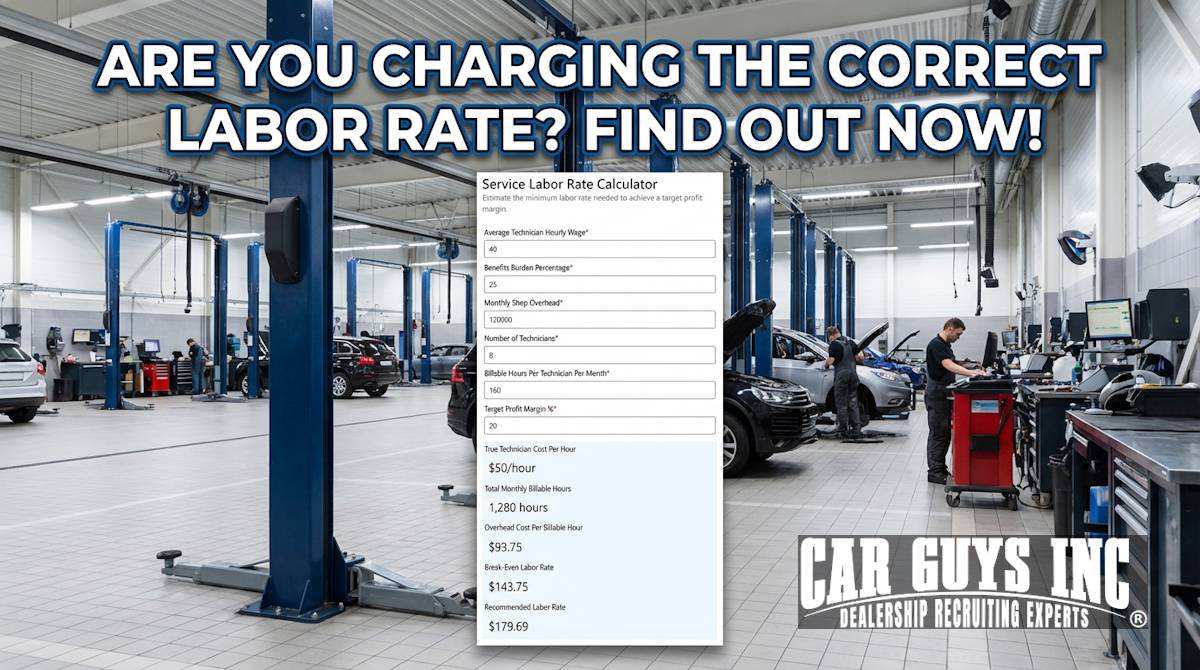
Setting your labor rate too low can quietly hurt profitability, even when your service department looks busy on paper. Many shops focus on technician pay or competitor pricing, but the real question is whether your current labor rate covers payroll burden, overhead, and your target profit margin.
Many dealerships underprice labor by $15–$40 per hour.
How the Service Labor Rate Calculator Works
This Service Labor Rate Calculator helps estimate the minimum labor rate your shop may need based on technician wages, benefits burden, shop overhead, available billable hours, and profit goals. It is built for dealership service departments and independent repair shops that want a clearer, more data-driven pricing baseline

This calculator is meant to provide a planning benchmark, not a final pricing decision. Actual labor rates may also be influenced by market conditions, warranty mix, brand positioning, technician skill level, local competition, and the type of work your shop performs most often.
Still, if your calculated minimum labor rate is higher than what you currently charge, that can be an important signal. It may suggest that your shop is underpricing labor, carrying too much overhead for its current productivity, or not generating enough billed hours per technician.
Industry Benchmarks for Labor Rate Calculator Inputs
To get realistic results, it helps to start with practical benchmark ranges. Below are typical inputs many automotive service departments use when evaluating labor rate targets.
Average Technician Hourly Wage
Technician wages vary based on skill level, certifications, franchise brand, region, and pay plan structure.
Typical ranges:
- Entry-level or light service technician: $18 to $28 per hour
- Mid-level technician: $28 to $40 per hour
- Master technician or diagnostic specialist: $40 to $60+ per hour
Some dealerships and high-demand markets may exceed these ranges, especially for brand-certified or high-output technicians.
Benefits Burden Percentage
Benefits burden includes payroll taxes, workers’ compensation, health insurance contributions, paid time off, uniforms, training, and other labor-related costs beyond hourly wage.
Typical ranges:
- Lean burden estimate: 15% to 20%
- Common planning range: 20% to 30%
- Higher burden environments: 30% to 40%
Many shops use 25% as a starting point if they do not yet track a more exact loaded labor cost.
Monthly Shop Overhead
This includes fixed and semi-variable operating expenses such as rent or mortgage, utilities, service advisor payroll, software, equipment, insurance, admin support, marketing, and other non-technician costs.
Typical ranges:
- Small independent shop: $20,000 to $50,000 per month
- Mid-size repair facility: $50,000 to $100,000 per month
- Larger dealership service department: $100,000 to $300,000+ per month
The right number depends heavily on facility size, staffing structure, and local operating costs.
Number of Technicians
This field helps spread payroll and overhead across the labor-producing team.
Typical ranges:
- Small shop: 2 to 5 technicians
- Mid-size shop or department: 6 to 12 technicians
- Large service department: 12 to 30+ technicians
This number should include technicians who meaningfully contribute billed labor hours.
Billable Hours Per Technician Per Month
This is one of the most important inputs in the calculator. It reflects how many labor hours each technician actually bills in a month, not just how many hours they are on the clock.
Typical ranges:
- Lower productivity environment: 100 to 130 billed hours per month
- Solid average productivity: 130 to 160 billed hours per month
- Strong productivity shop: 160 to 200+ billed hours per month
A technician scheduled for full-time work may not bill all available hours. Dispatch efficiency, work mix, advisor performance, technician skill, and shop workflow all affect this number.
Target Profit Margin %
This is the desired profit margin built into the labor rate after wage, burden, and overhead are accounted for.
Typical ranges:
- Conservative target: 10% to 15%
- Healthy target: 15% to 25%
- Aggressive target: 25% to 35%
Shops with premium positioning, high-demand expertise, or stronger service processes may target the upper end of the range.
Why Labor Rate Strategy Matters for Shop Profitability
Many shops arrive at their labor rate by looking at nearby competitors and adjusting slightly up or down. While market awareness matters, competitor-based pricing alone can be dangerous.
A labor rate that looks competitive can still be too low to support:
- Technician compensation
- Rising overhead costs
- Reinvestment in equipment and training
- Target profit margins
- Long-term business stability
That is why a cost-based pricing model is so important. Before worrying about what the shop down the street charges, you need to understand what your own operation requires.
Labor Rate Is More Than Technician Pay
One of the most common mistakes in service pricing is assuming labor rate only needs to cover technician wage plus a small markup. In reality, the fully loaded cost of labor is much higher.
A technician earning $35 per hour may actually cost significantly more once you include:
- Payroll taxes
- Insurance
- PTO
- Benefits
- Uniforms
- Recruiting and onboarding
- Training
- Workers’ compensation
Then, on top of direct labor cost, the shop must also recover overhead. That means your labor rate has to help pay for the building, front office, utilities, equipment, software, and everything else required to operate.
Why Billable Hours Matter So Much
A shop’s required labor rate is heavily influenced by billable efficiency. The fewer hours your technicians actually bill, the more overhead each billed hour must carry.
For example, if your fixed monthly costs stay the same but billed hours drop, your effective cost per labor hour rises. That means:
- Weak dispatching can force higher required labor rates
- Poor advisor-to-tech workflow hurts profitability
- Idle time quietly reduces margin
- Warranty-heavy mix can compress earnings if retail pricing is not strong enough
This is why labor rate and productivity should always be evaluated together.
The Hidden Risk of Underpricing Labor
Shops often underprice labor because they worry customers will compare rates. But many customers do not evaluate price in isolation. They also value trust, convenience, speed, expertise, communication, and repair confidence.
When labor is priced too low, shops may experience:
- Thinner margins despite strong car count
- Inability to increase technician pay competitively
- Reduced investment in tools and training
- Higher stress on management
- Pressure to overbook or oversell
- Long-term difficulty scaling profitably
Underpricing can make a busy shop look healthy while quietly weakening the business underneath.
A Better Way to Think About Labor Rate
Instead of asking, “What should we charge compared to competitors?” a better question is:
“What labor rate supports our costs, our productivity, and our target margin?”
That does not mean you ignore your market. It means you establish an internal floor first. Once you know your minimum required labor rate, you can make smarter pricing decisions around:
- Menu services
- Diagnostic pricing
- Retail versus warranty mix
- Specialty work
- Premium labor categories
- Technician pay plan adjustments
When Shops Should Recalculate Labor Rate
This calculator is especially useful during periods of operational change. Shops should revisit labor rate assumptions when:
- Technician wages increase
- Benefits costs rise
- Rent, utilities, or software expenses increase
- Productivity declines
- New equipment or facility costs are added
- Management wants to increase profit targets
- The shop adds or loses technicians
In many cases, the labor rate that worked two years ago no longer reflects current cost structure.
Labor Rate Is Also a Recruiting Tool
Strong labor rates do more than protect margin. They can support better technician recruiting and retention.
Why? Because a properly priced service department is often in a better position to offer:
- More competitive pay
- Better tools and working conditions
- Training and development
- Modern equipment
- Stable hours and stronger workflow
In that sense, labor rate is not just an accounting issue. It affects the quality of the team you can build.
FAQ About Service Department Labor Rates
What does a service labor rate calculator measure?
It estimates the minimum labor rate your shop may need to cover technician compensation, benefits burden, overhead, and your target profit margin.
Is this calculator only for dealerships?
No. It can also be used by independent repair shops, specialty repair businesses, and fleet service operations.
Why include benefits burden in labor rate calculations?
Because hourly wage alone does not reflect the true cost of employing a technician. Taxes, insurance, PTO, training, and other costs can materially increase loaded labor cost.
What are billable hours per technician?
These are the labor hours actually sold and billed in a month, not just the hours a technician is scheduled or present in the shop.
What is a good target profit margin for service labor?
Many shops aim for 15% to 25%, though the right target depends on business model, market position, and operational efficiency.
What if my current labor rate is below the calculator result?
That may suggest your pricing is too low, your overhead is high, your billed hours are underperforming, or your profit expectations are not being met.
Should I base my labor rate only on this calculator?
No. This tool should be used alongside market analysis, work mix, customer expectations, and shop positioning.
Final Thoughts on Setting a Profitable Labor Rate
Your labor rate should not be based on guesswork, outdated assumptions, or competitor pricing alone. It should reflect the real cost of operating your service department and the profit margin needed to keep the business healthy.
This Service Labor Rate Calculator helps shop owners, service managers, and fixed ops leaders better understand the relationship between wages, burden, overhead, billed hours, and pricing. Used consistently, it can support smarter decisions around profitability, hiring, compensation, and long-term growth.
CarGuys Inc. is an automotive recruiting company built exclusively for the car business. From technicians and service advisors to salespeople and managers, we connect dealerships and repair shops with qualified talent faster, using nationwide reach, and years of hands-on experience.


With over 700 clients and thousands of hires, we don’t just fill positions;
we help build stronger teams that drive long-term success.